Almost every power station uses the same three-part chain
Definition
Energy resource
A store of energy in the natural world from which useful energy, usually electrical energy, can be obtained.
- Most large-scale generation works by turning a store of energy into thermal energy, then into rotation, then into electricity.
- A boiler transfers energy to water, turning it into high-pressure steam.
- The steam is forced through a turbine, and the pressure of the steam does mechanical work that spins the turbine blades.
- The spinning turbine drives a generator, in which a coil rotates in a magnetic field so that electromagnetic induction produces a potential difference.
- Fossil fuels, biofuels, nuclear fuel and geothermal resources all feed this same chain. They differ only in what heats the water.
- Some resources skip the boiler. Hydroelectric, tidal, wave and wind stations spin the turbine directly, and solar cells miss out the turbine altogether.
Where the energy actually comes from
- Fossil fuels, meaning coal, oil and natural gas, release their chemical store when burned, heating water in a boiler.
- Biofuels, such as wood, ethanol from crops and biogas from waste, also release a chemical store when burned, but the plants they came from absorbed carbon dioxide as they grew.
- Water behind a hydroelectric dam holds a gravitational potential store; the falling water drives turbines directly.
- Waves and tides carry a kinetic store of moving water, which turns turbines built into a barrage or floating on the surface.
- Geothermal resources use the internal energy of hot rocks deep underground; water pumped down returns as steam to drive a turbine.
- Nuclear fuel, usually uranium, releases its nuclear store by fission inside a reactor, heating water for the boiler.
- Solar cells transfer energy from light directly into an electrical output, with no boiler, turbine or generator at all.
- Solar panels use infrared and other electromagnetic waves from the Sun to heat water for washing and heating, rather than to generate electricity.
- Wind turbines use the kinetic store of moving air, which itself exists because the Sun heats the atmosphere unevenly.
Judging a resource on five things at once
- Renewability: a renewable resource is replaced as fast as it is used, so it will not run out. Wind, water, solar, biofuel and geothermal are renewable; fossil fuels and nuclear fuel are non-renewable.
- Availability: geothermal needs the right geology, hydroelectric needs a river valley, and tidal needs a suitable estuary, so some resources are only possible in some places.
- Reliability: fossil, nuclear, geothermal and tidal supplies can be relied on, while wind and solar depend on the weather and the time of day.
- Scale: fossil and nuclear stations deliver gigawatts, whereas a single wind turbine or roof of solar cells delivers far less.
- Environmental impact: burning fossil fuels and biofuels releases carbon dioxide, which contributes to the enhanced greenhouse effect; nuclear fission produces radioactive waste that stays dangerous for a very long time; dams and barrages flood land and disrupt habitats.
Example
- A country with a mountainous, rainy interior and a long windy coastline can build hydroelectric stations inland and wind farms offshore.
- The hydroelectric stations are reliable and can be switched on within seconds to cover the moments when the wind drops, which is why the two are often planned together.
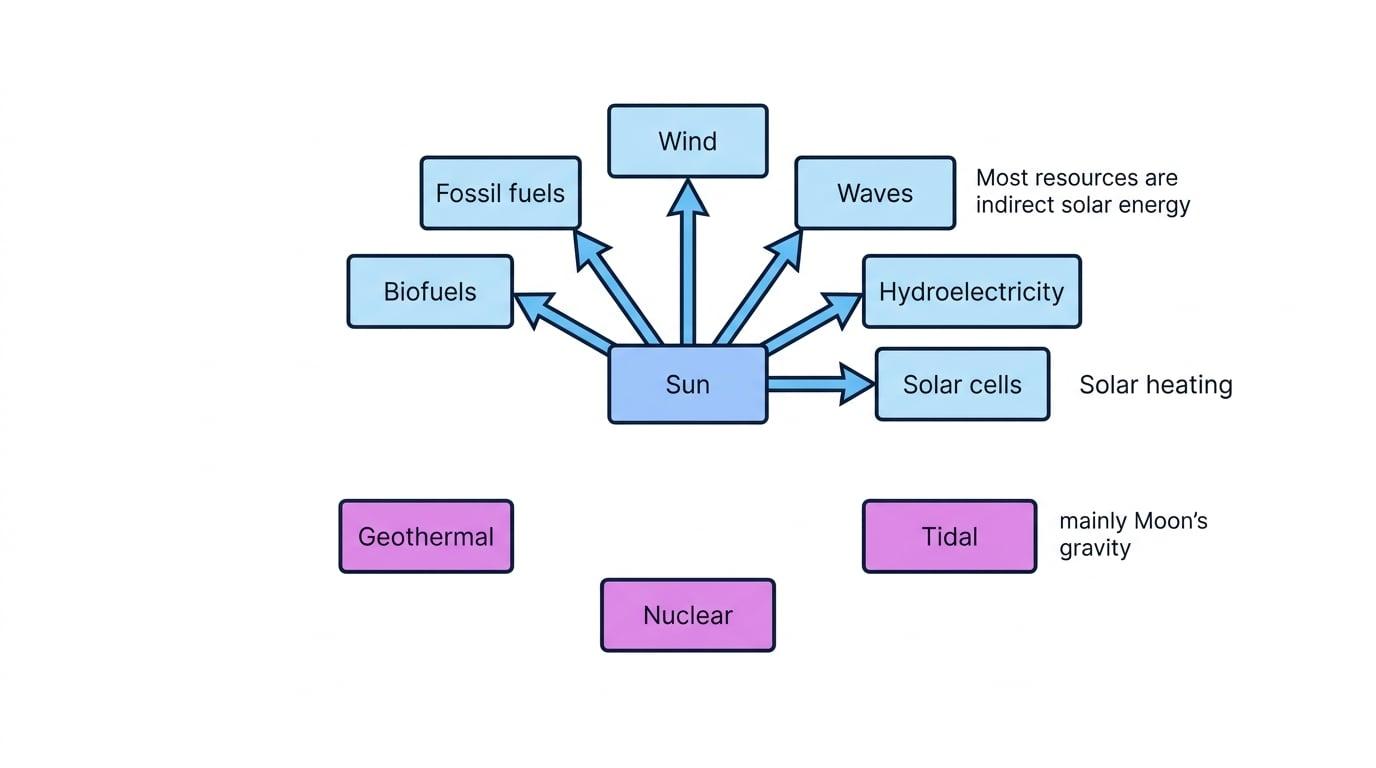
Nearly everything traces back to the Sun
- Radiation from the Sun is the original source for almost every energy resource we use.
- Fossil fuels store energy captured by plants by photosynthesis millions of years ago, and biofuels store the same thing from this year's crop.
- The Sun evaporates water into clouds, which fall as rain and fill the reservoirs behind hydroelectric dams.
- Uneven solar heating of the atmosphere drives the winds, which raise the waves, so wind and wave power are solar in origin too.
- Only three resources are not ultimately solar: geothermal, which comes from radioactive decay inside the Earth, nuclear, which comes from the fuel's own nuclei, and tidal, which comes from the gravitational pull of the Moon and the Sun on the oceans.
Every stage wastes some of what it is given
Definition
Efficiency
The proportion of the energy supplied to a device that is transferred to the useful output store.
- No transfer is perfect. At every stage in the chain, some energy is dissipated to the internal energy store of the surroundings, mainly through friction in bearings and through hot exhaust gases.
- A device with high efficiency wastes little of what it is given; a device with low efficiency wastes most of it.
- A typical coal-fired station transfers only about a third of the chemical store into electrical output, because the hot waste gases and the cooling towers carry away the rest.
- Efficiency can never exceed 100%100\%100%, because that would mean getting out more energy than was put in, which conservation of energy forbids.
Common Mistake
- Renewable is not the same as clean. Burning biofuel is renewable but still releases carbon dioxide.
- Do not say a resource "creates" energy. Resources are stores from which energy is transferred.
- Solar cells and solar panels are different. Cells generate electricity from light; panels heat water using infrared and other electromagnetic waves.
- Nuclear power stations use fission, not fusion, and fission is not a renewable resource.
Exam technique
- When asked how a station generates electricity, name all three parts of the chain: boiler, turbine, generator, and say what each one does.
- For advantages and disadvantages, pick a different one of the five criteria for each point, rather than making the same environmental point twice in different words.
- Give exactly the number of points asked for. Extra wrong points can cancel correct ones.
- If a question asks about the "original" source of a resource, trace it back to radiation from the Sun unless it is geothermal, nuclear or tidal.
Self review
- Name the three main parts of a fossil-fuel power station and state what each does.
- Give two resources that drive a turbine without needing a boiler.
- State two advantages and two disadvantages of nuclear fuel as an energy resource.
- Which three energy resources do not ultimately come from radiation from the Sun?
- Explain why the efficiency of a power station can never be 100%100\%100%.