The field of a straight wire weakens quickly with distance
- The circular field lines around a straight wire are closest together near the wire and spread out as you move away from it.
- Closer lines mean a stronger field, so the field is strongest at the surface of the wire and falls away steadily with distance.
- Doubling the distance from the wire roughly halves the field strength, so the drop-off is noticeable over a few centimetres.
- Hold a plotting compass close to the wire and the needle swings sharply into line with the circles.
- Move it a few centimetres away and the deflection fades until the Earth's own field takes over the needle again.
- That weakness is why a single straight wire needs a fairly large current before any effect can be seen at all.
Inside a solenoid the field is strong and nearly uniform
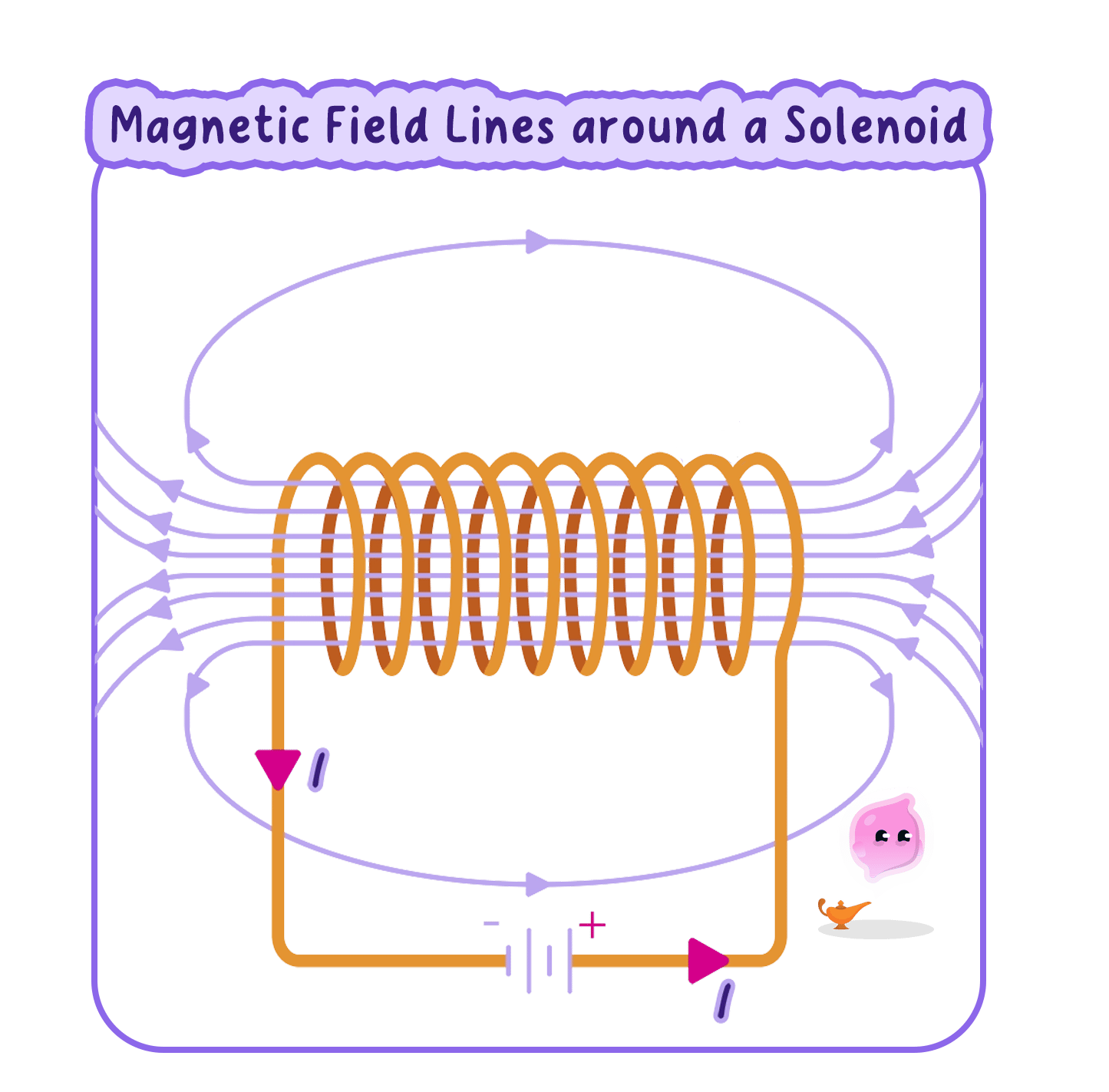
- Along the axis inside a solenoid the field lines are straight, parallel and evenly spaced, so the field there is strong and nearly uniform.
- At the ends the lines start to spread apart, so the field there is weaker than at the middle.
- Outside the solenoid the lines spread widely into the bar-magnet pattern, so the external field is much weaker than the internal one.
- Winding the same number of turns onto a longer former spreads them out and weakens the field inside.
- Packing the turns closer together, or adding more of them, strengthens it.
- Slipping a soft-iron core inside strengthens the field dramatically, because the core becomes magnetised and contributes its own field.
Changing the current changes the field in two separate ways
- Increasing the size of the current strengthens the field everywhere, around a straight wire and inside a solenoid alike.
- The field strength is roughly proportional to the current, so doubling the current roughly doubles the field.
- Reducing the current to zero removes the field completely, which is exactly what makes an electromagnet switchable.
- Reversing the direction of the current reverses the direction of the field without changing its strength at all.
- Around a straight wire that means every arrow on the circular field lines turns round.
- In a solenoid it means the N and S ends swap over, which a plotting compass held at one end confirms immediately.
- Taken together, these two effects are why an electromagnet can be made stronger, weaker, or turned round on demand, while a permanent magnet cannot.
Common Mistake
- Reversing the current changes the direction of the field, not its strength, so do not say the field gets weaker.
- The field inside a solenoid is strong; it is the field outside that is weak, which is easy to state the wrong way round.
- More turns strengthens the field only if the coil is not stretched out at the same time, since what matters is the turns packed into each unit of length.
- Adding a soft-iron core makes the electromagnet stronger, but it is the current that produces the field in the first place, so the core alone does nothing.
Exam technique
- Answer strength questions with line spacing, as in "the lines are closer near the wire, so the field is stronger there".
- When a question changes the current, say explicitly whether the size or the direction has changed, because they have different consequences.
- If asked how to make an electromagnet stronger, give at least two of a larger current, more turns and a soft-iron core.
- On a solenoid sketch, show the lines close and parallel inside and spreading out at the ends, since that contrast is what is being marked.
Self review
- How does the strength of the field around a straight wire change as you move away from it?
- Compare the field inside a solenoid with the field outside it.
- What happens to the field when the size of the current is doubled?
- What happens to the field when the direction of the current is reversed?
- State three ways of making the field of a solenoid stronger.
