A current in a wire produces a magnetic field around it
- Every current produces a magnetic field, which is why a plotting compass held near a current-carrying wire is deflected.
- Around a long straight wire the field lines are concentric circles centred on the wire, lying in a plane at right angles to it.
- The circles are packed closest to the wire and spread further apart with distance, so the field is strongest right beside it.
- The direction comes from the right-hand grip rule: grip the wire with the right hand, thumb pointing along the conventional current, and the curled fingers give the direction of the field lines.
- Reversing the current reverses the field, so every arrow on the circles turns round.
A solenoid produces a field shaped like a bar magnet's
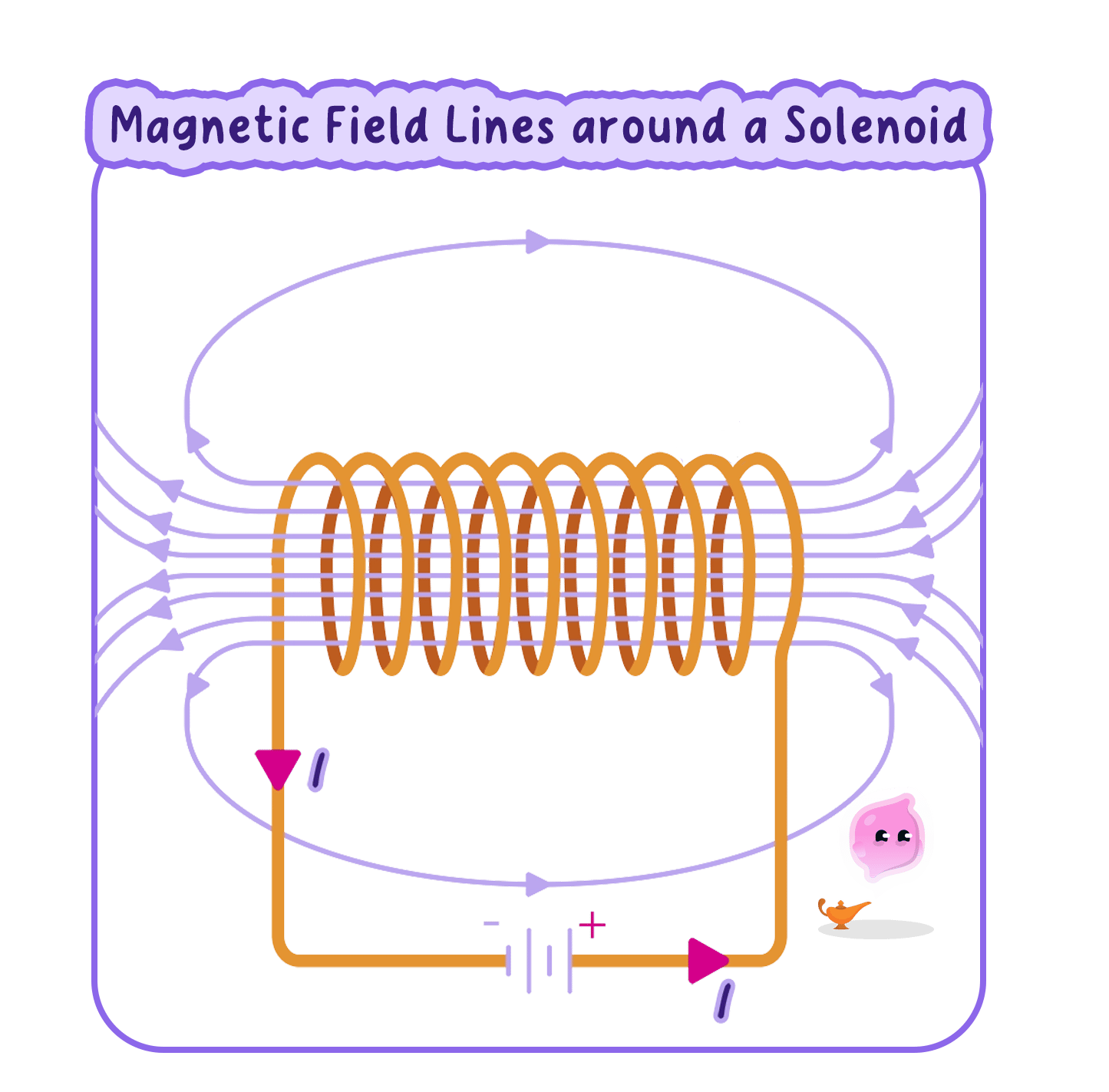
- A solenoid is a long coil of wire, and its field is the sum of the circular fields of every one of its turns.
- Inside the solenoid the fields from the turns line up, giving a strong, nearly uniform field running along the axis.
- Outside it the lines spread out and loop round from one end to the other, giving a pattern identical to that of a bar magnet.
- One end therefore behaves as an N pole and the other as an S pole.
- Use the right-hand grip rule again, this time gripping the coil so that the fingers curl the way the current goes round the turns, and the thumb points to the N pole.
- Reversing the current swaps the poles over, which is something a permanent magnet can never do.
- Slipping a soft-iron core inside the solenoid turns it into an electromagnet, far stronger because the core becomes magnetised and adds its own field.
Practical
Investigation: building and testing an electromagnet
- Aim: to build an electromagnet, find what makes it stronger, and identify its poles.
- Apparatus: insulated copper wire, an iron nail, a cell, a switch, an ammeter, a variable resistor, a box of steel paper clips and a plotting compass.
- Method:
- Wind the insulated wire neatly onto the iron nail, keeping the turns close together and all going the same way, counting them as you go and leaving two long ends free.
- Connect the coil in series with the cell, the switch, the ammeter and the variable resistor.
- Close the switch briefly, dip the end of the nail into the paper clips, lift it clear and count how many it holds.
- Open the switch and note that the clips drop off, which confirms that the magnetism switches off with the current.
- Adjust the variable resistor to give a larger current and repeat the count, recording the ammeter reading each time.
- Wind a second nail with more turns and repeat the count at the same current, so that only the number of turns has changed.
- Bring the plotting compass to each end of the nail in turn to identify which end is the N pole.
- Swap the connections to the cell over and check the compass again, to show that the poles have changed places.
- Measure and record: record the number of paper clips held against current / A at a fixed number of turns, and against number of turns at a fixed current, noting which end is the N pole for each direction of current.
- Result: the electromagnet holds more clips with a larger current and with more turns; its magnetism disappears the moment the current is switched off; reversing the current reverses the poles.
- Watch out:
- The coil heats up quickly, so switch on for only a few seconds at a time and switch off between readings.
- Dip the nail to the same depth into the clips every time, or the count is not a fair comparison.
- Keep every turn wound the same way round, because a reversed section cancels part of the field.
- Repeat each count and average, since the clips tangle together and the number picked up varies.
- Safety: the wire becomes hot at larger currents, so do not touch the coil and keep the switch closed only briefly.
Relays use a small current to switch a large one
- A relay is an electromagnet with a pivoted iron armature beside it and a pair of switch contacts.
- A small current in the coil magnetises the soft-iron core, which attracts the armature towards it.
- The armature pivots and pushes the contacts of a second, separate circuit together, switching that circuit on.
- Switching the small current off demagnetises the core, a spring pulls the armature back, and the contacts open again.
- The point is isolation: the small, safe current at a car's ignition key can switch the very large current the starter motor needs.
- The same arrangement protects anyone operating machinery, because the high-current circuit never runs through the control they touch.
Loudspeakers turn a changing current into sound
- A loudspeaker has a coil wound round the neck of a paper cone, sitting in the gap of a permanent magnet.
- The alternating current from the amplifier passes through the coil and turns it into an electromagnet whose poles keep swapping.
- Those changing poles are alternately attracted to and repelled by the permanent magnet, so the coil is pushed back and forth.
- The coil is fixed to the cone, so the cone vibrates and pushes the air in front of it into compressions and rarefactions.
- A larger current gives a bigger movement and so a louder sound, while a higher frequency of current gives a higher pitch.
- Headphones and the earpiece of a phone work in exactly the same way on a smaller scale.
Common Mistake
- The field round a straight wire is a set of circles, not lines running along the wire, so draw them as rings seen end on.
- The grip rule uses the conventional current, from positive to negative, and not the direction the electrons travel.
- A relay switches a second circuit; it does not amplify the small current, so avoid saying it "makes the current bigger".
- A loudspeaker needs both a permanent magnet and a coil carrying an alternating current, so an answer mentioning only one of them is incomplete.
Exam technique
- For a field-pattern sketch, show the shape and the arrows, and label which end of a solenoid is the N pole.
- Describing the plotting experiment earns marks for the compass or iron filings, for a large enough current, and for reversing the current to show the field reverses.
- For a relay question, walk through the two circuits in order and say clearly which current is small and which is large.
- A loudspeaker answer needs the chain to reach the air: current, force on the coil, coil moves, cone vibrates, sound wave.
Self review
- Describe the pattern of the magnetic field around a long straight wire carrying a current.
- How is the direction of that field found?
- Sketch the field pattern of a solenoid and label its N pole.
- Explain how a relay allows a small current to switch a large one.
- Describe how a loudspeaker produces sound from an alternating current.
