A current in a magnetic field feels a force
Definition
Motor effect
The force experienced by a current-carrying conductor placed in a magnetic field, acting at right angles to both the current and the field.
- Place a wire carrying a current between the poles of a magnet and the wire is pushed sideways, out of the gap.
- The force arises because two fields interact: the circular field of the current and the straight field of the magnet.
- On one side of the wire the two fields point the same way and the lines crowd together, while on the other side they oppose and the lines thin out.
- The wire is pushed from the crowded side towards the thin side, which is the direction of the force.
- The force is at right angles to both the current and the field.
- It is zero when the current runs parallel to the field, and greatest when the wire is at right angles to it.
- The force gets larger with a bigger current, a stronger field, or a greater length of wire sitting in the field.
The experiment that shows the force, and what reversing things does
- Set two magnadur magnets on a steel yoke with opposite poles facing, so that a field runs straight across the gap between them.
- Lay a stiff bare copper wire loosely across the gap on two horizontal rails, so that it is free to roll or swing.
- Connect the rails through a switch and an ammeter to a low-voltage supply, and close the switch only briefly.
- The wire jumps out of the gap, which shows that a force acts on it.
- Swap the supply leads to reverse the current, and the wire jumps the opposite way.
- Put the current back as it was and turn the magnets round instead, and again the wire jumps the opposite way.
- Reverse both together and the wire jumps its original way, which shows the two reversals act independently.
- Turn the wire so it runs along the field instead of across it and nothing moves at all, confirming that the wire must cut across the field lines.
Fleming's left-hand rule gives the direction of the force
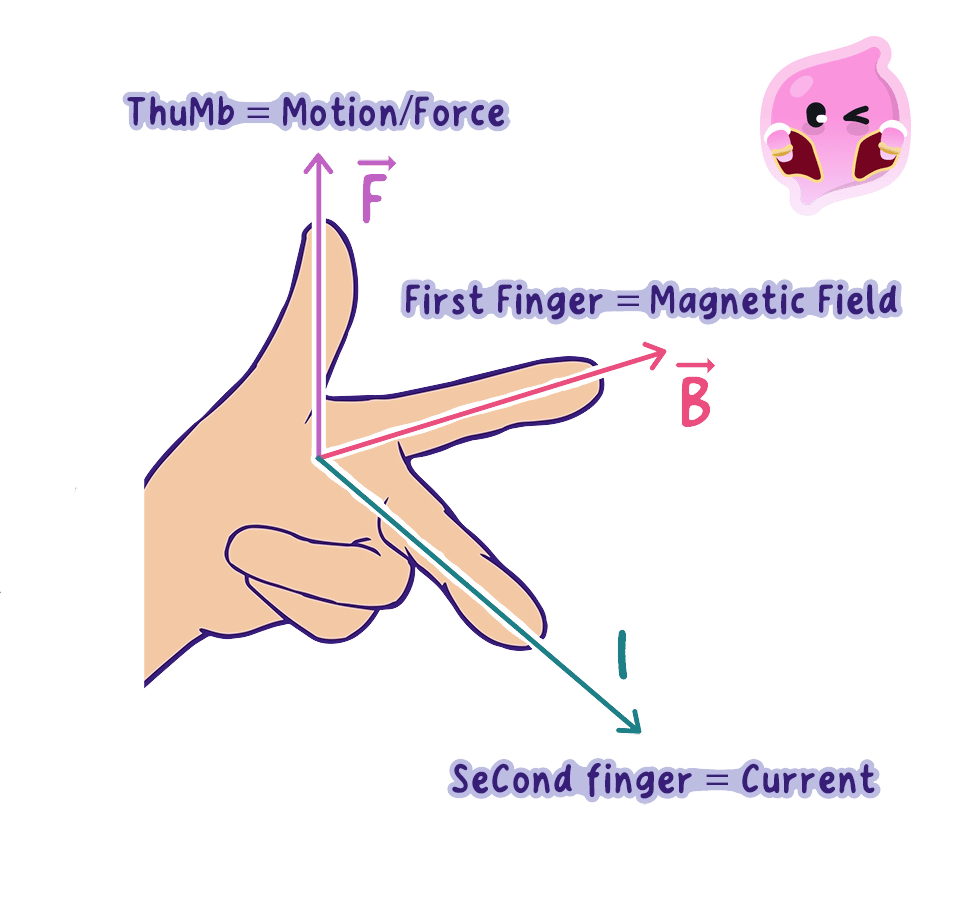
- Hold the left hand with the thumb, first finger and second finger all at right angles to one another.
- The first finger points along the field, from N to S.
- The second finger points along the conventional current, from positive to negative.
- The thumb then gives the direction of the force, and so of the motion that results.
- The initials help: Force on the thuMb for Motion, Field on the First finger, Current on the seCond finger.
- Use the left hand here, where a current produces movement, and keep the right hand for induction, where movement produces a current.
Common Mistake
- Use the left hand for the motor effect; reaching for the right hand reverses every answer.
- The second finger takes the conventional current, so do not point it the way the electrons travel.
- Reversing the current and the field together leaves the force unchanged, so check whether one or both have been altered.
- A wire carrying a current along the field lines feels no force, so the orientation on the diagram matters as much as the directions.
Exam technique
- Mark the field arrow from N to S and the current arrow on the diagram before you lift your hand, because most errors come from guessing them.
- Physically hold your left hand up and turn it to match the diagram, rather than trying to picture it.
- Describing the experiment earns marks for the wire free to move, the field across the gap, the observed movement, and what happens on each reversal.
- Give the direction of the force as "upwards", "into the page" or "towards the N pole", rather than a vague "sideways".
Self review
- Describe an experiment to show that a force acts on a current-carrying conductor in a magnetic field.
- What happens to the direction of the force if the current is reversed?
- What happens if the magnetic field is reversed instead?
- Name the three quantities given by the thumb, first finger and second finger in Fleming's left-hand rule.
- Why is there no force on the wire when the current runs parallel to the field?
