Solids, liquids and gases are told apart by shape and volume
Definition
States of matter
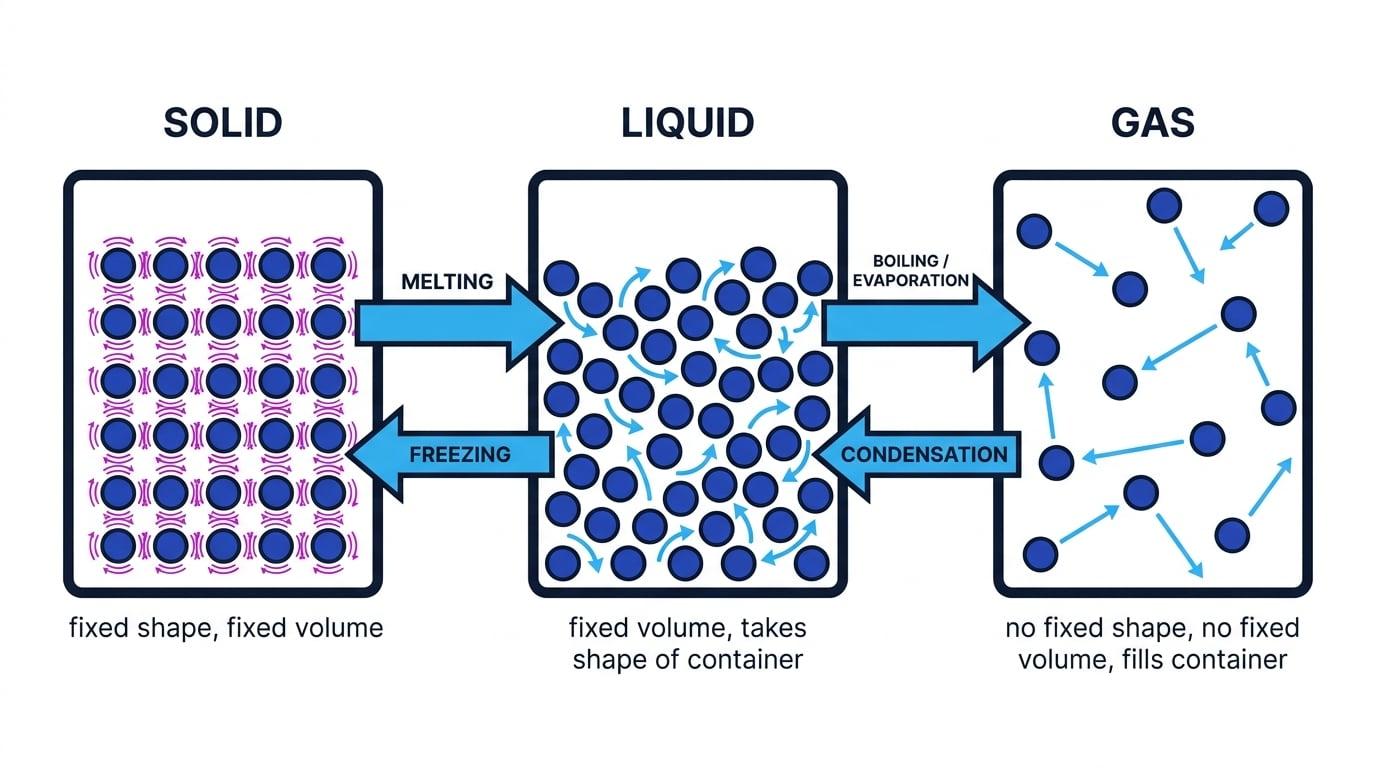
The three forms in which a substance can exist, solid, liquid and gas, told apart by whether the substance holds its own shape and whether it holds a fixed volume.
- A solid holds both a fixed shape and a fixed volume, so a steel spanner is the same shape and the same size on the bench as it is in your hand.
- A liquid holds a fixed volume but no fixed shape, so 500 cm3500\ \text{cm}^3500 cm3 of water tipped from a jug into a shallow tray is still 500 cm3500\ \text{cm}^3500 cm3, just spread out differently.
- A gas holds neither a fixed shape nor a fixed volume, and always spreads out until it fills every corner of its container.
- Solids and liquids are almost impossible to compress, while a gas is easily compressed, which is why a bicycle pump with its outlet blocked still squashes down but a syringe full of water barely moves.
- Liquids and gases both flow, which is why the two together are called fluids; a solid does not flow, and keeps its shape until a force deforms it.
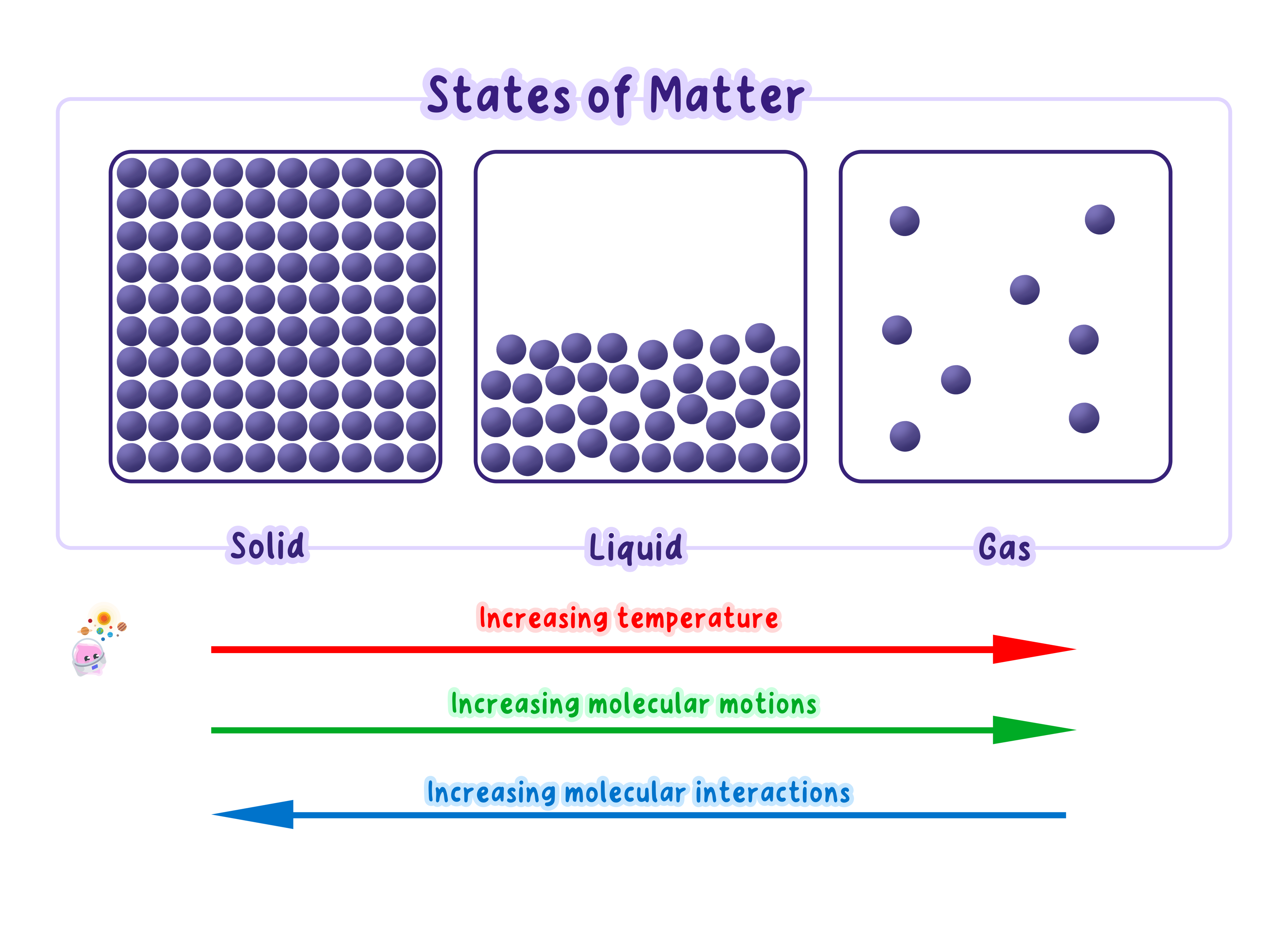
- For the same substance the solid is usually the most dense and the gas by far the least dense, often around a thousand times less dense than the same substance as a liquid.
- Water is the familiar exception, because ice is less dense than liquid water, and that is why ice cubes float in a glass instead of sinking to the bottom.
Changing state: the changes you need to name
- Melting is the change from solid to liquid, and for a pure substance it happens at one fixed temperature called the melting point.
- Solidification, also called freezing, is the reverse change from liquid to solid, and it happens at that same fixed temperature.
- Boiling is the change from liquid to gas happening throughout the liquid, at the fixed temperature called the boiling point.
- Condensation is the reverse change from gas to liquid, which is what forms the film of water on a cold window when a kettle has been boiling nearby.
- Evaporation also turns liquid into gas, but only from the surface of the liquid and at any temperature below the boiling point.
- Each pair of changes is reversible, so a pure substance melts and solidifies at the same temperature, and boils and condenses at the same temperature.
- Only these changes are needed here, so direct solid to gas and gas to solid changes are outside the course, and the energy behind each change is dealt with later in the thermal properties topic.
Example
- Ice cubes tipped from the freezer into a glass of squash warm up and melt into liquid water.
- The kettle reaches 100 ∘C100\ ^\circ\text{C}100 ∘C and the water turns to steam by boiling.
- That steam meets the cold kitchen window and turns back to droplets by condensation.
- Water poured back into the ice-cube tray and returned to the freezer turns solid again by solidification.
Common Mistake
- Do not write that a liquid has no fixed volume: it has a fixed volume and no fixed shape.
- Do not use boiling and evaporation as if they mean the same thing, because boiling happens throughout the liquid at one temperature and evaporation happens only at the surface.
- Do not call the white cloud above a kettle steam: steam is an invisible gas, and the cloud you can see is already tiny droplets of liquid water.
- Do not assume every solid is denser than its liquid, because ice floats on water.
Exam technique
- Answer a question that asks you to distinguish the three states using the words shape and volume, because those two carry the marks and vaguer words like "loose" or "solid-ish" do not.
- A one-word answer naming a change of state has to be exact, so write melting, boiling, condensation or solidification rather than "turning into a liquid".
- If a question gives melting and boiling points and asks for the state at some temperature, compare the numbers on the page rather than relying on what the substance is normally like.
- Keep the word fluid for liquids and gases only, and never apply it to a solid.
Self review
- Which of shape and volume is fixed for a liquid?
- Name the change of state from gas to liquid.
- Which state of matter can be compressed easily?
- State the term for the change from liquid to solid.
- Give one everyday example of condensation.