Pressure in a liquid grows with depth and with density
Definition
Pressure beneath a liquid surface
The pressure caused by the weight of the liquid above a point, which increases with the depth below the surface and with the density of the liquid.
- Picture a column of liquid standing above a point. The pressure at that point is produced by the weight of everything in the column.
- Go deeper and the column is taller, so it weighs more, so the pressure is greater. This is why a dam wall is built thick at the bottom and thin at the top.
- Use a denser liquid and every metre of that column weighs more, so the pressure is greater again at the same depth. Mercury produces far more pressure than water at the same depth.
- Pressure in a liquid acts equally in all directions at a given depth, not just downwards. That is why water squirts sideways out of a hole in the side of a container, and why the pressure on your eardrums when you dive is the same whichever way you turn your head.
- The pressure does not depend on the shape of the container or on how much liquid there is in total. Only the vertical depth below the surface counts.
- Liquids are effectively incompressible, so their density stays the same all the way down, which is why the pressure rises steadily and evenly with depth.
Example
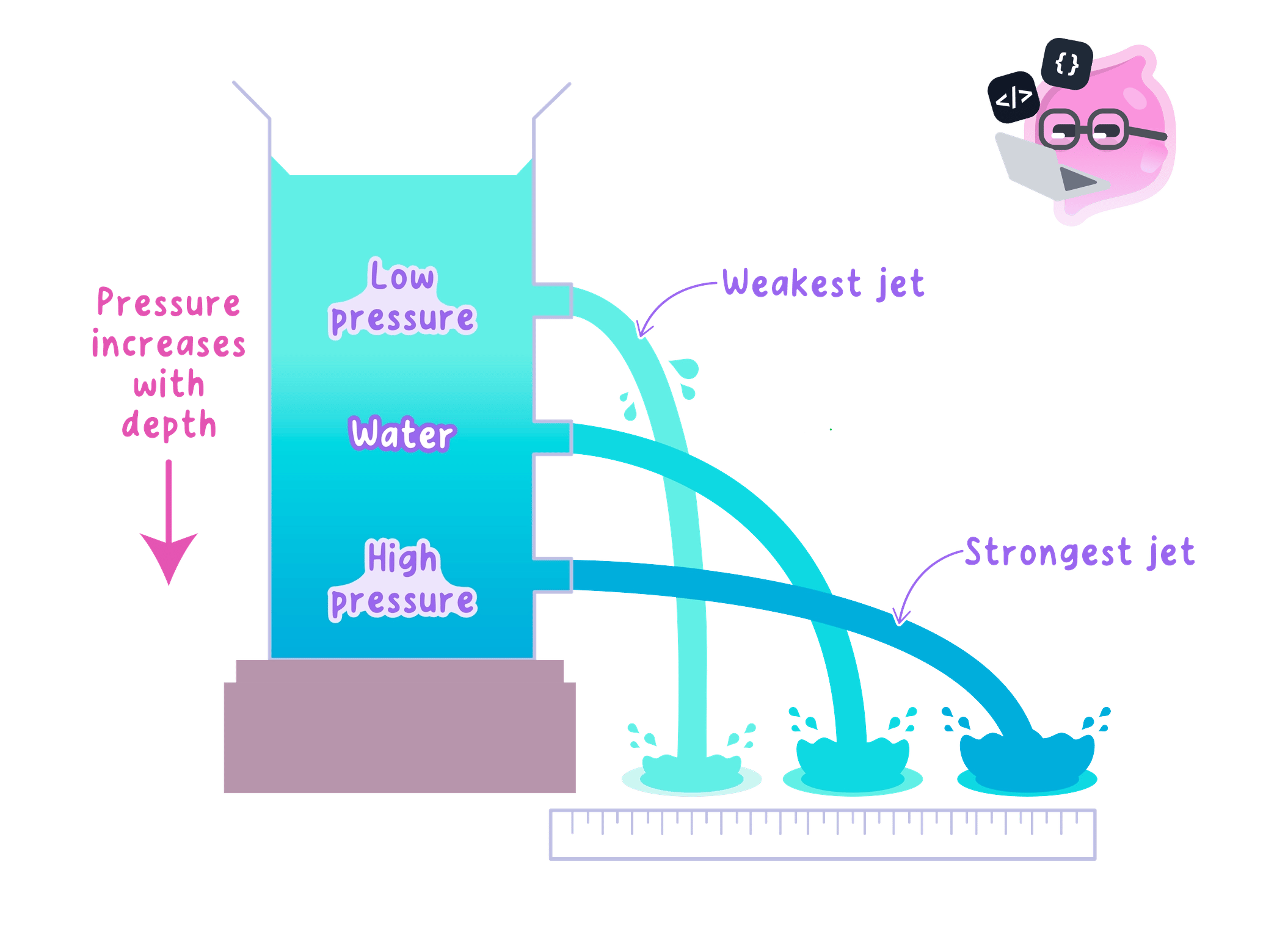
- A tall can of water is punctured with three holes at different heights, and water jets out of all three.
- The jet from the lowest hole travels furthest, because the water there is under the greatest pressure. The jet from the top hole barely dribbles out.
Calculating the change in pressure
Definition
Change in pressure with depth
The extra pressure produced by descending through a liquid, found from the density of the liquid, the gravitational field strength and the change in depth.
Δp=ρgΔh \Delta p = \rho g \Delta h Δp=ρgΔhwhere Δp\Delta pΔp is the change in pressure in Pa\text{Pa}Pa, ρ\rhoρ is the density of the liquid in kg/m3\text{kg}/\text{m}^3kg/m3, ggg is the gravitational field strength in N/kg\text{N/kg}N/kg and Δh\Delta hΔh is the change in depth in m\text{m}m.
- The equation confirms in symbols what the picture already showed: pressure rises in direct proportion to depth, and in direct proportion to density.
- It gives the pressure due to the liquid alone. To find the total pressure at that point you must add the atmospheric pressure pushing down on the surface, which is about 1.0×10⁵ Pa1.0 \times 10^{5}\ \text{Pa}1.0×10⁵ Pa.
- Density must be in kg/m3\text{kg}/\text{m}^3kg/m3. A density quoted in g/cm3\text{g}/\text{cm}^3g/cm3 is multiplied by 100010001000, so water at 1.0 g/cm31.0\ \text{g}/\text{cm}^31.0 g/cm3 becomes 1000 kg/m31000\ \text{kg}/\text{m}^31000 kg/m3.
- Δh\Delta hΔh is the vertical depth change. Following a sloping pipe downwards for 20 m20\ \text{m}20 m while dropping only 6 m6\ \text{m}6 m vertically counts as Δh=6 m\Delta h = 6\ \text{m}Δh=6 m.
- Notice that neither the area nor the volume of liquid appears anywhere in the equation, which is the algebraic reason the shape of the container makes no difference.
Common Mistake
- Depth is measured from the surface downwards. A point 2 m2\ \text{m}2 m above the bottom of a 10 m10\ \text{m}10 m tank is at a depth of 8 m8\ \text{m}8 m, not 2 m2\ \text{m}2 m.
- Density must be in kg/m3\text{kg}/\text{m}^3kg/m3. Substituting 1.01.01.0 instead of 100010001000 for water makes the answer a thousand times too small.
- Δp=ρgΔh\Delta p = \rho g \Delta hΔp=ρgΔh gives the pressure due to the liquid only. Add atmospheric pressure when the question asks for the total.
- The width or shape of the container is irrelevant. A narrow tube and a wide tank of the same depth give the same pressure at the bottom.
Exam technique
- For qualitative questions, give a reason as well as a direction: "the pressure increases with depth because the weight of liquid above the point is greater".
- Check the units of every quantity before substituting, especially depths given in mm\text{mm}mm or cm\text{cm}cm and densities given in g/cm3\text{g}/\text{cm}^3g/cm3.
- Read carefully whether the question wants the pressure due to the liquid or the total pressure including the atmosphere. The word "total" is the signal.
- When comparing two liquids or two depths, state which quantity is being kept constant, then apply the direct proportionality.
Self review
- Describe how the pressure in a liquid changes as you go deeper, and explain why.
- Explain why a dam is thicker at its base than at its top.
- Write the equation for the change in pressure beneath the surface of a liquid.
- Calculate the pressure due to sea water of density 1030 kg/m31030\ \text{kg}/\text{m}^31030 kg/m3 at a depth of 30 m30\ \text{m}30 m, taking g=9.8 N/kgg = 9.8\ \text{N/kg}g=9.8 N/kg.
- Two containers of different width hold water to the same depth. Compare the pressure at the bottom of each.
