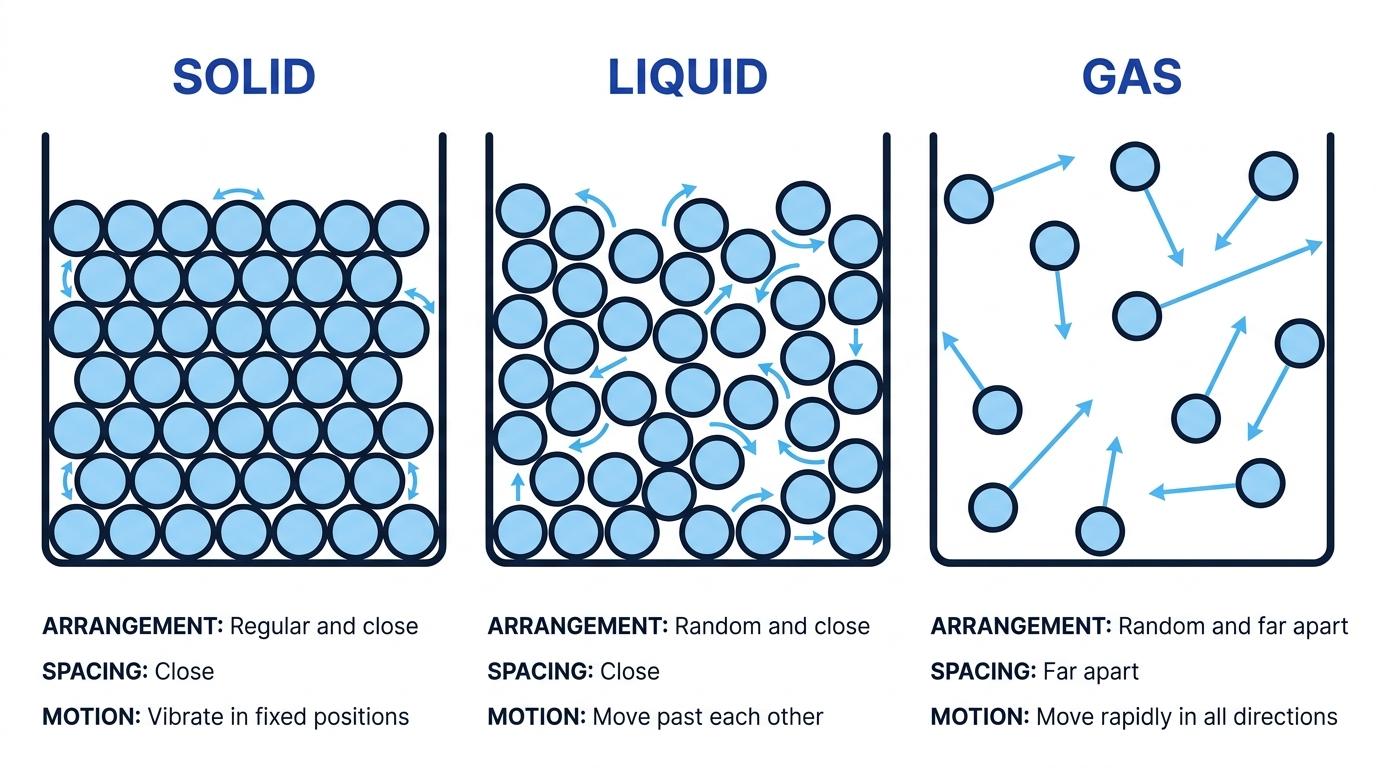
Arrangement, separation and motion define each state
Definition
Kinetic particle model
The model that treats every substance as a very large number of tiny particles in constant motion, whose arrangement, separation and speed account for the properties of solids, liquids and gases.
- In a solid the particles are regularly arranged and touching, and each one vibrates about a fixed position instead of swapping places with its neighbours.
- In a liquid the particles are still close together and touching, but the arrangement is random and they can slide past one another.
- In a gas the particles are far apart, roughly ten times further apart than in the liquid, randomly arranged and moving quickly in all directions.
- The three properties a question asks about are always the same three: arrangement (regular or random), separation (touching or far apart) and motion (vibrating, sliding or flying freely).
- A particle diagram for a solid shows equal circles in a neat grid, all touching, filling the container.
- A diagram for a liquid shows the same circles still touching but in an untidy jumble, with a flat free surface part-way up the container.
- A diagram for a gas shows the circles well spaced across the whole container, with short arrows pointing in different directions to show the random motion.
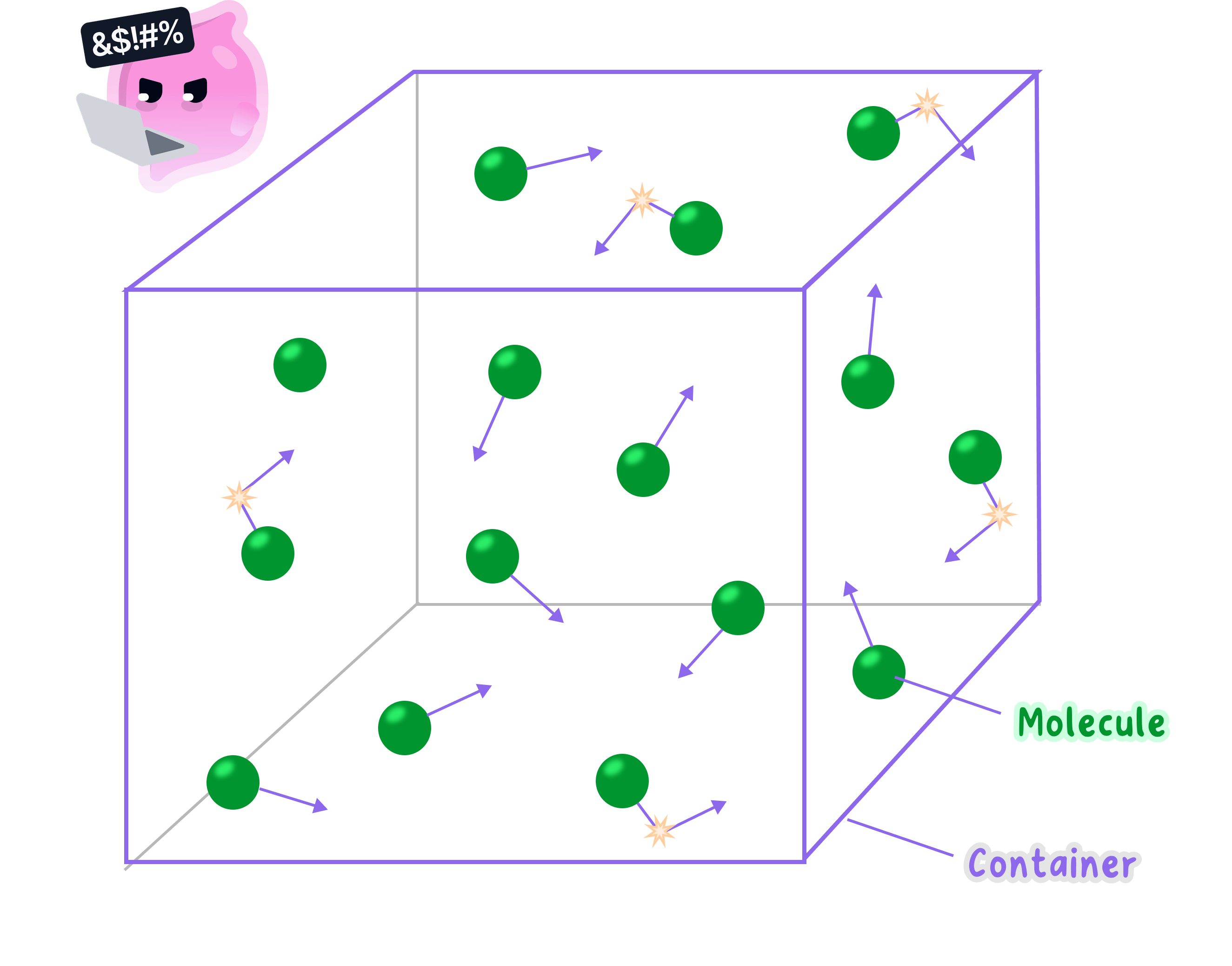
Temperature is a measure of how fast the particles move
- Heating a substance transfers energy to its particles, so their average kinetic energy rises and they move faster.
- In a solid, faster means the particles vibrate more quickly and through a larger distance about their fixed positions.
- In a liquid and a gas, faster means the particles travel more quickly between collisions, so they cover more ground each second.
- Cooling does the reverse, taking energy away so the particles slow down and their average kinetic energy falls.
- The slowing cannot go on forever, because there is a lowest possible temperature of −273 ∘C-273\ ^\circ\text{C}−273 ∘C, known as absolute zero.
- At absolute zero the particles have the least kinetic energy they can possibly have, so there is nothing left to take away and no lower temperature exists.
Forces and separations between particles set the properties of each state
- The particles making up a substance may be atoms, molecules, ions or electrons, and it is the forces between them, the distances between them and their motion that decide how the substance behaves.
- The forces are strongest when the particles are closest and become weaker the further apart the particles get.
- In a solid the separation is smallest, so the forces are strong enough to hold each particle in place, which is why a solid keeps its own shape as well as its volume.
- In a liquid the separation is almost as small, so the forces still hold the particles together and fix the volume, but the particles now have enough energy to break away from one neighbour and move next to another, so the liquid flows.
- In a gas the separation is so large that the forces between particles are negligible, so nothing holds the particles back and the gas spreads out to fill whatever it is put in.
- The same picture explains compression: a gas has large empty gaps that can be closed up, while a solid or liquid has almost none, so squeezing it means pushing particles that are already touching.
- It also explains density, because close packing crams far more mass into the same volume than the wide spacing of a gas does.
Example
- A copper saucepan standing on a cold worktop already has vibrating particles, and they simply vibrate less than they will once the pan is hot.
- Turn the hob on and those copper particles vibrate faster and further about their fixed positions, so the metal expands very slightly.
- The water inside is a liquid, so its particles slide past one another and the water settles into the shape of the pan.
- The steam that leaves is a gas, so its particles fly apart at speed and spread right across the kitchen.
Common Mistake
- Do not write that particles in a solid are still, because they vibrate about fixed positions at every temperature above absolute zero.
- Do not describe the particles in a liquid as far apart, because they are as close as in a solid and only their arrangement has changed.
- Do not write that the particles themselves get bigger, melt or expand when a substance is heated, because only their spacing and motion change.
- Do not put absolute zero at 0 ∘C0\ ^\circ\text{C}0 ∘C, because it is −273 ∘C-273\ ^\circ\text{C}−273 ∘C and 0 ∘C0\ ^\circ\text{C}0 ∘C is just the melting point of ice.
Exam technique
- Build a "describe the particle structure" answer round the three words the question is made of: arrangement, separation and motion.
- Draw particle diagrams with identical circles and keep solid and liquid particles touching, since careless gaps in a liquid diagram are the mark most often dropped here.
- Write average kinetic energy rather than just "energy" whenever you link temperature to the particles.
- Explain why a gas compresses and a liquid does not by pointing at the space between the particles, never at the size of the particles.
Self review
- Describe the arrangement, separation and motion of the particles in a liquid.
- What happens to the average kinetic energy of the particles when a substance is cooled?
- State the value of absolute zero in degrees Celsius.
- Why can a gas be compressed far more easily than a liquid?
- Name three kinds of particle that a substance may be built from.