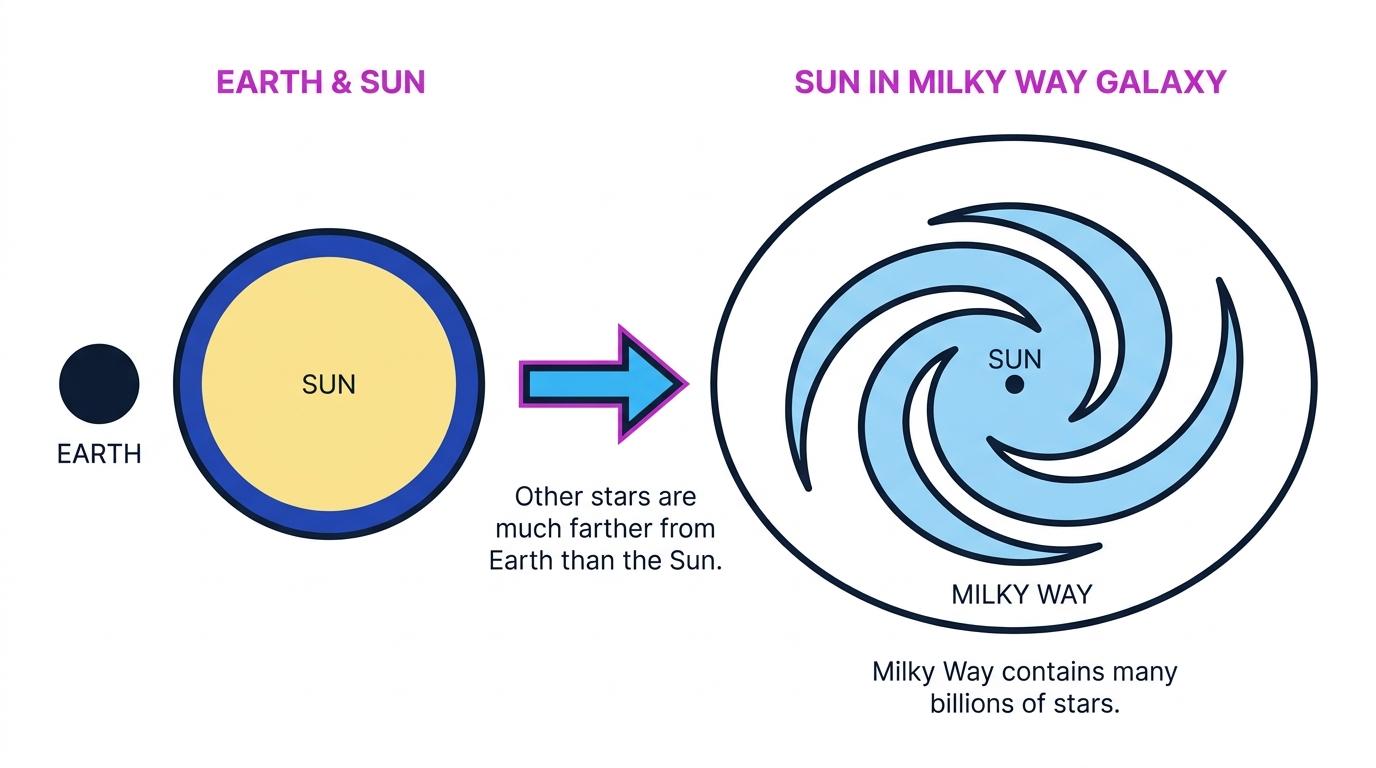
Galaxies: stars come in groups of billions
Definition
Galaxy
A collection of many billions of stars held together by gravity.
- Stars are not scattered evenly through space; they are gathered into galaxies, each holding many billions of stars.
- Say many billions rather than "lots", because the number is the piece of information the question is testing.
- Even inside a galaxy the stars are enormously far apart, so a galaxy is far emptier than the crowded photographs suggest.
- The Sun is a star in the galaxy known as the Milky Way, one member among all those billions.
- The faint band of light you can see across a really dark sky is the Milky Way seen edge-on from inside it, which is why it looks like a stripe rather than a spiral.
Key Idea
Keep the hierarchy straight: the Sun is a star, the Milky Way is the galaxy that contains it, and a galaxy contains many billions of stars.
Every other star is vastly further away than the Sun
- The other stars that make up the Milky Way are much further from the Earth than the Sun is.
- That single fact explains the whole appearance of the sky: the Sun blazes and every other star is a pinprick, even though many of them are far bigger and brighter than the Sun.
- Sunlight takes about 888 minutes to reach us, whereas light from the next nearest star takes over four years.
- Written in metres those distances run to sixteen or seventeen digits, which is impossible to compare at a glance and easy to mistype.
- Astronomers therefore switch to a bigger unit built out of the distance light covers, the light-year.
The light-year measures distance, despite its name
Definition
Light-year
The distance travelled by light through the vacuum of space in one year.
1 light-year=9.5×10¹⁵ m 1\ \text{light-year} = 9.5 \times 10^{15}\ \text{m} 1 light-year=9.5×10¹⁵ m- A light-year is a unit of distance, in the same family as the metre and the kilometre, and it is not a length of time.
- The word "year" is there only because the distance is defined using how far light gets in a year, travelling at 3.0×10⁸ m/s3.0 \times 10^{8}\ \text{m/s}3.0×108 m/s the whole time.
- A full definition has four parts, and dropping any one of them usually costs the mark.
- It is a distance.
- It is travelled by light.
- The light travels through the vacuum of space.
- The time taken is one year.
- In metres, one light-year is 9.5×10¹⁵ m9.5 \times 10^{15}\ \text{m}9.5×10¹⁵ m, a 9.59.59.5 followed by fifteen more decimal places, which is why the unit exists at all.
- There is a bonus in the unit: a star 444 light-years away is being seen as it was 4 years ago, because that is how long its light has been in transit.
Common Mistake
- Do not treat a light-year as a time, so never write that a star is "four light-years old" when you mean four light-years away.
- Do not call the Milky Way a star or a solar system, because it is the galaxy that our whole Solar System sits inside.
- Do not shorten the definition to "the distance light travels", since it leaves out the one year that makes the unit mean anything.
Exam technique
- Learn the light-year definition as one memorised sentence, because it is a state question where the exact wording carries the mark.
- Use the word billions when describing a galaxy, since vaguer words like "many" are usually not credited.
- In a conversion, check whether the question wants light-years into metres (multiply) or metres into light-years (divide), because reversing it is the usual slip.
- Finish every large answer in proper standard form, with a single digit before the decimal point.
Self review
- What is a galaxy, and roughly how many stars does one contain?
- State the relationship between the Sun and the Milky Way.
- How do the distances to other stars in the Milky Way compare with the distance to the Sun?
- Give the full definition of one light-year.
- A galaxy is 2.0×1062.0 \times 10^{6}2.0×10⁶ light-years away. Write this distance in metres in standard form.