Stars are born when gravity squeezes a cloud until it ignites
Definition
Protostar
An interstellar cloud that is collapsing under its own gravitational attraction and heating up as it does so, before nuclear fusion has begun.
- A star is formed from an interstellar cloud of gas and dust that contains hydrogen.
- The cloud's own internal gravitational attraction pulls it inwards, and once it starts collapsing it is called a protostar.
- As it collapses, the protostar's temperature rises, because the falling material is squeezed into a smaller volume and its particles end up moving far faster.
- When the centre is hot enough, hydrogen nuclei begin to fuse into helium, and the object starts producing its own energy.
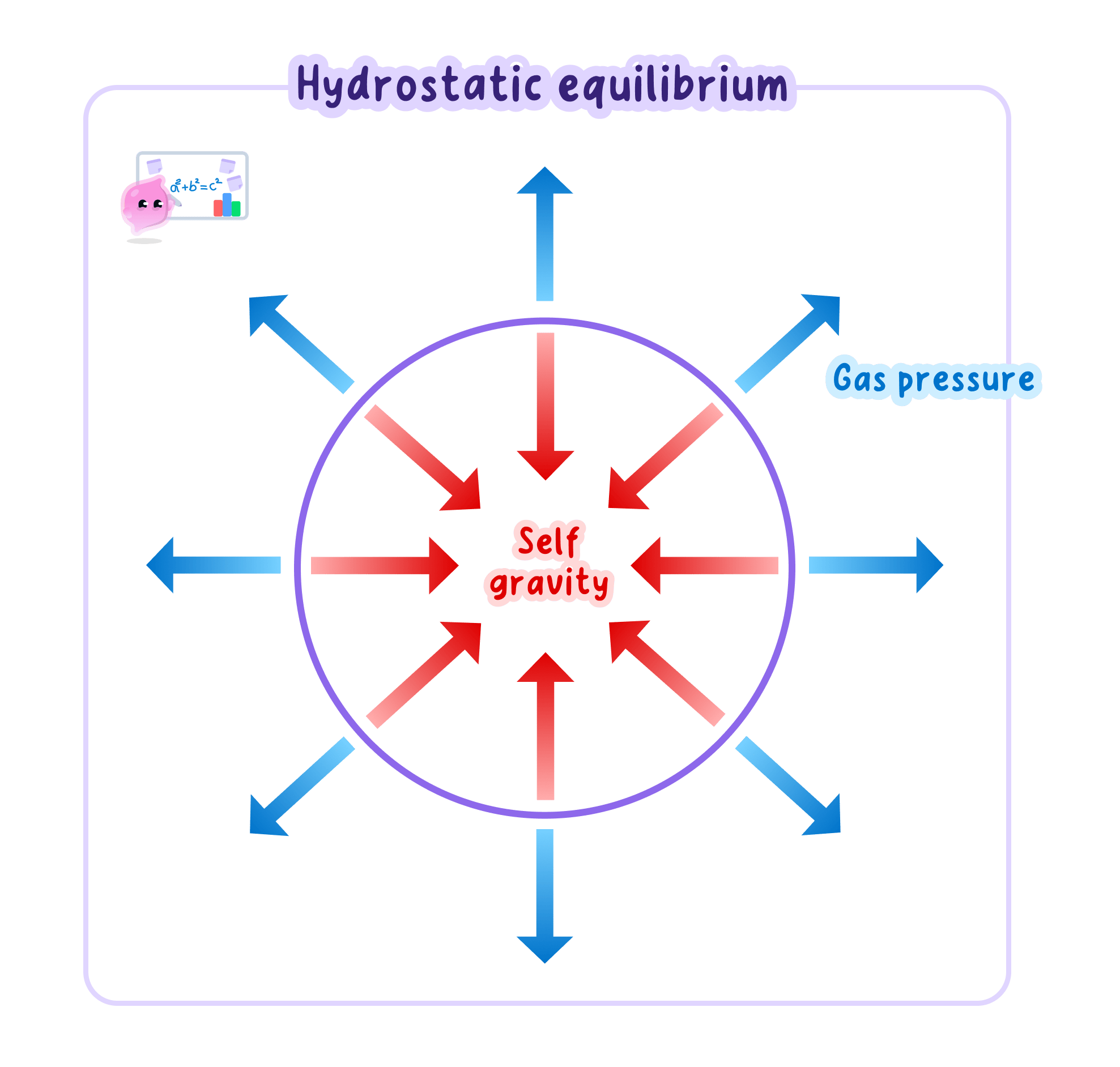
- A protostar becomes a stable star when the inward force of gravitational attraction is balanced by an outward force caused by the high temperature at its centre.
- That balance is what stops the collapse, so the star holds a steady size for as long as the fusion keeps running.
Key Idea
A stable star is a tug of war that has reached a draw: gravity pulling in, the heat of fusion pushing out, and every later stage of the life cycle happens when that balance is broken.
Every star runs out of hydrogen and swells up
Definition
Red giant
The large, cooler star produced when a star expands after most of the hydrogen in its centre has been converted to helium.
- All stars eventually run out of hydrogen as fuel, because each fusion reaction uses some up and none is replaced.
- Once most of the hydrogen in the centre has been converted to helium, the balance that held the star steady is lost and the star expands.
- What it expands into depends entirely on how massive the star is, and this is the fork that decides the whole rest of the story.
- Most stars, including the Sun, expand to form a red giant.
- More massive stars expand to form a red supergiant, larger again.
- These stars look red because the swollen outer layers are spread over a huge area and are therefore cooler than the surface of a stable star.
Two endings: a quiet fade or a violent explosion
Definition
Supernova
The explosion of a red supergiant, which scatters a nebula containing hydrogen and newly made heavier elements into space.
- The less massive route, ending in a white dwarf.
- A red giant from a less massive star throws off its outer layers, which form a glowing shell of gas called a planetary nebula.
- The hot, dense core left behind at its centre is a white dwarf, which slowly cools with no fusion left to power it.
- This is the ending the Sun is heading for, in about five billion years.
- The massive route, ending in a neutron star or a black hole.
- A red supergiant explodes as a supernova, briefly outshining an entire galaxy.
- The explosion forms a nebula containing hydrogen and new heavier elements made during the star's life and in the explosion itself.
- At the centre it leaves behind either a neutron star or, for the most massive stars, a black hole.
- The nebula from a supernova may form new stars with orbiting planets, which closes the cycle back to where the first section started.
- That last step is why the Earth is rocky at all: the heavier elements in our planet, and in you, were made inside earlier stars and spread out by supernovae.
Common Mistake
- Do not send a Sun-like star to a supernova: only red supergiants explode, and a red giant ends as a planetary nebula with a white dwarf.
- Do not confuse a planetary nebula with planets, because it is a shell of gas thrown off by a dying star and has nothing to do with planets.
- Do not say a red giant is hotter because it is bigger, since its surface is cooler than that of a stable star, which is why it looks red.
- Do not describe a stable star as having "no forces" acting on it, because the two forces are large and simply balanced.
Exam technique
- Decide from the question whether the star is Sun-like or much more massive before writing anything, because picking the wrong branch loses every mark after that point.
- Use the named stages as your marking points, since "it gets bigger and then dies" describes the right physics but names nothing.
- For the stable-star stage, always mention both forces, the inward gravitational attraction and the outward force from the high central temperature.
- Count the marks and produce that many stages, because these questions are point-marked and a flowing paragraph often hides one of them.
Self review
- What is a protostar, and why does its temperature rise?
- Name the two forces that balance in a stable star.
- What triggers a star to expand into a red giant or red supergiant?
- Give the full sequence of stages for a less massive star after it becomes a red giant.
- What can be left at the centre after a supernova, and what happens to the nebula it scatters?
