The Sun is an ordinary star that happens to be close
Definition
Star
A huge ball of hot gas that releases energy from nuclear reactions in its core and radiates it into space as electromagnetic radiation.
- The Sun is a star of medium size, sitting in the middle of the range rather than at either extreme.
- It looks enormous and blindingly bright only because it is far closer to us than any other star, roughly 270 000270\,000270000 times closer than the next nearest one.
- Put the Sun at the distance of a typical night-sky star and it would be one more faint dot, which is the point behind calling it medium-sized.
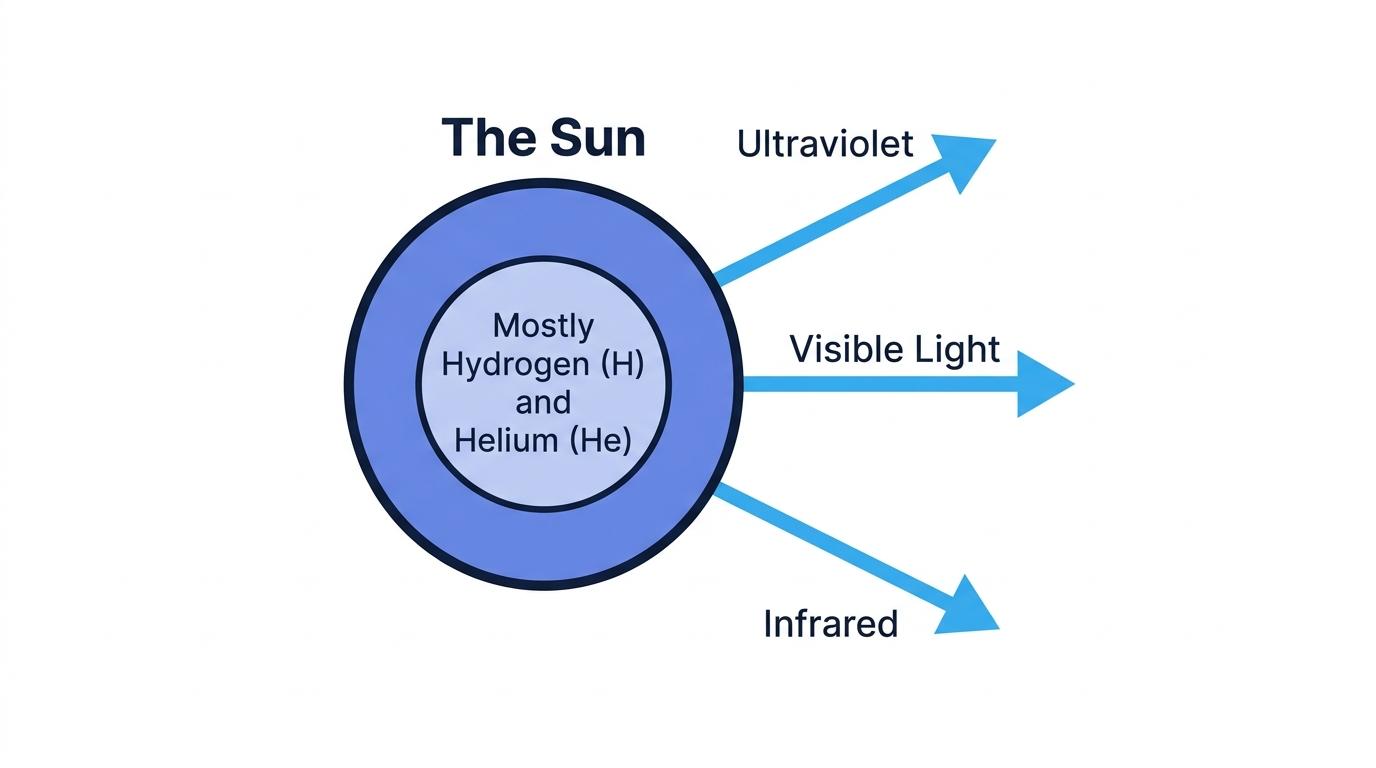
- The Sun consists mostly of hydrogen and helium, with hydrogen the most abundant by a long way and helium second.
- Everything else, the carbon, oxygen and iron, together makes up only a trace, which matches the composition of the cloud the Solar System formed from.
Common Mistake
Do not describe the Sun as the largest or brightest star, and never as a planet. It is a medium-sized star that only outshines the others because of how near it is.
Three bands carry most of the Sun's energy, and only one of them is visible
- The Sun transfers its energy into space as electromagnetic radiation, which needs no material to travel through.
- Most of that energy sits in three neighbouring regions of the spectrum: infrared, visible light and ultraviolet.
- You meet all three on a summer day: visible light lets you see, infrared is the warmth on your skin, and ultraviolet is what burns it.
- In order of increasing frequency they run infrared, then visible light, then ultraviolet.
- In order of increasing wavelength the list reverses to ultraviolet, visible light, infrared, because a higher frequency always goes with a shorter wavelength.
- Which band a star peaks in depends on its surface temperature: hotter stars push their peak towards the shorter wavelengths, which is why the Sun's peak falls in the visible band rather than the infrared.
Key Idea
The Sun does not radiate visible light alone: most of its output is spread across the infrared, visible and ultraviolet regions together.
The energy comes from hydrogen fusing into helium
Definition
Nuclear fusion
The joining of small nuclei to form a larger nucleus, a process that releases energy.
- Stars are powered by nuclear reactions that release energy, not by anything burning.
- In a stable star those reactions are the fusion of hydrogen into helium.
- Fusion needs the enormous temperature and pressure of the core, because hydrogen nuclei are positively charged and repel each other until they are forced close enough together.
- Energy released in the core works its way outwards over a very long time and is finally radiated from the surface as the infrared, visible and ultraviolet radiation reaching us.
- The star is stable while the outward push from the hot core balances the inward pull of its own gravity, which is what keeps its size steady for billions of years.
Common Mistake
- Do not write fission when you mean fusion: fission splits large nuclei apart, while a star joins small ones together.
- Do not say the Sun burns hydrogen, because burning is a chemical reaction between atoms and this is a nuclear reaction between nuclei.
- Do not say fusion creates energy, since energy is released from the store already there, not made from nothing.
Exam technique
- This topic is marked on precise words, so "a hot ball of gas" earns nothing where "medium-sized star of hydrogen and helium" earns the mark.
- Name all three radiation regions when asked about the Sun's output, because listing only visible light is the answer that most often drops a mark here.
- Keep the answer at the level asked for: naming fusion of hydrogen into helium and the release of energy is enough, and a detailed reaction sequence wins nothing extra.
- Watch the mark allocation: a two-mark question wants two separate statements, so write them as two clauses rather than one.
Self review
- What size of star is the Sun, and why does it look so much brighter than the others?
- Which two elements make up most of the Sun?
- Name the three regions of the electromagnetic spectrum in which the Sun radiates most of its energy.
- Put those three regions in order of increasing frequency.
- What nuclear reaction powers a stable star, and what does it produce?