Gas pressure is the result of countless collisions with the walls
Definition
Gas pressure
The steady outward push a gas exerts on every surface it touches, produced by its particles colliding with that surface and rebounding from it.
- The particles of a gas move quickly and in random directions, so they are constantly striking every surface inside the container.
- Each particle that reaches a wall bounces off it, and in changing direction it gives the wall a tiny push.
- A single push would be far too small to notice, but a gas holds an enormous number of particles making an enormous number of collisions every second.
- Added together those pushes give a steady average force acting outwards on the wall, and that is what is felt as pressure.
- Because the motion is random, collisions happen just as often on every wall, so gas pressure acts equally in all directions rather than only downwards.
- The gas does not need to be pushed against the wall by anything else, so a sealed container of gas presses outwards even when nothing is touching it.
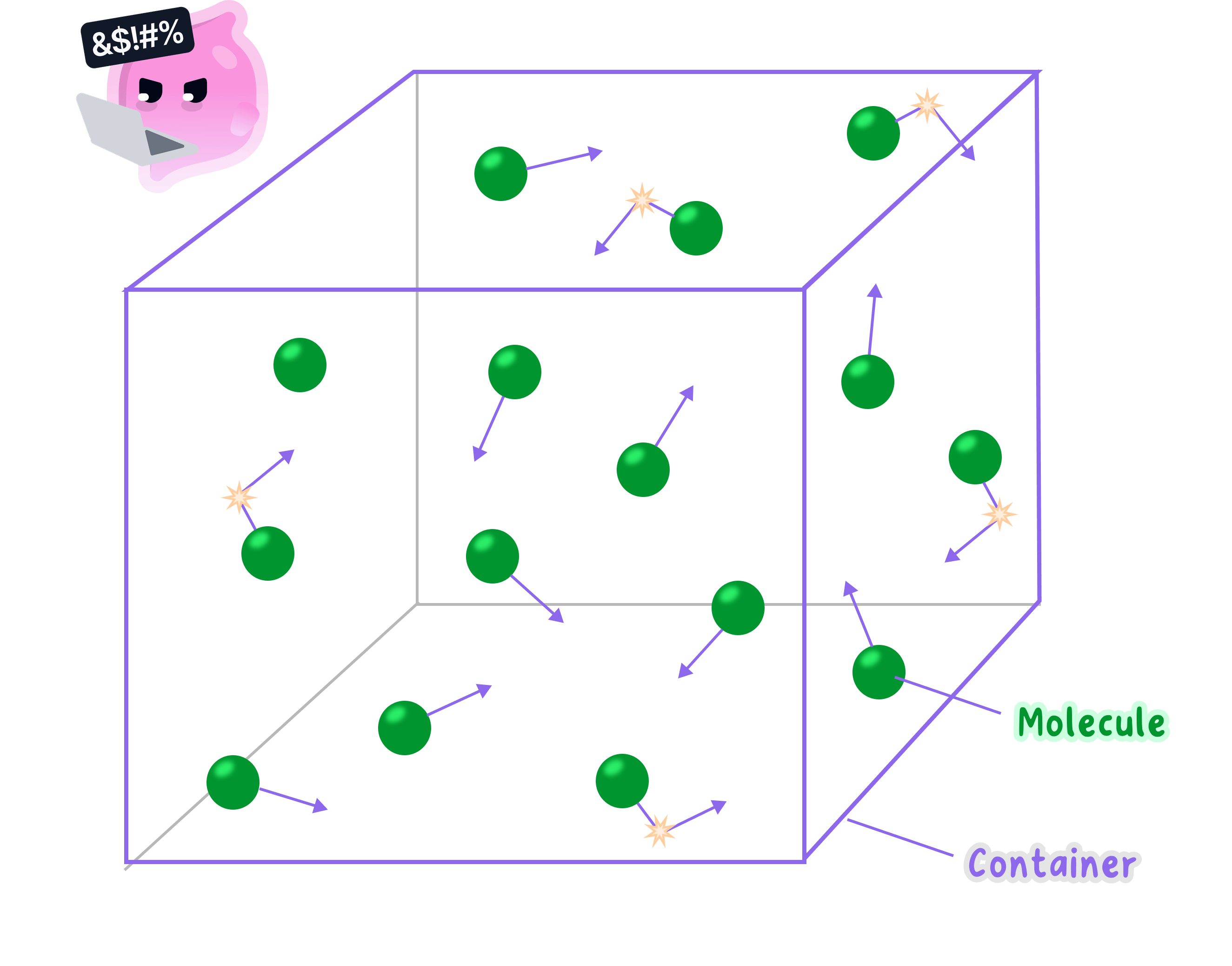
Pressure changes when the collisions become more frequent or harder
- There are only two ways to change the pressure of a gas: change how often the particles hit the walls, or change how hard each hit is.
- Squeezing the same gas into a smaller volume gives each particle less distance to travel between walls, so the collisions become more frequent and the pressure rises.
- Heating the gas raises the average kinetic energy of its particles, so they move faster, reach the walls more often and hit them harder, and the pressure rises on both counts.
- Pumping more particles into a fixed container also raises the pressure, because more particles means more collisions each second on the same area of wall.
- Letting gas escape, or cooling it, reverses each of these and the pressure falls.
Pressure is the force per unit area on the surface
Definition
Pressure
The force acting at right angles to a surface, per unit area of that surface.
p=FA p = \frac{F}{A} p=AFwhere FFF is the force in N\text{N}N and AAA is the area in m2\text{m}^2m2, giving ppp in Pa\text{Pa}Pa.
- Every colliding particle exerts a small force on the wall, and the total force on the wall is the sum of all of those small forces.
- Dividing that total force by the area of the wall gives the pressure, which is why pressure is described as a force per unit area.
- The unit is the pascal, written Pa\text{Pa}Pa, and 1 Pa=1 N/m21\ \text{Pa} = 1\ \text{N}/\text{m}^21 Pa=1 N/m2.
- Dividing by area is what makes the pressure the same on every wall: a wall with twice the area receives twice as many collisions each second, so the force doubles and F/AF/AF/A is unchanged.
- It also explains why a gas at modest pressure can still burst a container, since a small pressure acting over a large area adds up to a very large total force.
Example
- A football pumped up in a warm changing room feels noticeably softer by half-time on a cold pitch.
- The air inside has cooled, so its particles have less average kinetic energy and move more slowly.
- Slower particles reach the inside surface less often and push less hard when they get there.
- The pressure inside therefore falls even though not a single particle of air has escaped.
Common Mistake
- Do not say the particles push against each other to create the pressure on a wall, because the pressure on a surface comes from collisions with that surface.
- Do not write that heating makes the particles expand, because the particles are unchanged and only their speed has risen.
- Do not treat force and pressure as the same quantity, because pressure is force divided by area and its unit is Pa\text{Pa}Pa, not N\text{N}N.
- Do not say the pressure is caused by the weight of the gas, because the collisions happen just as strongly on the ceiling of the container as on its floor.
Exam technique
- An answer worth full marks runs through the whole chain: random motion, collisions with the walls, a force from each collision, and force per unit area.
- When the pressure changes, name which of collision frequency and collision force has changed, since "the particles move more" is the answer that scores nothing.
- Repeat the condition the question fixes, such as "at constant volume", because the explanation is incomplete without it.
- Give the unit as Pa\text{Pa}Pa or N/m2\text{N}/\text{m}^2N/m2, and convert any area given in cm2\text{cm}^2cm2 to m2\text{m}^2m2 before substituting.
Self review
- What causes a gas to exert a pressure on the walls of its container?
- Why does gas pressure act equally in all directions?
- Explain, in terms of collisions, why heating a gas in a sealed rigid container raises its pressure.
- State the equation linking pressure, force and area.
- Give the unit of pressure and write it in terms of newtons and metres.
