Conservation of energy: the books always balance
Definition
Principle of the conservation of energy
Energy cannot be created or destroyed. It can only be transferred from one store to another, so the total energy of a closed system stays constant.
- Nothing in physics is exempt from this. Every event, from a bouncing ball to a power station, redistributes energy that already existed.
- The principle is the reason you can solve problems you have no other route into. If you can list every store at the start and every store at the end, the two totals must match.
- Energy that is wasted has not vanished. It has been dissipated, usually into the internal energy store of the surroundings, where it is spread so thinly that no useful transfer can be made from it.
- This is why a bouncing ball never returns to the height it was dropped from. Each impact squashes the ball and pushes air aside, so some of the gravitational potential store ends up as internal energy in the ball, the floor and the air, plus a little sound.
- A closed system is one you have drawn a boundary around, counting every store inside it and allowing nothing across the edge. Choosing that boundary carefully is what turns the principle into a calculation.
Reading flow diagrams and Sankey diagrams
Definition
Sankey diagram
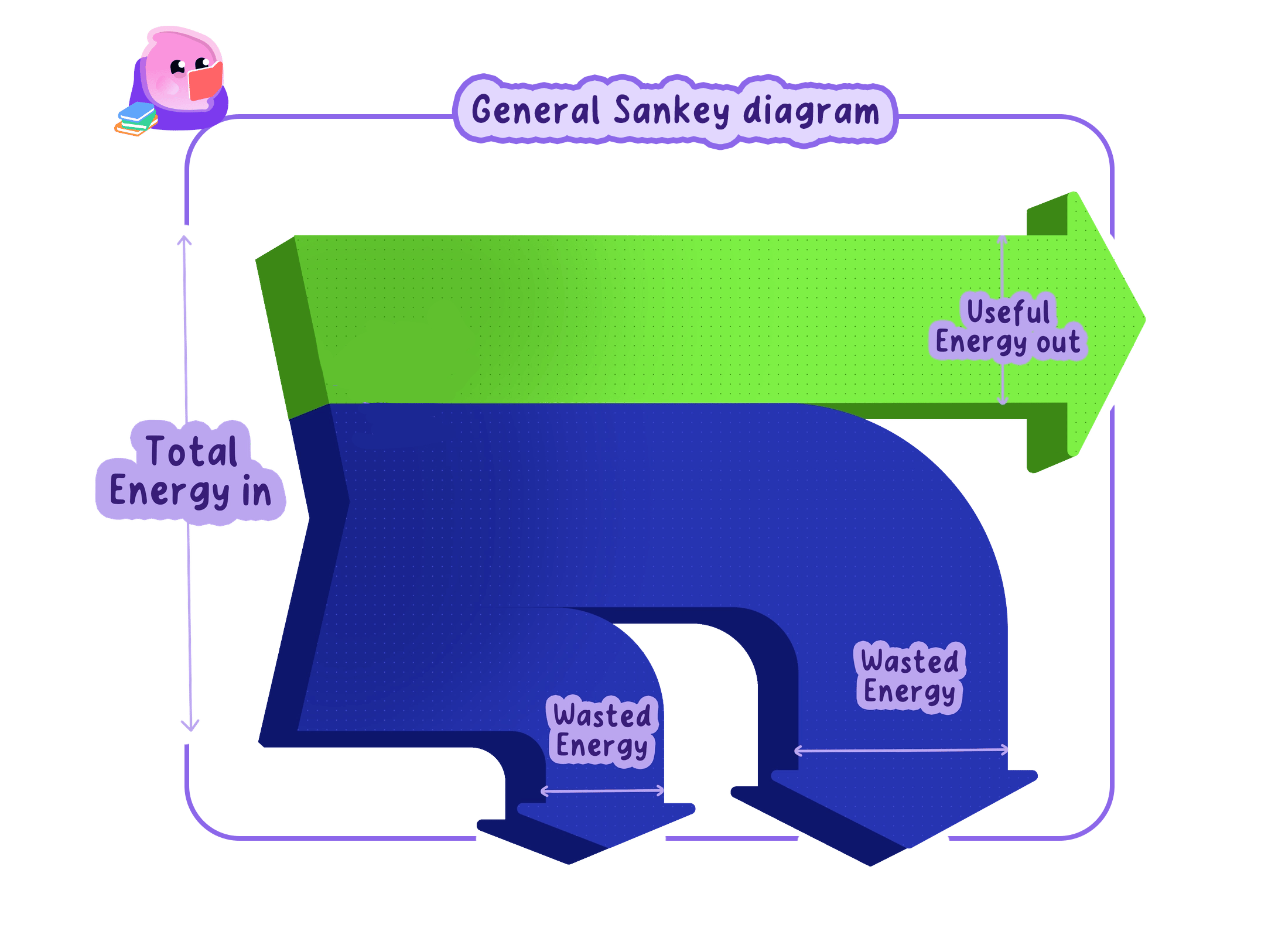
A flow diagram in which the width of each arrow is drawn in proportion to the amount of energy it represents, showing useful output and wasted energy at each stage.
- A simple flow diagram names the stores in order and joins them with labelled arrows, so you can follow an event from beginning to end.
- A Sankey diagram adds the quantities. The single arrow entering on the left is the total energy input; the arrows leaving carry the useful output and the wasted energy.
- Because energy is conserved, the widths of all the arrows leaving a stage must add up to the width of the arrow entering it. That is the check to run first on any Sankey question.
- Wasted branches are drawn turning away, usually downwards, and are almost always labelled as energy dissipated to the internal energy store of the surroundings.
- A multi-stage transfer simply repeats this. The useful output of one stage becomes the input of the next, so the useful arrow gets narrower at every step and the wasted branches accumulate.
- The width of the useful arrow compared with the width of the input arrow is a picture of the efficiency of that stage.
Example
- A lamp is supplied with 100 J100\ \text{J}100 J of energy by electrical working each second. Its Sankey diagram shows a useful branch of 20 J20\ \text{J}20 J transferred by light waves and a wasted branch of 80 J80\ \text{J}80 J transferred by heating to the surroundings.
- The two output arrows add to 100 J100\ \text{J}100 J, matching the input, so energy is conserved.
- The wasted arrow is four times wider than the useful one, which is the diagram telling you at a glance that most of the input ends up warming the room.
Common Mistake
- Energy is never "lost", "used up" or "destroyed". Use dissipated, wasted or transferred to the surroundings.
- In a Sankey diagram the arrows must balance. If your output branches do not add up to the input, you have missed a branch.
- The length of a Sankey arrow means nothing. Only its width carries the quantity.
- Conservation of energy does not mean the useful energy stays the same. It means the total stays the same.
Exam technique
- Answer "what happens to the energy" questions with a full chain: starting store, transfer process, finishing store, and then where the wasted energy is dissipated to.
- For a multi-stage question, work through one stage at a time and write the numbers under each arrow before you try to find any total.
- If a Sankey question gives you the input and one output, get the other output by subtraction, and say that you are using conservation of energy to do it.
Self review
- State the principle of the conservation of energy.
- Explain why a bouncing ball does not return to its original height.
- What quantity does the width of a Sankey arrow represent?
- A motor is supplied with 500 J500\ \text{J}500 J and transfers 150 J150\ \text{J}150 J usefully. How much energy is wasted, and where does it go?
- Why is dissipated energy described as no longer useful, even though it still exists?
