Speed from the gradient of a distance-time graph
Definition
Gradient of a distance-time graph
Equal to the speed of the object, in m/s\text{m/s}m/s.
gradient=change in distancechange in time=ΔsΔt \text{gradient} = \frac{\text{change in distance}}{\text{change in time}} = \frac{\Delta s}{\Delta t} gradient=change in timechange in distance=ΔtΔs- This works because speed is distance travelled per unit time, so the gradient, a distance divided by a time, is a speed.
- A steeper gradient means a greater speed; a horizontal line has zero gradient, so the object is at rest.
- Take a gradient only from a straight section: on a curve the speed is changing, and a straight line drawn between two points on it gives only an average.
Distance from the area under a speed-time graph
Definition
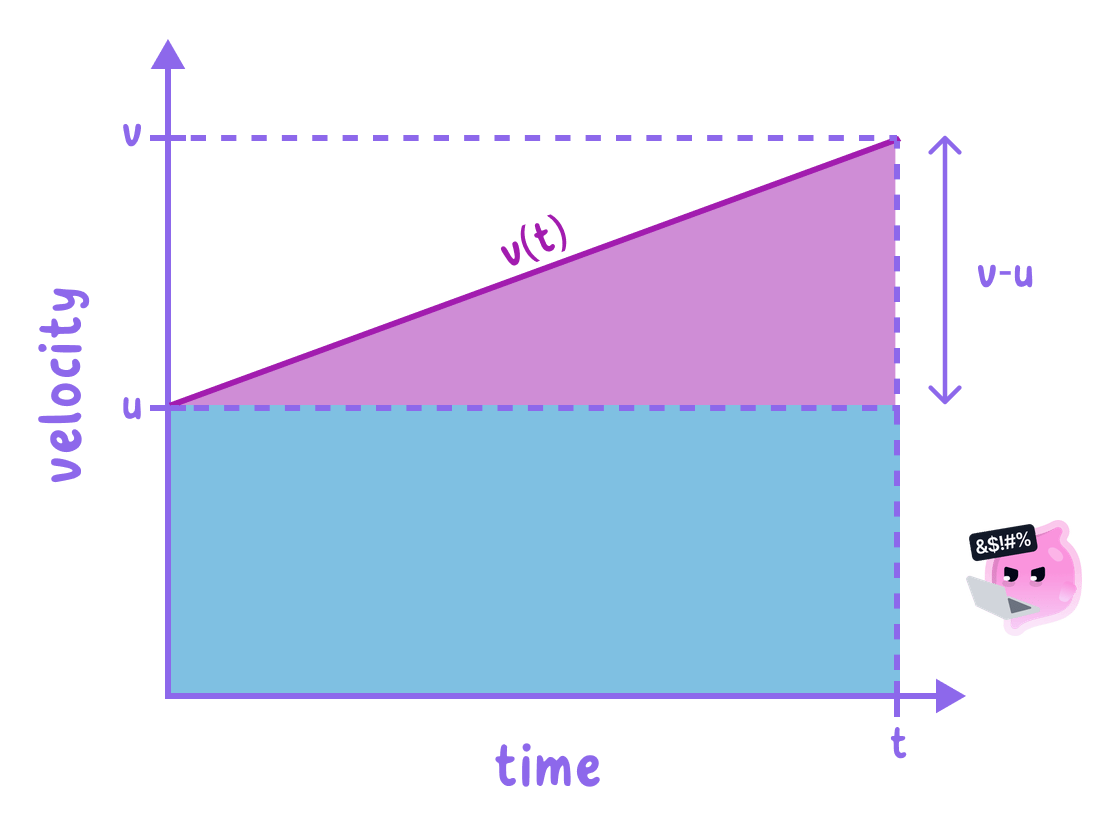
Area under a speed-time graph
Equal to the distance travelled, in m\text{m}m.
- A height on the graph is a speed in m/s\text{m/s}m/s and a width is a time in s\text{s}s, so height ×\times× width gives m/s×s=m\text{m/s} \times \text{s} = \text{m}m/s×s=m, a distance.
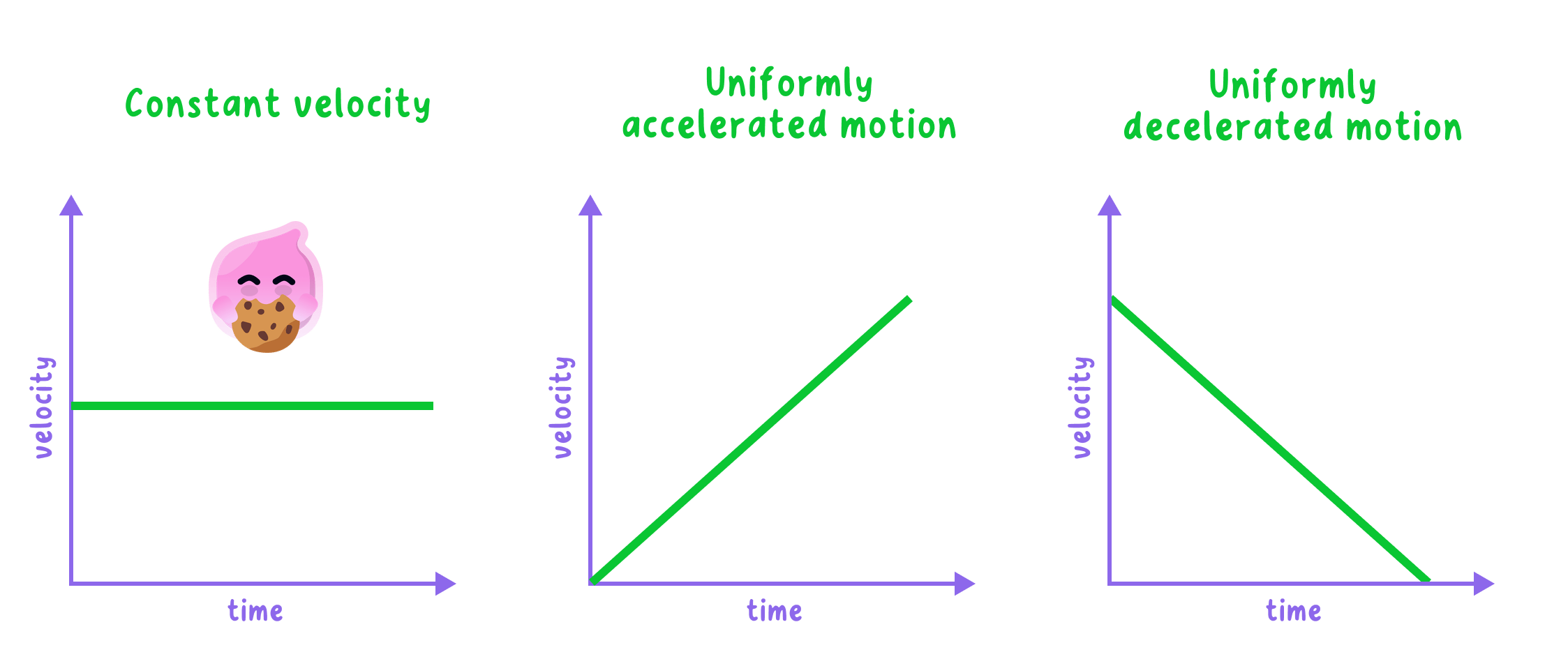
- Constant speed is a horizontal line, so the area is a rectangle: distance=speed×time\text{distance} = \text{speed} \times \text{time}distance=speed×time.
- Constant acceleration is a sloping straight line, so the area is a triangle, 12×base×height\tfrac{1}{2} \times \text{base} \times \text{height}21×base×height (a trapezium if the object does not start from rest).
- For a journey made of several straight sections, split the area into these simple shapes, work out each one, then add them.
Acceleration from the gradient of a speed-time graph
Definition
Gradient of a speed-time graph
Equal to the acceleration, in m/s2\text{m/s}^2m/s2.
a=ΔvΔt a = \frac{\Delta v}{\Delta t} a=ΔtΔv- Acceleration is the change in velocity per unit time, so once again the gradient, a speed divided by a time, is exactly the quantity you want.
- A steeper line means a larger acceleration; a horizontal line has zero gradient, so zero acceleration (constant speed).
- A line sloping downwards has a negative gradient, so the acceleration is negative and the object is slowing down.
Common Mistake
- The most costly error is treating the two graphs as the same graph.
- On a distance-time graph the gradient is the speed, and the area underneath means nothing, never calculate it.
- On a speed-time graph the gradient is the acceleration and the area underneath is the distance.
- A horizontal line means stationary on a distance-time graph but constant speed on a speed-time graph, so "it has stopped" is only right when a flat speed-time line sits on the time axis.
Exam technique
- Check the axis labels before deciding whether to take a gradient or an area, the stem will not label the graph for you.
- Take a gradient with a large triangle, its hypotenuse covering at least half the straight section, reading the corners off gridlines; a small triangle magnifies the reading error.
- Show the equation and the substitution, not just the answer, so staged marks still score if the arithmetic slips.
- Always give the unit: m/s\text{m/s}m/s for a distance-time gradient, m\text{m}m for an area, m/s2\text{m/s}^2m/s2 for a speed-time gradient.
Self review
- How do you find the speed from a distance-time graph?
- How do you find the distance travelled from a speed-time graph?
- What does the gradient of a speed-time graph give, and in what unit?
- Why should you use a large triangle when taking a gradient?
- What area shape does constant acceleration from rest give on a speed-time graph?
