Acceleration: how quickly the velocity changes
Definition
Acceleration
The change in velocity per unit time.
a=ΔvΔt a = \frac{\Delta v}{\Delta t} a=ΔtΔvwhere Δv\Delta vΔv is the change in velocity in m/s\text{m/s}m/s and Δt\Delta tΔt is the time taken in s\text{s}s; the unit of acceleration is m/s2\text{m/s}^2m/s2.
- The symbol Δ\DeltaΔ means "change in", and a change is always final value minus initial value, so a=v−uta = \dfrac{v - u}{t}a=tv−u.
- The unit follows from the equation: a velocity in m/s\text{m/s}m/s divided by a time in s\text{s}s gives metres per second, per second, written m/s2\text{m/s}^2m/s2.
- An acceleration of 3 m/s23\ \text{m/s}^23 m/s2 means the velocity changes by 3 m/s3\ \text{m/s}3 m/s during every second.
Practical
Investigation: measuring speed and acceleration with a tickertape timer
- Aim: to use a tickertape timer to find the speed of a trolley and to identify and calculate its acceleration.
- Apparatus: tickertape timer and power supply, paper tape, trolley, a sloping runway, and a ruler.
- Method:
- Attach the tape to the trolley and thread it through the timer.
- Switch the timer on and release the trolley down the sloping runway.
- The timer prints 50 dots per second, so a ten-tick strip lasts 10×150=0.2 s10 \times \tfrac{1}{50} = 0.2\ \text{s}10×501=0.2 s; measure a strip's length to get the average speed over it from v=length/0.2 sv = \text{length} / 0.2\ \text{s}v=length/0.2 s.
- Compare successive ten-tick strips and find the acceleration from a=Δv/Δta = \Delta v / \Delta ta=Δv/Δt.
- Measure and plot:
- Measure the length of each ten-tick strip, which gives the speed over it.
- Build a tape chart of successive strips to show how the speed changes.
- Result: equal strip lengths mean constant speed; strips that lengthen evenly mean constant acceleration, with a=Δv/Δta = \Delta v / \Delta ta=Δv/Δt.
- Watch out:
- The dots bunch together at the crowded start, so ignore that region.
- Average over several ten-tick strips rather than trusting a single reading.
- Safety: stop the trolley before it runs off the end of the runway.
Constant and changing acceleration
- On a speed-time graph, how steeply the line rises shows how quickly the speed is changing.
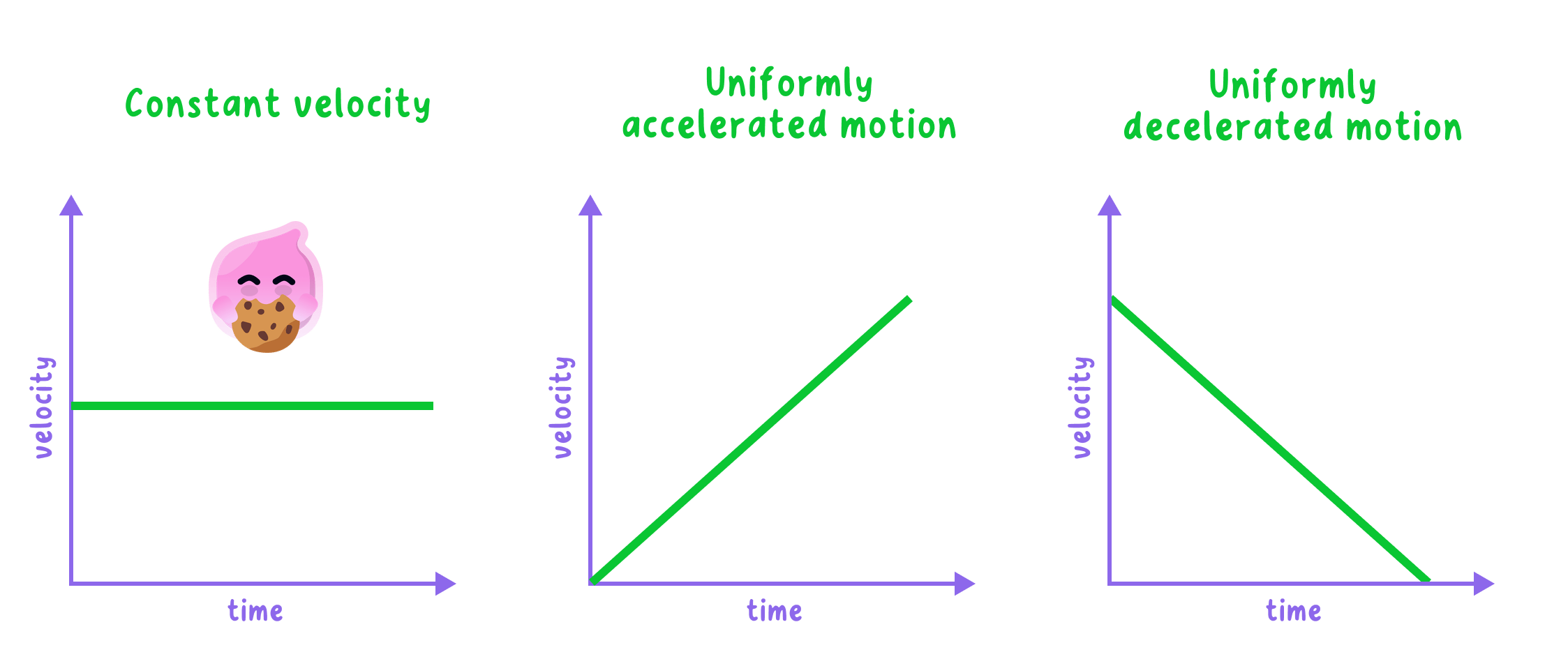
- A horizontal line means the speed is not changing: zero acceleration (constant speed).
- A straight sloping line means the speed changes by the same amount every second: constant (uniform) acceleration; the steeper the line, the larger the acceleration.
- A curved line means changing (non-uniform) acceleration, a curve that steepens shows an increasing acceleration, one that flattens shows a decreasing acceleration.
- From data, compare the change in speed over equal time intervals: equal changes mean constant acceleration, unequal changes mean changing acceleration.
Example
- Two vehicles have their speed recorded every 1.0 s1.0\ \text{s}1.0 s.
- Vehicle A: 0, 4, 8, 12, 16 m/s0,\ 4,\ 8,\ 12,\ 16\ \text{m/s}0, 4, 8, 12, 16 m/s. The speed rises by 4 m/s4\ \text{m/s}4 m/s every second, so the acceleration is constant at 4 m/s24\ \text{m/s}^24 m/s2 and the graph is a straight sloping line.
- Vehicle B: 0, 6, 10, 12, 13 m/s0,\ 6,\ 10,\ 12,\ 13\ \text{m/s}0, 6, 10, 12, 13 m/s. The rises are 666, 444, 222 and 1 m/s1\ \text{m/s}1 m/s, so the acceleration is changing, it is decreasing, and the graph is a curve that flattens out.
- Vehicle B is speeding up the whole time, even though its acceleration is falling.
Deceleration is a negative acceleration
Definition
Deceleration
A negative acceleration: the object is slowing down, so its final velocity is less than its initial velocity.
- There is no separate equation: use a=Δv/Δta = \Delta v / \Delta ta=Δv/Δt, take the direction of travel as positive, and because vvv is less than uuu, Δv\Delta vΔv comes out negative and so does aaa.
- Keep the minus sign in your working; it carries the physics.
Common Mistake
- A negative acceleration does not mean moving backwards; it means slowing down while still travelling forwards.
- Do not write "a deceleration of −2 m/s2-2\ \text{m/s}^2−2 m/s2", which says it is speeding up. Either give the acceleration as −2 m/s2-2\ \text{m/s}^2−2 m/s2, or call it a deceleration of 2 m/s22\ \text{m/s}^22 m/s2.
- Constant acceleration is not constant speed: on a speed-time graph a straight slope is constant acceleration, a horizontal line is constant speed and zero acceleration.
- Do not read a speed-time graph as a distance-time graph: gradient of distance-time is speed, gradient of speed-time is acceleration, area under speed-time is distance.
Exam technique
- Write a=Δv/Δta = \Delta v / \Delta ta=Δv/Δt from recall before substituting, and show v−uv - uv−u as its own step, so staged marks still score if the arithmetic slips.
- Always give the unit m/s2\text{m/s}^2m/s2, and convert a time given in minutes to seconds first.
- When asked to judge "from the shape of the graph", name the shape and state the conclusion ("a straight slope, so constant acceleration"); no calculation is wanted.
Self review
- Define acceleration, and give its equation and unit.
- What does Δv\Delta vΔv stand for, and how do you work it out?
- On a speed-time graph, how do you tell constant acceleration from changing acceleration?
- Why does a deceleration come out as a negative acceleration?
- Does a negative acceleration mean the object is moving backwards?
