The acceleration of free fall, g
Definition
Acceleration of free fall (g)
The acceleration of an object that is falling freely, acted on by gravity alone; near the surface of the Earth it is approximately constant and approximately 9.8 m/s29.8\ \text{m/s}^29.8 m/s2.
- Near the surface of the Earth: ggg gets smaller far from the planet, so the value only holds close to the ground.
- Approximately constant: over the heights used in exam questions the field is treated as uniform, so ggg does not change as the object falls.
- Some questions tell you to use 10 m/s210\ \text{m/s}^210 m/s2 instead; always use the value printed in the question.
- The same number is the gravitational field strength, 9.8 N/kg9.8\ \text{N/kg}9.8 N/kg: a field that pulls each kilogram with 9.8 N9.8\ \text{N}9.8 N gives each kilogram an acceleration of 9.8 m/s29.8\ \text{m/s}^29.8 m/s2.
- In free fall, all objects accelerate at the same rate whatever their mass: a larger mass is pulled by a larger weight, but is also harder to accelerate, and the two effects cancel exactly.
Key Idea
Released together on the airless Moon, a hammer and a feather hit the ground at the same instant: with no air resistance only gravity acts, and ggg is the same for both.
Falling with no resistance
- With no air or liquid resistance, the only force on the object is its weight.
- The weight is constant, so the resultant force is constant and downward, and the object falls with a constant acceleration of ggg.
- The speed increases by about 9.8 m/s9.8\ \text{m/s}9.8 m/s every second: 000, then 9.8 m/s9.8\ \text{m/s}9.8 m/s, then 19.6 m/s19.6\ \text{m/s}19.6 m/s, and so on.
- On a speed-time graph this is a straight line of constant gradient from the origin, and it never levels off: with no resistance there is no terminal velocity.
Falling with air or liquid resistance
Definition
Terminal velocity
The constant velocity a falling object reaches when the upward resistive force has grown equal to its weight, so the resultant force on it, and therefore its acceleration, is zero.
- Air resistance (drag) acts upwards on a falling object, and it increases as the object goes faster.
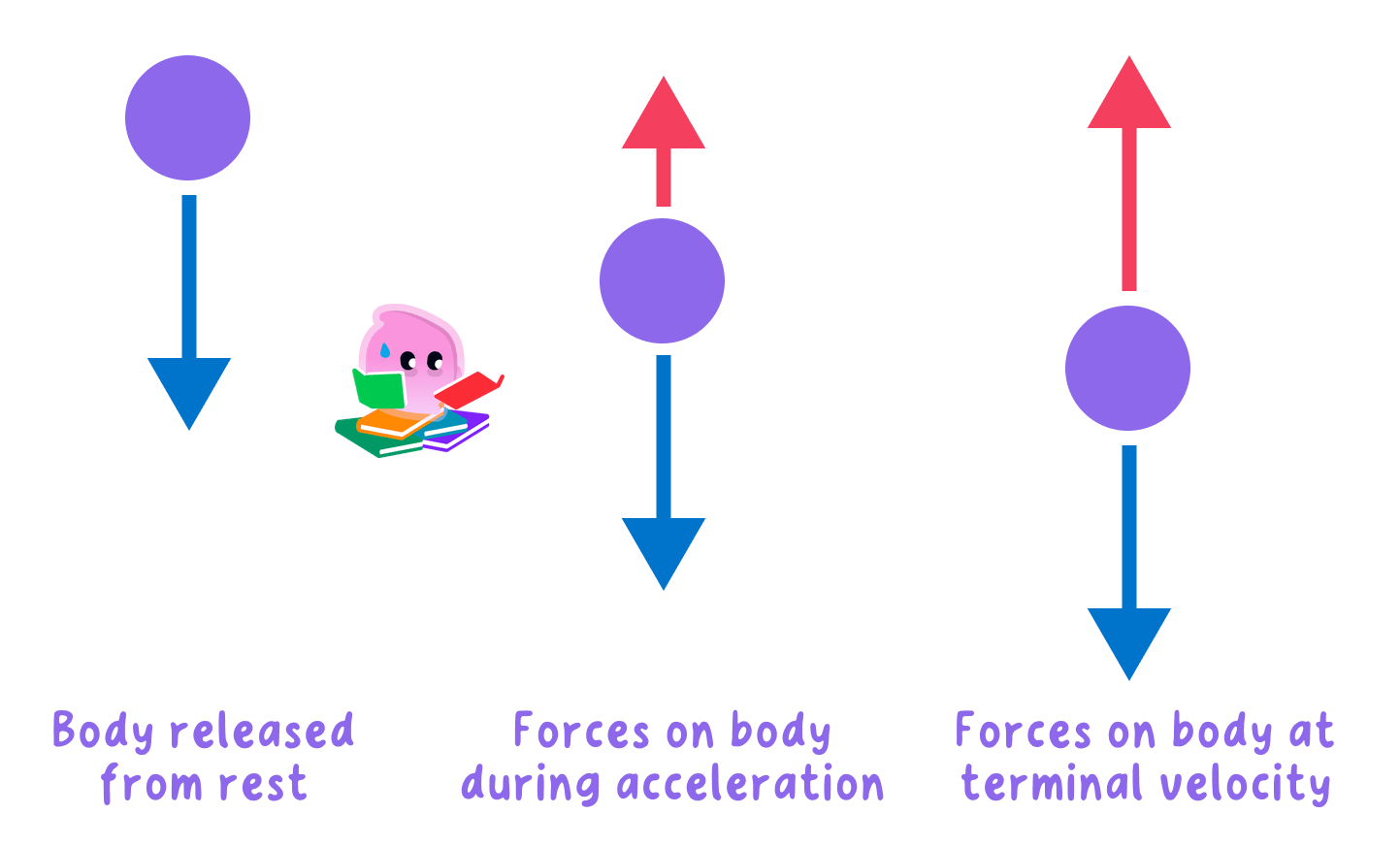
- At the moment of release the speed is zero, so the drag is zero; the resultant force is the full weight and the acceleration is at its maximum value, ggg.
- As the object speeds up, the drag increases, so the resultant force (weight minus drag) decreases and the acceleration decreases, but the object is still speeding up, just less quickly each second.
- When the drag has grown to equal the weight, the resultant force is zero, the acceleration is zero, and the object falls at a constant speed: its terminal velocity.
- On a speed-time graph this is a curve that starts steep, gets less steep, and levels off into a horizontal line at the terminal velocity.
- If a parachute opens, the surface area jumps and the drag becomes larger than the weight, so the resultant force acts upwards and the skydiver decelerates to a new, much lower terminal velocity that is safe for landing.
- The same reasoning applies in a liquid: a ball bearing dropped into a tall tube of oil meets a large resistance even at low speed, so it reaches a small terminal velocity quickly and then falls at constant speed.
Common Mistake
- "Heavier objects fall faster." Without resistance they do not: mass makes no difference to ggg. A denser object reaches a higher terminal velocity, but that is the resistance, not gravity.
- "At terminal velocity there are no forces on it." There are two forces, weight and resistance; they are equal and opposite, so the resultant force is zero. Never write "no forces".
- "The acceleration decreases, so it slows down." A decreasing acceleration still means speeding up, just more gently; the object only slows once the resistive force becomes greater than the weight.
Exam technique
- "Describe the motion as it falls" is point-marked, so write separable points: name the forces, compare them, state the resultant, then say what happens to the acceleration and to the speed, linked with "because" and "so".
- Use the exact terms weight, air resistance (or drag), resultant force, acceleration and terminal velocity; contradicting yourself, such as "resultant force zero, still accelerating", cancels the mark.
- If a value of ggg is printed in the question, use that value.
Self review
- State the approximate value of ggg near the Earth's surface, with its unit.
- Why do all objects fall with the same acceleration when there is no air resistance?
- What happens to the acceleration of a falling object as air resistance builds up?
- Define terminal velocity.
- What happens to a skydiver's motion when the parachute opens?
