Mass: the quantity of matter in an object
Definition
Mass
A measure of the quantity of matter in an object at rest relative to the observer.
- Mass is measured in kilograms (kg\text{kg}kg), with 1 kg=1000 g1\ \text{kg} = 1000\ \text{g}1 kg=1000 g, and it is a scalar: it has size but no direction.
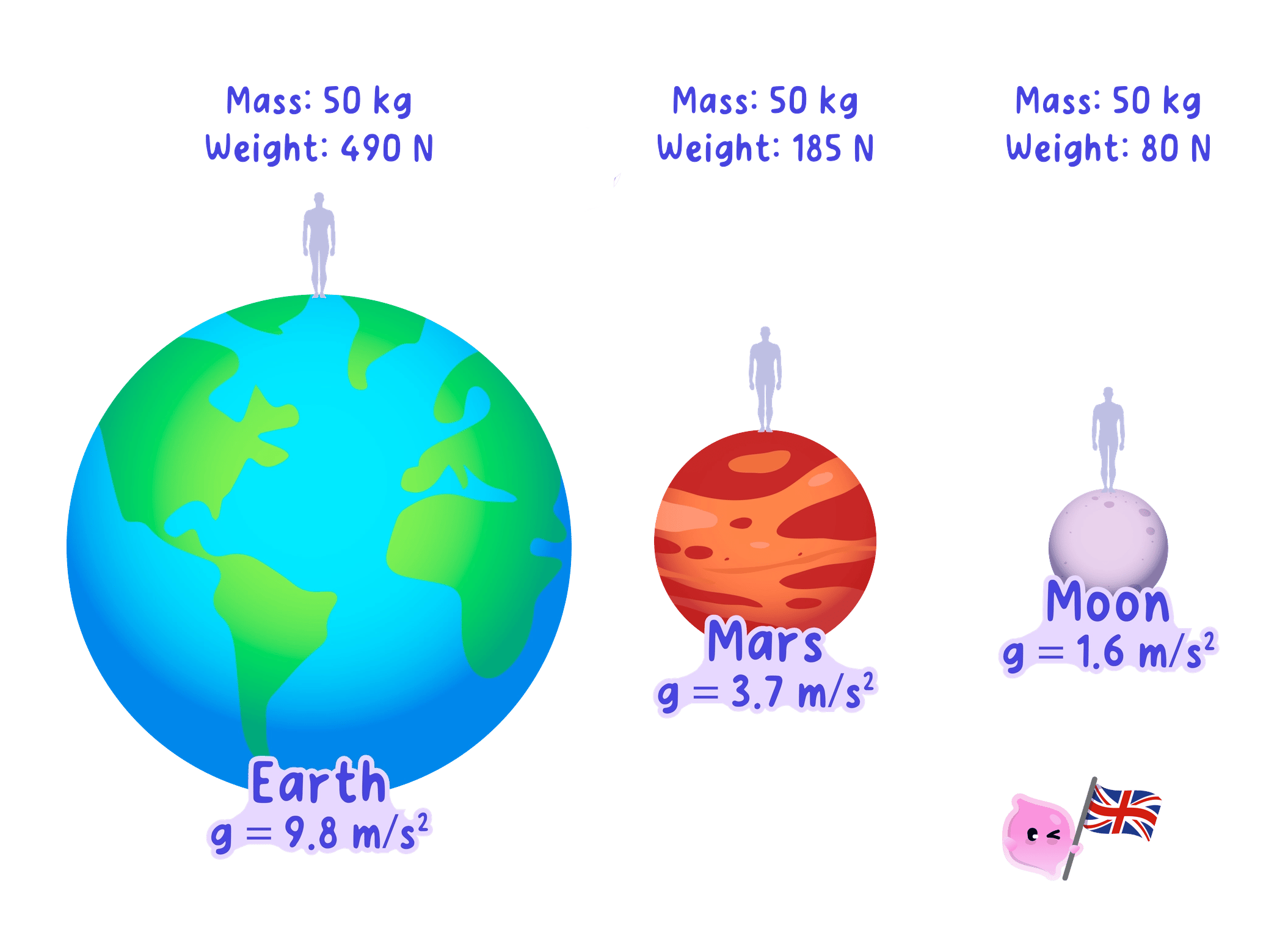
- Because mass counts the matter itself, it does not depend on location: a 2 kg2\ \text{kg}2 kg bag of sugar has a mass of 2 kg2\ \text{kg}2 kg on the Earth, on the Moon and in deep space.
- The only way to change an object's mass is to add or remove matter.
Weight: the gravitational force on a mass
Definition
Weight
A gravitational force on an object that has mass.
- Weight is measured in newtons (N\text{N}N), never in kilograms.
- It is a vector, acting vertically downwards towards the centre of the planet or moon producing the field.
- It is measured with a force meter, a spring balance (newtonmeter).
- An object has weight because it has mass and because it sits in the gravitational field of a nearby massive body.
- The same object weighs less on the Moon because the Moon's gravitational field is weaker, so the force on the same amount of matter is smaller.
Key Idea
Mass is the cause; weight is the effect. The matter in an object stays the same wherever you take it, but the gravitational force acting on that matter depends on where the object is.
Comparing masses with a balance
- A balance does not measure mass directly: it compares one weight with another.
- Put the object on one pan and add known standard masses to the other until the beam is level; the gravitational force pulling down on each side is then equal, so the two weights are equal.
- Both pans sit in the same gravitational field, so equal weights can only mean equal masses.
- This is why a beam balance reads the same on the Moon: every weight is reduced in the same proportion, so the same standard masses still balance the object.
- A spring balance behaves differently: it responds to the weight itself, so its reading in newtons falls on the Moon.
Common Mistake
- Do not give a weight in kilograms. "My weight is 60 kg60\ \text{kg}60 kg" is everyday language: that is a mass, and the weight is a force in newtons.
- Mass does not change on the Moon. The weight changes, because the gravitational field is weaker; the mass is fixed.
- An astronaut in orbit does not have "no gravity". A gravitational force still acts, so the astronaut still has both mass and weight.
- Write gravitational force, not just "gravity", where the mark scheme wants the full term.
Exam technique
- Define and State questions here are one mark for one precise sentence, so learn both definitions word for word rather than paraphrasing.
- If asked how a balance compares masses, the mark is the linking step: it compares weights, and because the gravitational field is the same on both pans, equal weights mean equal masses.
- Watch the unit: a weight quoted without N\text{N}N, or given in kg\text{kg}kg, loses the mark however good the reasoning.
Self review
- Define mass, and give its unit.
- Define weight, and give its unit.
- Why does an object's weight change on the Moon while its mass does not?
- How does a beam balance compare the masses of two objects?
- Why does a beam balance read the same on the Moon, but a spring balance does not?
