A beam of charged particles is a current, so a field pushes it
- A moving charge is a current, whether it travels along a wire or through a vacuum, so a magnetic field exerts a force on it.
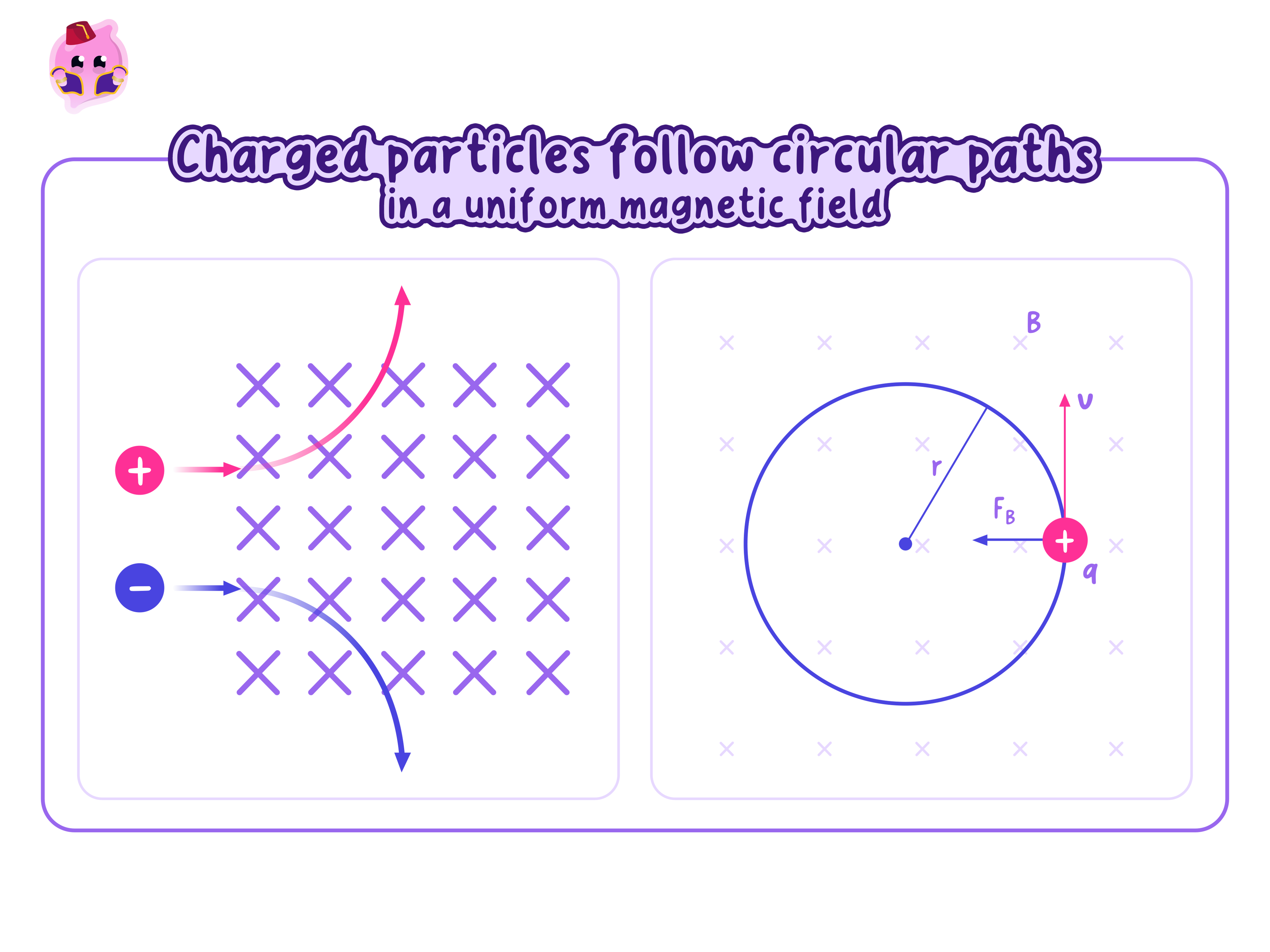
- The force acts at right angles to both the velocity of the particles and the magnetic field.
- Because it is always perpendicular to the motion, it changes the direction of the beam without changing its speed, so the beam curves rather than slowing down.
- The beam is undeflected if it travels along the field lines, exactly as a wire feels no force when its current runs parallel to the field.
- A stronger field gives a larger force, so the beam curves more sharply.
Applying the left-hand rule to a beam of charges
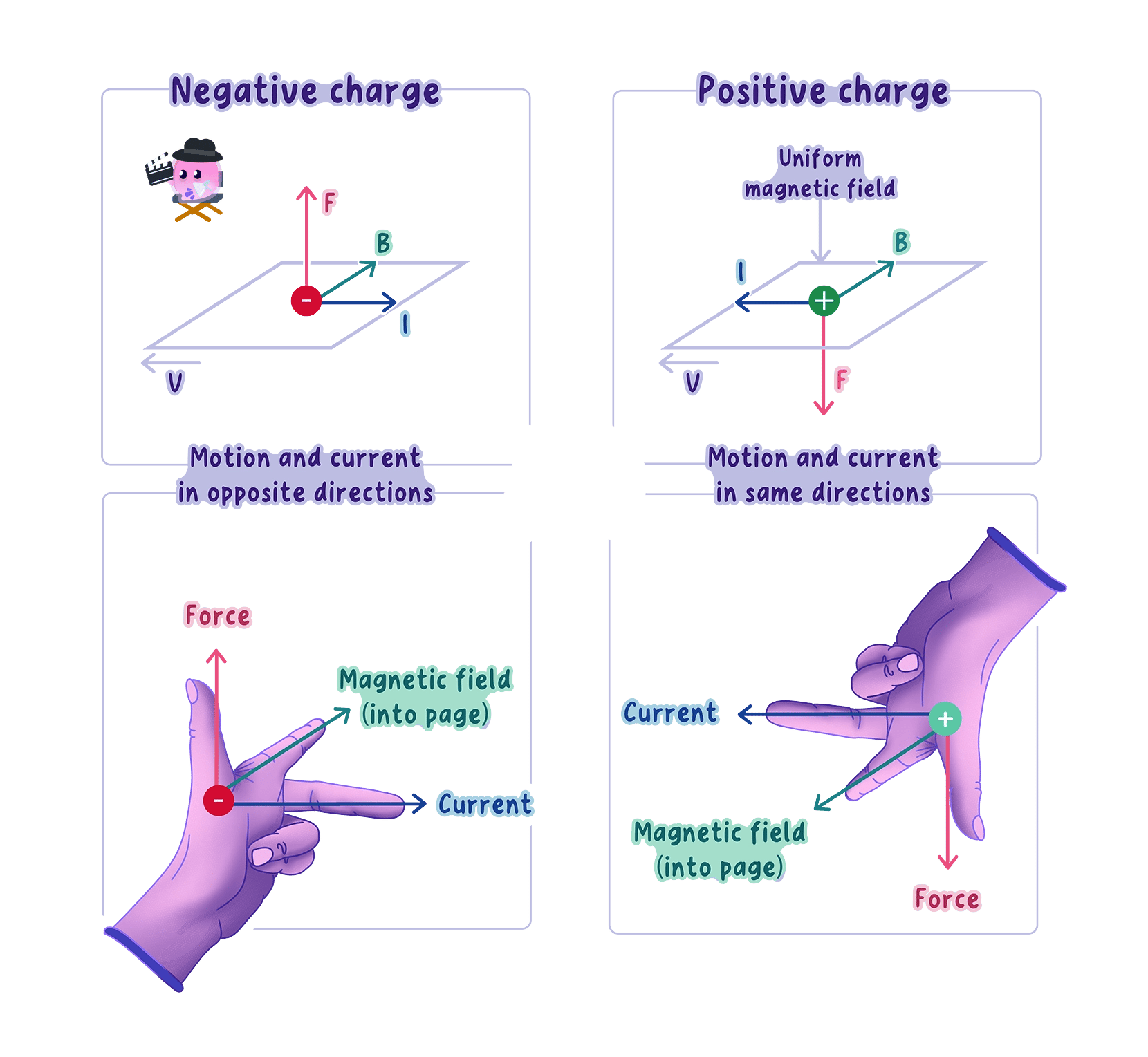
- Use Fleming's left-hand rule exactly as for a wire, but work out which way the conventional current points before you start.
- For a beam of positive charges the conventional current is in the same direction as the particles are moving.
- For a beam of negative charges such as electrons, the conventional current is in the opposite direction to the motion.
- So an electron beam and a proton beam travelling the same way through the same field are pushed in opposite directions.
- Set the first finger along the field, the second finger along the conventional current you worked out, and the thumb then gives the force.
- Getting the current direction right for a negative beam is where nearly all the marks on this topic are lost.
Practical
Investigation: the effect of a magnetic field on a beam of electrons
- Aim: to show that a magnetic field deflects a beam of electrons, and that reversing the pole reverses the deflection. This is a teacher demonstration.
- Apparatus: eye protection, a Maltese cross tube, an extra-high-tension supply of about 3 kV3\ \text{kV}3 kV, a 6 V6\ \text{V}6 V heater supply, a bar magnet and a safety screen.
- Method:
- The teacher connects the tube so that a sharp shadow of the metal cross appears on the fluorescent screen at the far end.
- The room lights are dimmed so that the faint glowing shadow can be seen clearly.
- Two shadows are identified: a fixed optical shadow cast by light from the filament, and a fluorescent shadow cast by the electron beam.
- The N pole of a bar magnet is brought slowly up to the side of the tube, and the electron shadow is seen to move while the optical shadow stays exactly where it was.
- The magnet is turned round and the S pole brought to the same place, and the electron shadow moves the opposite way.
- Measure and record: the observations are qualitative, so record which way the electron shadow moves for each pole, and note that the optical shadow does not move at all.
- Result: the sharp shadow shows that the electrons travel in straight lines; the field deflects the beam; opposite poles deflect it in opposite directions, which confirms that a force acts on a moving negative charge in the direction given by the left-hand rule.
- Watch out:
- Dim the lights before starting, because the fluorescent shadow is faint and easily washed out.
- Take care to tell the moveable electron shadow apart from the fixed optical one, since confusing them makes it look as though nothing has happened.
- Bring the magnet up slowly, so that the movement of the shadow can be followed as it happens.
- Safety: the extra-high-tension supply at about 3 kV3\ \text{kV}3 kV is dangerous and the evacuated tube can implode, so the demonstrator works behind a safety screen, wears eye protection and keeps students back from the apparatus.
Where the deflection of charged beams shows up
- If the field covers a large enough region the path curves into a circle, because the force stays perpendicular to the motion at every point along the path.
- An older television or oscilloscope tube steers its electron beam across the screen with coils that produce a changing magnetic field.
- Particle accelerators use large magnets to bend beams of charged particles round a ring.
- Charged particles streaming from the Sun are deflected by the Earth's own magnetic field towards the poles, which is what produces the aurora.
Common Mistake
- For an electron beam the conventional current runs opposite to the direction the electrons travel, which is the step most answers miss.
- The magnetic force changes the beam's direction but not its speed, so do not say the field slows the particles down.
- A beam travelling along the field lines is not deflected at all, so check the geometry before applying the rule.
- This is a magnetic deflection, so do not answer it as though the beam were being attracted to a magnetic pole.
Exam technique
- Write down the direction of the conventional current as your first line, especially for a negative beam, so the marker can see the step.
- Draw the field arrow on the diagram from N to S before lifting your left hand.
- Give the deflection as a clear direction, such as "upwards" or "out of the page", and mark it on the diagram as well.
- If the question changes the sign of the charge, say that the conventional current reverses and therefore so does the force.
Self review
- Why does a magnetic field exert a force on a beam of charged particles?
- For a beam of electrons, which way does the conventional current point?
- An electron beam travels to the right through a field pointing into the page. Use the left-hand rule to find the direction of the force.
- Why does the beam curve rather than speed up or slow down?
- In what direction must a beam travel for the field to have no effect on it?
