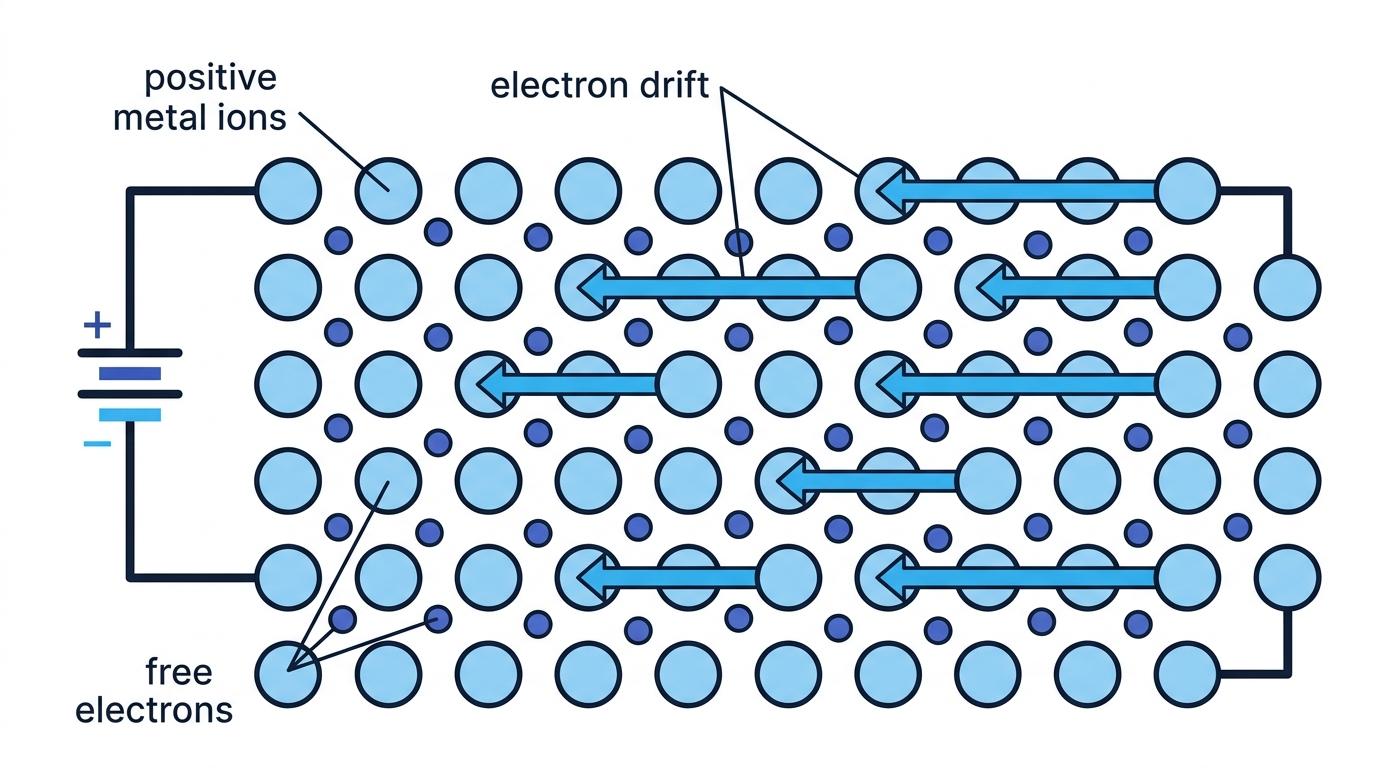
Current is charge on the move
Definition
Electric current
The charge passing a point per unit time, so a current exists wherever charge is flowing.
I=Qt I = \frac{Q}{t} I=tQ- Nothing flows unless there is a complete loop from one terminal of the supply back to the other, which is why opening a switch stops the current instantly.
- In a metal wire the moving charges are free electrons, and in a solution they are ions.
- The unit of current is the ampere, symbol A\text{A}A, and a current of 1 A1\ \text{A}1 A means 1 C1\ \text{C}1 C of charge passes each point every second.
- Everyday sizes are worth carrying in your head: an LED draws about 20 mA20\ \text{mA}20 mA, a torch bulb about 0.3 A0.3\ \text{A}0.3 A, and a kettle about 10 A10\ \text{A}10 A.
- Current is not used up as it goes round a loop: every electron that leaves the cell comes back to it, so the current is the same all the way round a series circuit.
- What the lamp uses up is energy, carried by the charge, not the charge itself.
An ammeter goes in series, and the range is chosen before you connect it
- An ammeter has to have the current flowing through it, so it is connected in series with the component.
- A good ammeter has a very low resistance, so that inserting it hardly changes the current it is there to measure.
- On a d.c. circuit connect the red terminal towards the positive of the supply, or an analogue needle will try to swing backwards off the scale.
- Choose the range before switching on: start on the highest range and step down until the reading uses most of the scale.
- An analogue meter has a needle over a printed scale, so read it at eye level to avoid parallax error, and check which printed scale matches the range you selected.
- A digital meter shows a number, which removes the reading error, but you still have to notice whether the display is in mA\text{mA}mA or A\text{A}A.
- A reading of 0.42 A0.42\ \text{A}0.42 A taken on a 000 to 1 A1\ \text{A}1 A range is far more precise than the same current squeezed into the bottom of a 000 to 10 A10\ \text{A}10 A range.
Practical
Investigation: measuring current in series and parallel circuits
- Aim: to measure the current at different points in a series circuit and in a parallel circuit, and to find the rule that holds in each.
- Apparatus: two cells in a holder, two identical lamps, an ammeter reading 000 to 1 A1\ \text{A}1 A, a switch, connecting leads and a circuit board.
- Method:
- Build a series circuit containing the cells, the switch, both lamps and the ammeter, with the red terminal of the ammeter facing the positive of the supply.
- Close the switch, let the reading settle, record the current, then open the switch again.
- Move the ammeter to a different point in the loop, first between the two lamps and then after the second lamp, taking a reading at each position.
- Rebuild the circuit with the two lamps side by side in parallel.
- Read the current in the main lead coming from the cells, then move the ammeter into each branch in turn and read the current there.
- Repeat every reading at least once and average, switching off between changes.
- Measure and record: record the ammeter reading at each position in a table headed position and current / A; no graph is needed.
- Result: the current is the same at every point in a series circuit, and in a parallel circuit the current from the source equals the sum of the branch currents.
- Watch out:
- Switch off between changes, because a warm filament has a higher resistance and gives a lower reading than a cold one.
- Start on the largest range and work down, so that a large current cannot damage the meter.
- If the needle tries to move backwards, switch off and swap the two leads rather than forcing it.
- Read an analogue scale at eye level, and push every connection fully home, since a loose crocodile clip adds resistance and lowers the current.
- Safety: switch off between changes and keep the current low, because large currents make components hot enough to burn and can damage the meter.
Charge, current and time are linked by one equation
- The equation to recall is I=QtI = \dfrac{Q}{t}I=tQ, where III is the current in A\text{A}A, QQQ is the charge in C\text{C}C and ttt is the time in s\text{s}s.
- Rearranged it gives Q=ItQ = ItQ=It, which is the form most questions actually need.
- Time must be in seconds, so convert first, since two minutes is 120 s120\ \text{s}120 s and not 222.
- Because Q=ItQ = ItQ=It, a small current flowing for a long time moves far more charge than a large current flowing briefly.
Common Mistake
- Current is not used up by a lamp, so the reading is the same on both sides of it in a series circuit.
- Never connect an ammeter across a component; its very low resistance would let a huge current through and could destroy it.
- Convert minutes and hours to seconds before using Q=ItQ = ItQ=It, because the equation only works in SI units.
Exam technique
- Write the equation, then the substitution, then the answer with a unit, because each of those steps carries its own mark in a staged calculation.
- If a diagram shows an analogue scale, state the range in use and count the divisions rather than estimating from the picture.
- When asked why an ammeter has a low resistance, the mark is for it not reducing the current in the circuit.
- A question that asks you to "describe how you would measure the current" wants the ammeter in series, a suitable range, and repeated readings.
Self review
- Define electric current and give its unit.
- How is an ammeter connected into a circuit, and why must its resistance be low?
- State one advantage of a digital ammeter over an analogue one.
- A current of 2.5 A2.5\ \text{A}2.5 A flows for 40 s40\ \text{s}40 s. Calculate the charge that passes.
- Why is the current the same at every point in a series circuit?