Charge is measured in coulombs, and one coulomb is a lot of charge
Definition
Coulomb
The unit of electric charge, symbol C\text{C}C. One coulomb is the charge that passes a point when a current of 1 A1\ \text{A}1 A flows for 1 s1\ \text{s}1 s.
- The symbol for charge is QQQ and the unit is the coulomb, written C\text{C}C.
- The charge on one electron is only about 1.6×10⁻¹⁹ C1.6 \times 10^{-19}\ \text{C}1.6×10⁻¹⁹ C, so a single coulomb represents an enormous number of electrons.
- The static charge left on a rubbed polythene rod is a few nanocoulombs, around 10−9 C10^{-9}\ \text{C}10−9 C, which is why it lifts scraps of paper but nothing heavier.
- By contrast a torch bulb drawing 0.30 A0.30\ \text{A}0.30 A moves 0.30 C0.30\ \text{C}0.30 C past every point each second, so a working circuit shifts far more charge than static electricity ever does.
An electric field is the region where a charge feels a force
Definition
Electric field
A region in which an electric charge experiences a force.
- Bring any charge into that region and it is pushed or pulled, with nothing touching it.
- The field is strongest close to the charge producing it and weakens as you move away.
- The idea runs parallel to the magnetic field, with one substitution: the thing that feels the force is a charge rather than a magnetic pole.
- Field lines are drawn the same way too: their shape shows the field, their arrows show its direction, and their spacing shows its strength.
Field direction is the direction of the force on a positive charge
- The direction of an electric field at a point is the direction of the force on a positive charge placed at that point.
- That single rule fixes every arrow you will ever draw: lines point away from positive charge and towards negative charge.
- A negative charge sitting in the field feels a force in the opposite direction to the field line through it.
- Electric field lines never cross, for the same reason as magnetic ones: the force at a point has only one direction.
A point charge and a charged sphere both give a radial field
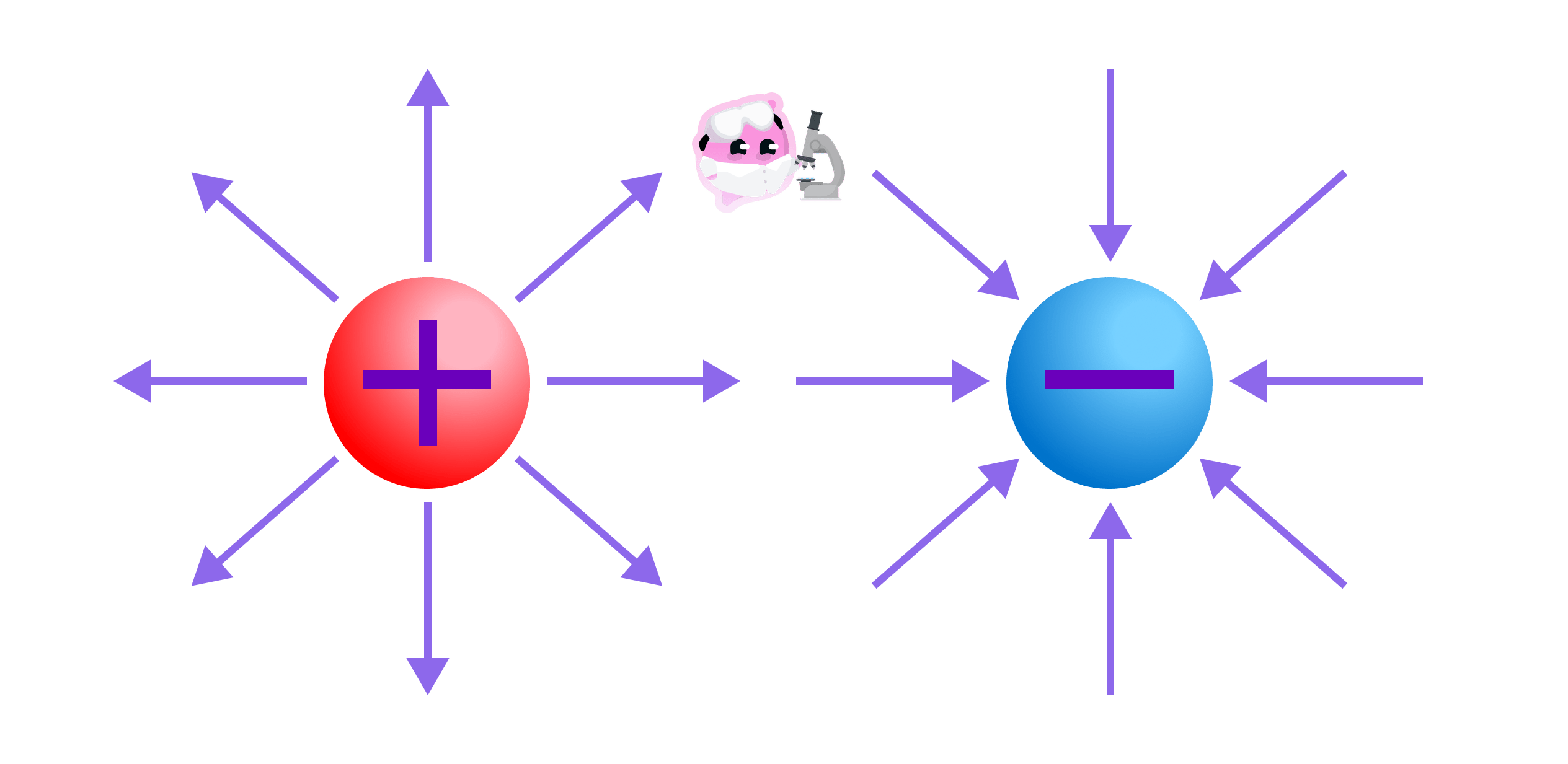
- Around an isolated point charge the field is radial: straight lines spreading out evenly in all directions.
- For a positive charge the arrows point outwards, away from the charge.
- For a negative charge the arrows point inwards, towards the charge.
- The lines spread further apart with distance, which is the picture of the field getting weaker.
- Around a charged conducting sphere the pattern outside is identical to that of a point charge sitting at its centre.
- Draw the radial lines starting at the surface of the sphere and leaving it at right angles, not from a dot in the middle.
- The charge spreads evenly over the outer surface, because like charges repel and push each other as far apart as they can get.
Parallel plates give a uniform field of equally spaced lines
- Two flat metal plates held close together and given opposite charges produce a uniform field in the region between them.
- The lines are straight, parallel and evenly spaced, running from the positive plate across to the negative plate.
- They meet both plates at right angles, so draw them perpendicular to the plate surfaces.
- Even spacing is the whole point, because it says the field has the same strength everywhere between the plates.
- Draw only the region between the plates and stop at their edges, since the way the field bulges at the ends is not examined.
Common Mistake
- Field lines start on positive and end on negative, so an arrow drawn the other way throws away the direction mark.
- For a charged conducting sphere the lines begin at the surface, so do not draw any lines inside the metal.
- Between parallel plates the lines must be straight and evenly spaced, not curved or fanning out like a radial field.
- A negative charge moves against the arrows, so do not assume every charge released in a field follows the field lines.
Exam technique
- Field-pattern questions carry separate marks for the shape and for the arrows, so never leave a sketch without arrowheads.
- Draw at least six radial lines evenly around a point charge, because two or three are not enough to show the pattern.
- Read the sign on the diagram before drawing, since the shape is identical for a positive and a negative charge and only the arrows change.
- If asked to define an electric field, give the region wording rather than describing what field lines look like.
Self review
- State the unit of electric charge and its symbol.
- Define an electric field.
- How is the direction of an electric field at a point defined?
- Sketch the field pattern around a negative point charge, with arrows.
- What does it mean to say the field between two oppositely charged parallel plates is uniform, and how does the diagram show it?
