A metal conducts because a sea of free electrons drifts through it
Definition
Free electrons
The outer electrons of the atoms in a metal, which are no longer bound to any one atom and are able to move through the whole structure.
- Each atom in the metal gives up one or more of its outer electrons, leaving behind a regular lattice of positive ions that vibrate about fixed positions.
- Those released electrons move at random and at high speed between the ions, in every direction at once, so with no supply connected there is no net flow along the wire.
- Connect a cell and a steady drift is added on top of that random motion, so the electrons all edge the same way along the wire.
- That drift is remarkably slow, well under a millimetre per second, yet the lamp lights the instant you press the switch, because every electron all along the wire starts moving together.
- The positive ions are locked into the lattice and cannot travel, so only the electrons carry the current in a metal.
- As they drift, the electrons collide with the vibrating ions and lose energy to them, which is why a wire carrying a current warms up.
Conventional current runs the opposite way to the electrons
- Conventional current is taken to flow from the positive terminal to the negative terminal of the supply, round the external circuit.
- That convention was fixed long before anyone knew electrons existed, and it was never changed once they were discovered.
- The actual flow of free electrons in a metal is from negative to positive, which is the opposite direction.
- Both descriptions are correct, since they are two conventions for describing the same current, but a question that names one will not accept the other.
- Circuit diagrams, motor rules and every current arrow you meet are written in terms of conventional current, so use that unless electron flow is asked for by name.
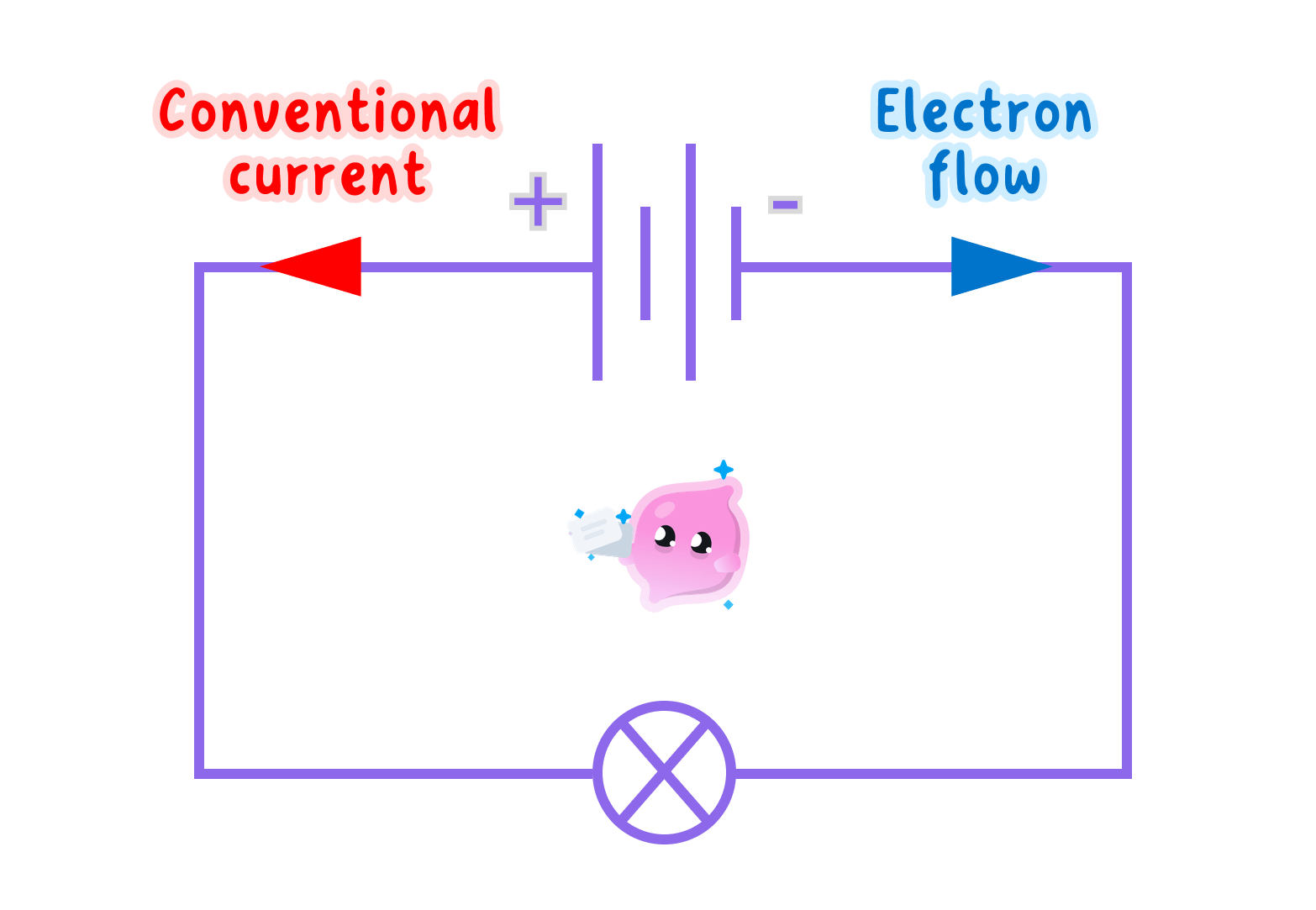
Reading the direction straight off a circuit diagram
- Find the cell symbol and identify its terminals: the long thin line is positive and the short thick line is negative.
- Conventional current leaves the long line, travels round the external circuit through the components, and returns to the short line.
- Electron flow is that same path traced backwards, setting out from the negative terminal.
- Mark an arrow on the diagram before you write anything, because the later marks in a question usually depend on getting the direction right first.
Common Mistake
- Conventional current is not an outdated mistake, and it is the direction used in every question unless electrons are named.
- The electrons themselves drift slowly, so do not write that they race round the circuit at the speed of light.
- Positive ions in a metal stay put, so a current in a wire is never a flow of positive charge.
- The wire is neutral overall while the current flows, since electrons enter one end as fast as they leave the other.
Exam technique
- Say from positive to negative for conventional current and from negative to positive for electron flow, naming which one you mean each time.
- Work the direction out from the long line on the cell, not from how the diagram happens to be drawn on the page.
- An explanation of metallic conduction needs three ideas: free electrons, a lattice of positive ions, and a drift in one direction once the supply is connected.
- If a diagram asks for both arrows, draw them on opposite sides of the wire and label each one, rather than relying on the marker to guess.
Self review
- Describe electrical conduction in a metal in terms of free electrons.
- What is left behind when the outer electrons break free from the atoms in a metal?
- In which direction does conventional current flow round a circuit?
- In which direction do the free electrons flow, and how does that compare with the conventional current?
- Why does a lamp light immediately even though the electrons drift very slowly?
