There are two kinds of electric charge, and every electrical effect starts there
Definition
Electric charge
A basic property of matter that comes in two kinds, positive and negative, and which makes objects attract or repel one another without touching.
- Every atom contains protons, which carry positive charge, and electrons, which carry negative charge, in equal numbers.
- The two charges are exactly equal in size, so one proton cancels one electron precisely and a complete atom is neutral.
- An object becomes charged when that balance is upset: an excess of electrons makes it negative, and a shortage of electrons makes it positive.
- Only electrons move in a solid, so a positively charged object is one that has lost electrons, never one that has gained protons.
- Charge is never made out of nothing: it is transferred, so whenever one object becomes negative another becomes equally positive.
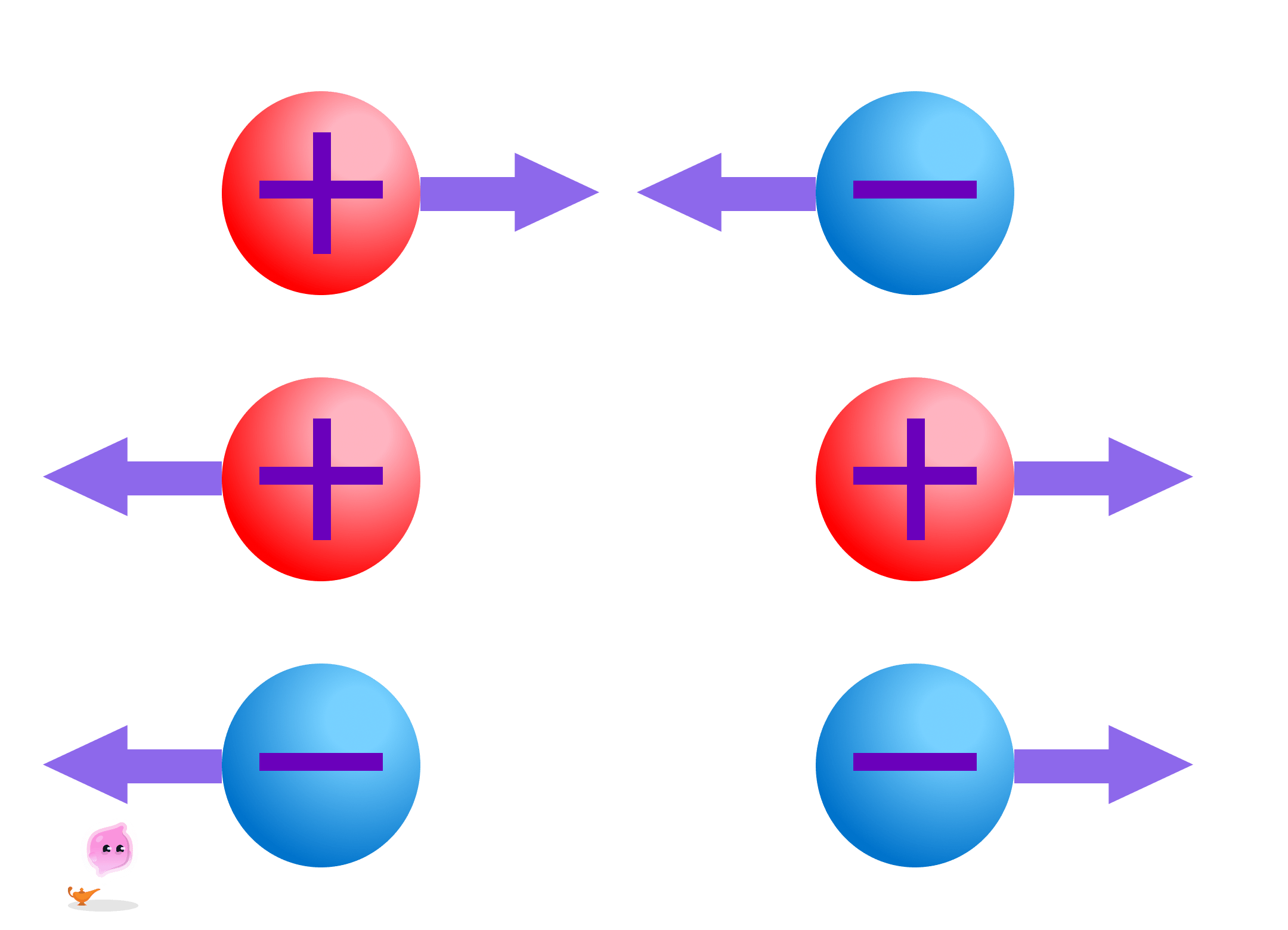
Like charges repel and unlike charges attract
- Two positive charges push each other apart.
- Two negative charges also push each other apart.
- A positive and a negative charge pull each other together.
- In one line: like charges repel, unlike charges attract.
- The force is a non-contact force, acting across a gap, and it grows as the charges get larger and as they get closer together.
- Rub a balloon on a jumper and it sticks to the wall, while two balloons rubbed the same way and hung on threads swing apart, because they now carry the same kind of charge.
Charge and magnetism follow the same rule but are not the same thing
- Magnetic poles obey a rule of the same shape, since like poles repel and unlike poles attract.
- The two effects are separate: a charged plastic rod does not attract a steel paper clip, and a bar magnet does not attract scraps of tissue paper.
- Charge can be stripped off an object and moved elsewhere, whereas a magnet's two poles can never be separated.
Common Mistake
- Do not label magnetic poles positive and negative, and do not label charges N and S; the two sets of words are not interchangeable.
- Never write that a positively charged rod has gained protons, because protons are locked in the nucleus and only electrons move.
- "Neutral" means equal amounts of positive and negative charge, not the complete absence of charge.
Exam technique
- When a diagram shows two suspended objects, state the charge on each one first, then say whether they attract or repel, and only then draw the arrows.
- Use the words attract and repel rather than "pull" and "push", because those are the words the marks are written against.
- Force arrows on two charges must be equal in length and opposite in direction, even when one object is much bigger than the other.
Self review
- Name the two kinds of electric charge.
- State what happens when two negatively charged objects are brought close together.
- Why is an ordinary atom neutral?
- In terms of electrons, what has happened to an object that carries a positive charge?
- Two balloons are rubbed on the same jumper and hung side by side. Predict what they do, and explain why.
