Rubbing two insulators together moves electrons from one to the other
Definition
Charging by friction
The production of electrostatic charge by rubbing two insulating materials together, which transfers electrons from one surface to the other and leaves them with equal and opposite charges.
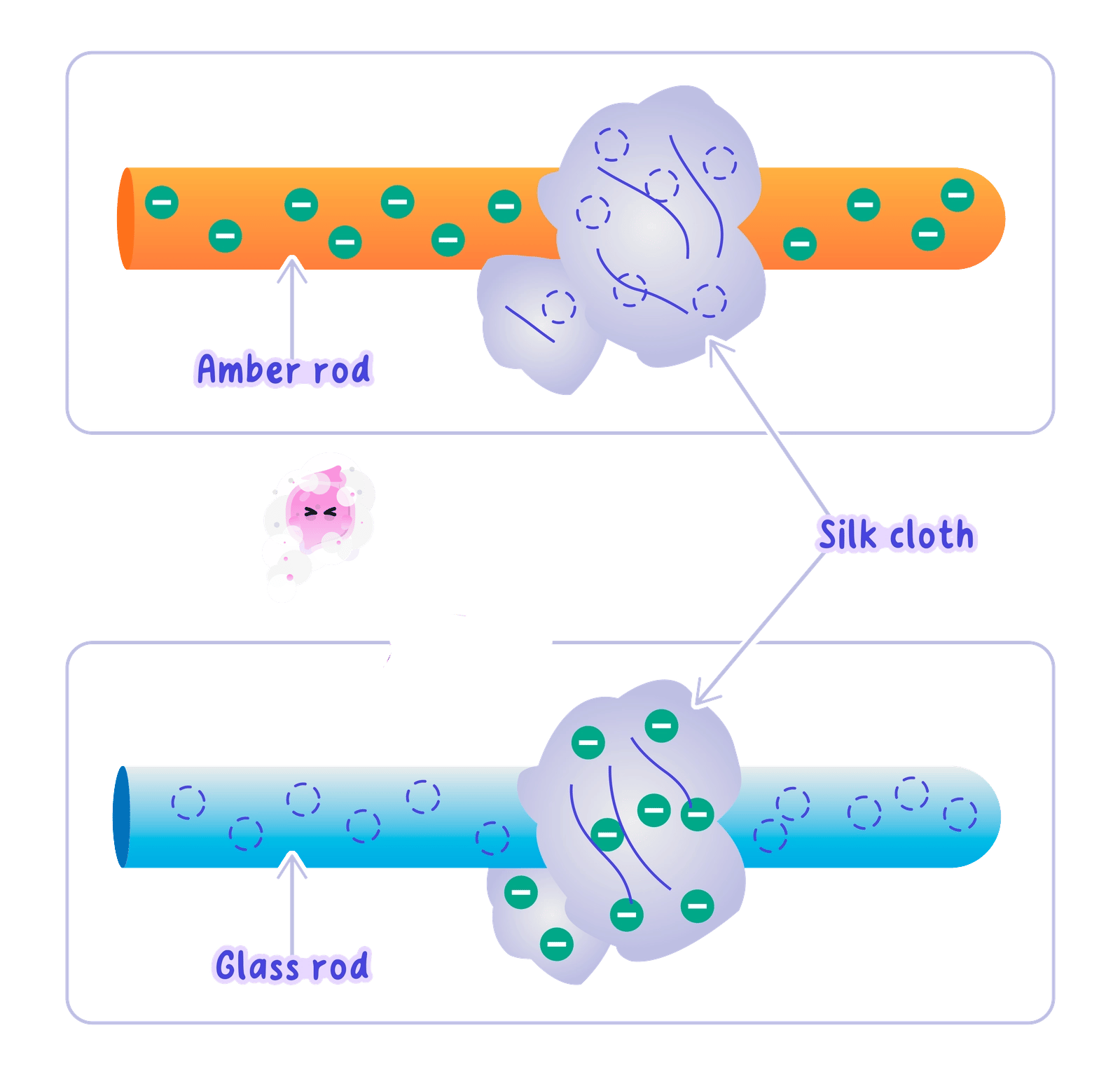
- Rub a polythene rod with a dry woollen cloth and the rod pulls electrons off the cloth, so it gains an excess of electrons and becomes negatively charged.
- The cloth has lost exactly those electrons, so it is left positively charged by the same amount.
- Rub an acetate or a glass rod with the same cloth and it works the other way round: the rod loses electrons to the cloth and ends up positively charged.
- Which way the electrons travel depends on the pair of materials, so the direction has to be learnt or read off the diagram rather than worked out.
- The trick only works with insulators, because charge produced on a metal rod held in your hand would run straight through you to earth.
- Damp air ruins the effect, since a thin film of moisture on the surface lets the charge leak away, which is why static works far better on a cold dry day than in a steamy lab.
Charge is detected by the force it exerts, or by a gold-leaf electroscope
- The quickest test is to hold the rod over small scraps of tissue paper: if they jump up onto it, the rod is charged.
- A better test hangs a charged rod in a wire stirrup on a thread so that it can swing freely, and then brings a second rod up to one end.
- Repulsion proves that the second rod carries the same kind of charge, while attraction on its own proves nothing, because a charged rod also attracts uncharged objects.
- A gold-leaf electroscope gives a clearer result: charge placed on the metal cap spreads down the metal stem to the stalk and the thin gold leaf attached to it.
- The stalk and the leaf now carry like charges, so they repel and the leaf lifts away from the stalk.
- The larger the charge, the further the leaf rises, so the electroscope shows roughly how much charge there is as well as detecting it.
- Touching the cap with a finger earths it and the leaf falls, because the excess charge escapes through you to the ground.
Practical
Investigation: producing and detecting electrostatic charges
- Aim: to produce electrostatic charges by friction, to show the forces between them, and to use a gold-leaf electroscope to detect charge and to sort conductors from insulators. This is normally set up as a teacher demonstration.
- Apparatus: a gold-leaf electroscope, polythene and acetate rods, a dry woollen cloth, a wire stirrup and thread on a stand, and test rods of copper, aluminium, wood, plastic and glass.
- Method:
- Rub a polythene rod briskly along its whole length with the dry cloth, hang it in the stirrup and let it stop swinging.
- Rub a second polythene rod the same way and bring it slowly up to one end of the hanging rod, watching whether that end swings away or towards.
- Repeat with a rubbed acetate rod brought up to the hanging polythene rod, and note that the result is the opposite.
- Charge the electroscope by rubbing a polythene rod and drawing it firmly across the metal cap so that charge is left behind on the cap.
- Watch the leaf rise, then touch the cap with a finger to earth it and watch the leaf collapse.
- Recharge the electroscope, then hold each test rod in turn so that one end touches the cap while your hand grips the far end, and note how quickly the leaf falls.
- Measure and record: the observations are qualitative, so record whether each pair of rods attracts or repels, and for each test material whether the leaf falls at once, falls slowly, or stays up.
- Result: like charges repel and unlike charges attract; rubbing transfers electrons, so the two rubbed surfaces end up oppositely charged; the leaf collapses at once through a metal such as copper, and stays up when a plastic or glass rod is used.
- Watch out:
- Damp air leaks charge away, so work on a dry day and keep the rods, the cloth and the cap dry.
- Discharge the electroscope between tests by touching the cap, or a leftover charge will confuse the next result.
- Grip each test rod by its own far end and not by the cap, so that you do not earth the electroscope through your hand and record every material as a conductor.
- Bring the second rod up slowly, because a fast approach makes the hanging rod swing on its thread and hides the real effect.
- Safety: minimal risk, although the gold leaf is extremely thin and tears if the cap is knocked or if a rod is pressed down onto it.
Only negative charge moves, so positive means electrons have left
- In a solid the positive charge sits in the nuclei of the atoms, held in a fixed lattice, and cannot move.
- Charging by friction therefore involves only a transfer of negative charge, and never any movement of protons.
- Describing a rod as having "gained a positive charge" is acceptable only if you can also say that it happened by losing electrons.
- The two objects always finish with equal and opposite charges, because every electron lost by one is the one gained by the other.
Common Mistake
- Do not write that protons move from the cloth to the rod, since protons stay in the nucleus and only electrons are transferred.
- Attraction alone does not show that something is charged, because a charged rod attracts uncharged scraps of paper just as readily.
- The leaf of an electroscope rises because the leaf and the stalk carry like charges and repel, not because the charge is somehow pushing it up from below.
- Rubbing does not create charge; it separates it, so the cloth is always left with the opposite charge to the rod.
Exam technique
- An electron-transfer explanation needs three steps in order: which way the electrons move, what that leaves on the rod, and what it leaves on the cloth.
- Describing the detection experiment earns marks for suspending the charged rod so it can turn freely and for using repulsion as the evidence.
- If a question mentions a humid room or a wet bench, the answer it wants is that the charge leaks away through the moisture.
- Say what the leaf does, not just that the electroscope "shows charge"; the marks are for the leaf rising or falling.
Self review
- A polythene rod is rubbed with a woollen cloth and becomes negative. What charge is left on the cloth, and why?
- Which particles are transferred when an insulator is charged by friction?
- Describe how you would show that two charged rods carry the same kind of charge.
- Explain why the leaf of a charged gold-leaf electroscope rises.
- Why is it hard to charge a rod by friction on a damp day?
