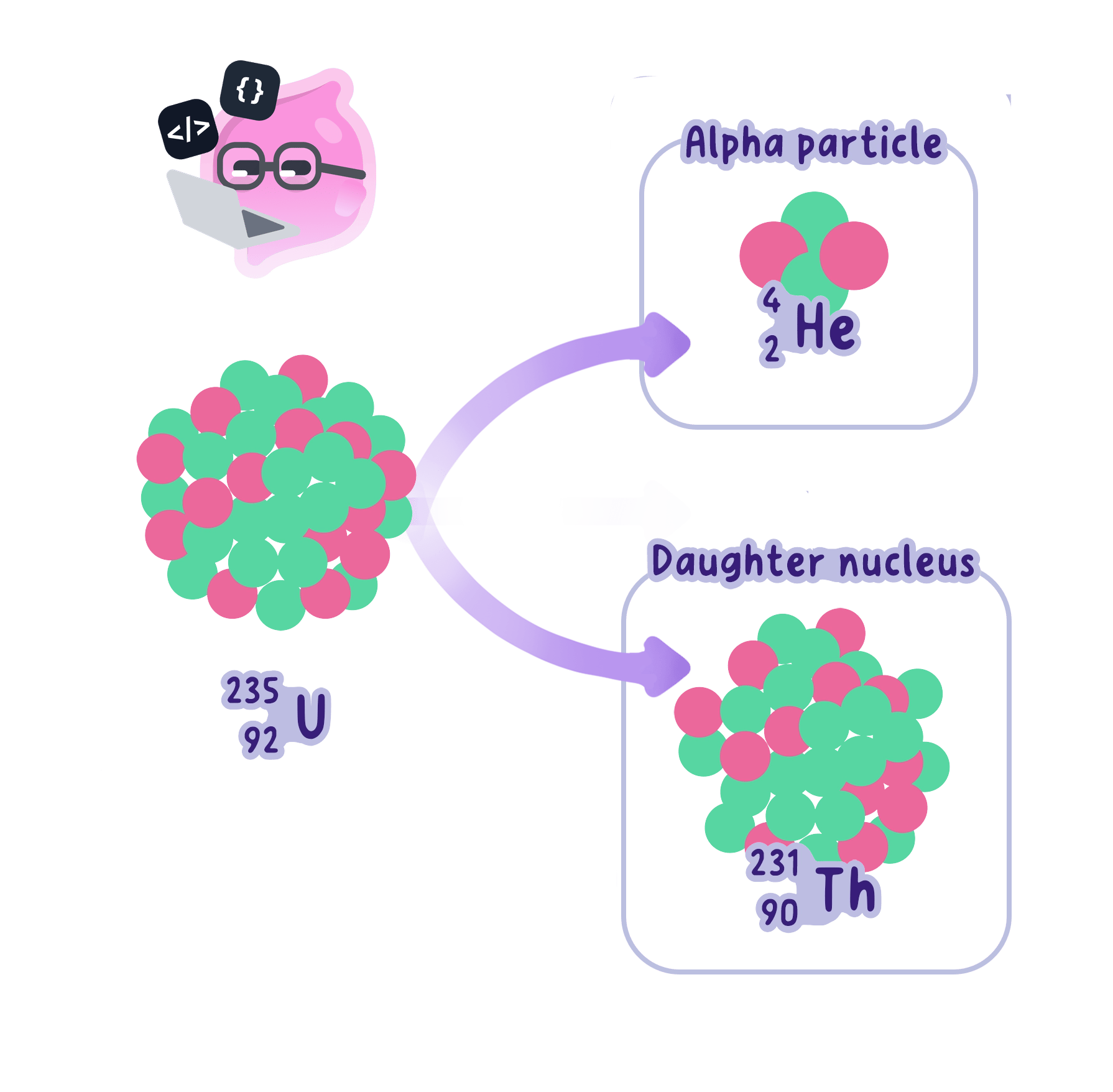
Alpha decay: the nucleus throws out two protons and two neutrons
Alpha decay
A decay in which the nucleus emits an alpha particle, losing two protons and two neutrons.
-
The alpha particle removed is 24α^{4}_{2}\alpha24α, so the parent nucleus loses four nucleons in total, two of which are protons.
-
The nucleon number therefore falls by 444 and the proton number falls by 222.
ZAX→Z−2A−4Y+24α ^{A}_{Z}\text{X} \rightarrow {}^{A-4}_{Z-2}\text{Y} + {}^{4}_{2}\alpha ZAX→Z−2A−4Y+24α -
Uranium-238 decaying to thorium-234 is the standard worked case.
92238U→90234Th+24α ^{238}_{92}\text{U} \rightarrow {}^{234}_{90}\text{Th} + {}^{4}_{2}\alpha 92238U→90234Th+24α -
Alpha decay is the route taken by nuclei that are too heavy, because shedding four nucleons at a stroke is the quickest way to get smaller.
-
The daughter nucleus is more stable than the parent, although with the very heaviest elements it often still needs to decay again.
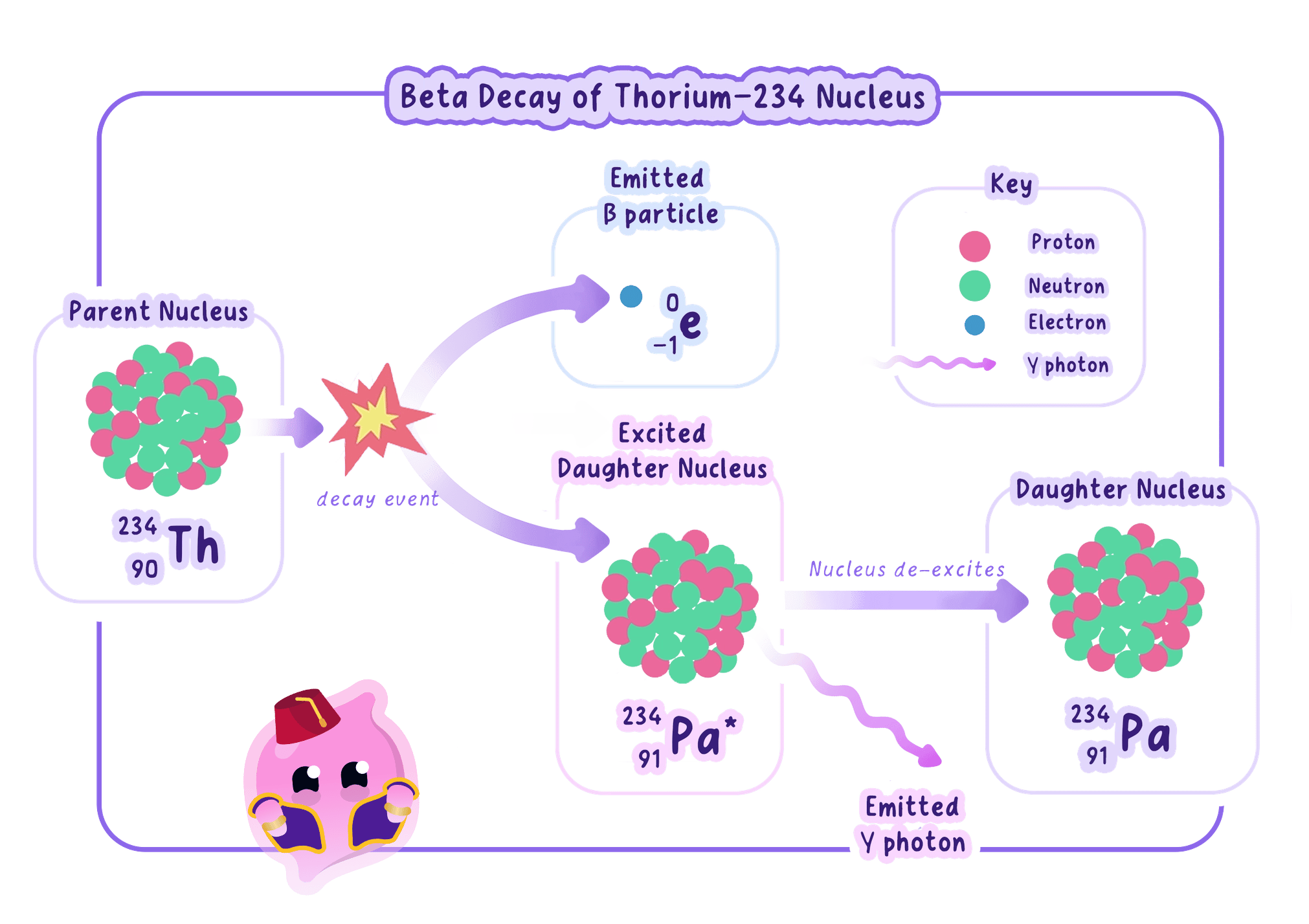
Beta decay: a neutron turns into a proton and an electron
Beta decay
A decay in which a neutron inside the nucleus changes into a proton and an electron, and the electron is emitted as a beta particle.
neutron→proton+electron \text{neutron} \rightarrow \text{proton} + \text{electron} neutron→proton+electron-
This one change explains everything else about beta decay, so learn it before you learn the numbers.
-
The proton stays in the nucleus while the electron is fired out at high speed, which is why the beta particle comes from the nucleus rather than from an orbit.
-
One neutron has been swapped for one proton, so the nucleon number is unchanged while the proton number increases by 111.
ZAX→Z+1 AY+−1 0β ^{A}_{Z}\text{X} \rightarrow {}^{\ \ \ A}_{Z+1}\text{Y} + {}^{\ \ 0}_{-1}\beta ZAX→Z+1 AY+−1 0β -
Thorium-234 decaying to protactinium-234 shows the pattern with real numbers.
90234Th→ 91234Pa+−1 0β ^{234}_{\ 90}\text{Th} \rightarrow {}^{234}_{\ 91}\text{Pa} + {}^{\ \ 0}_{-1}\beta 90234Th→ 91234Pa+−1 0β -
Beta decay is the route taken by nuclei with too many neutrons, since converting a surplus neutron into a proton reduces the excess and improves the balance.
-
The bottom number on the beta particle is −1-1−1, which is what makes the proton numbers balance when the daughter's has gone up.
Gamma emission: energy leaves and the nucleus stays the same
-
After an alpha or beta decay, the daughter nucleus is often left holding surplus energy, a state described as excited.
-
It sheds that energy as a burst of gamma radiation, which carries no charge and no nucleons away with it.
-
Both the nucleon number and the proton number are therefore unchanged, so the nucleus stays the same isotope of the same element.
ZAX→ZAX+00γ ^{A}_{Z}\text{X} \rightarrow {}^{A}_{Z}\text{X} + {}^{0}_{0}\gamma ZAX→ZAX+00γ -
What does change is the nucleus's energy, so gamma emission still counts as an increase in stability.
Balancing any decay equation comes down to two sums
- The top numbers must add up to the same total on both sides of the arrow, because nucleons are neither created nor destroyed.
- The bottom numbers must also add up to the same total, because charge is conserved.
- Work the two sums separately, then use the bottom number you found to identify which element the daughter is.
- A quick check on any completed equation: if the top number dropped by 444 it was alpha, if the bottom number rose by 111 with the top unchanged it was beta, and if neither moved it was gamma.
- Do not reduce the nucleon number in beta decay; a neutron is replaced by a proton, so the total stays the same.
- Do not decrease the proton number in beta decay; it goes up by one, even though a negative particle left.
- Do not change either number for gamma emission; only energy is carried away.
- Do not forget the −1-1−1 on the beta particle when balancing, because leaving it out makes the bottom row fail.
- Do not keep the parent's chemical symbol after an alpha or beta decay; the daughter is a different element.
- Write both sums out explicitly before filling anything in, since the mark for a missing number is awarded for the correct value and there is no credit for a guess that happens to look plausible.
- "Neutron changes into a proton and an electron" is the phrase that earns the beta-decay explanation mark, so use those words rather than "the nucleus loses a neutron".
- If the question asks how the decay affects stability, answer with the actual mechanism: fewer nucleons after alpha, fewer excess neutrons after beta, less energy after gamma.
- Where a periodic table is provided, use the proton number you calculated to look up the daughter's symbol rather than trying to recall it.
- How do the nucleon number and proton number change in alpha decay?
- Write down the change that takes place inside the nucleus during beta emission.
- Why does the proton number rise in beta decay even though a negative particle is emitted?
- Complete the equation 82214Pb→ZABi+−1 0β^{214}_{\ 82}\text{Pb} \rightarrow {}^{A}_{Z}\text{Bi} + {}^{\ \ 0}_{-1}\beta 82214Pb→ZABi+−1 0β.
- What effect does gamma emission have on the nucleon number and the proton number?
