Radioactive decay is an unstable nucleus rebuilding itself
Definition
Radioactive decay
A change in an unstable nucleus that can result in the emission of an alpha particle or a beta particle, and / or gamma radiation.
- Decay happens in the nucleus, not in the electron shells, which is why it is a completely different kind of change from a chemical reaction.
- It is spontaneous: no outside condition triggers it, and nothing you do to the sample can speed it up or slow it down.
- It is also random: every unstable nucleus in a sample has the same chance of decaying in the next second, and there is no way to tell which one will go.
- Randomness for one nucleus still gives predictability for a sample, because a speck of material contains an enormous number of nuclei and the average behaviour of that many is reliable.
- This is the same logic as rolling dice: you cannot predict a single roll, but you can predict fairly closely how many sixes appear in ten thousand rolls.
Why a nucleus becomes unstable in the first place
Definition
Radioactive isotope
An isotope whose nucleus is unstable, so that it decays and emits nuclear radiation.
- Stability depends on the combination of protons and neutrons, so two isotopes of the same element can behave completely differently.
- There are two reasons an isotope turns out to be radioactive.
- The nucleus has an excess of neutrons compared with the number of protons, so the mixture is out of balance.
- The nucleus is simply too heavy, holding so many nucleons that it cannot stay together whatever the mixture; every nucleus heavier than lead is unstable.
- Decaying is how the nucleus fixes the problem, because each emission leaves behind a nucleus that is more stable than the one before it.
- One decay is often not enough, so a very heavy nucleus such as uranium goes through a whole series of decays before it finally arrives at a stable nucleus of lead.
Alpha and beta decay change the atom into a different element
- The identity of an element is set by its number of protons, so anything that alters the proton number turns the atom into a different element altogether.
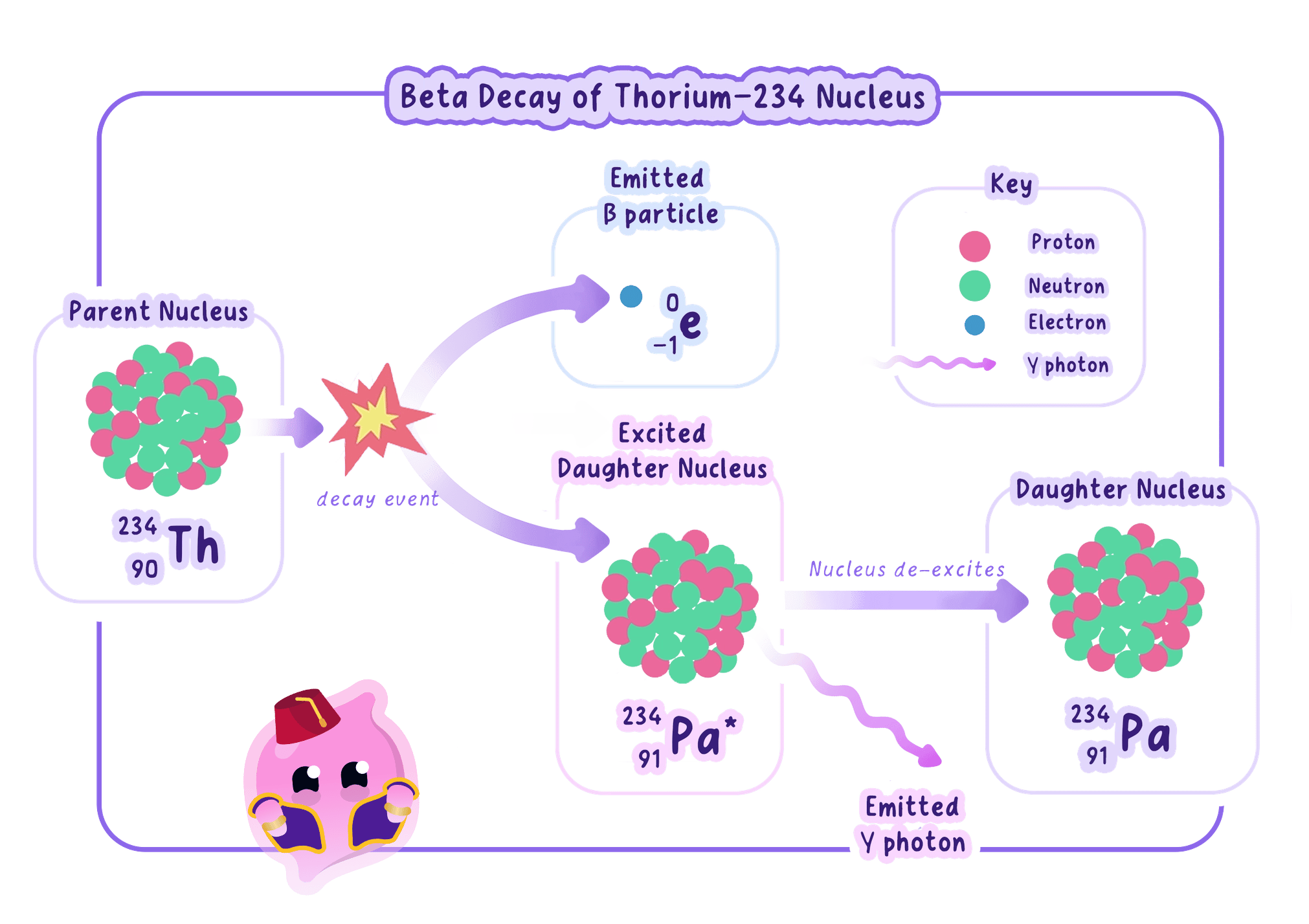
- Both alpha decay and beta decay do exactly that, so in each case the nucleus left behind belongs to a new element.
- The starting nucleus is called the parent and the one produced is the daughter.
- Gamma emission is the exception: it carries away only energy, leaving the proton number untouched, so the element does not change.
- Gamma rarely happens on its own, because it usually follows an alpha or beta decay that has left the new nucleus holding surplus energy.
Common Mistake
- Do not say a nucleus decays "when it gets old" or "once it has enough energy"; every unstable nucleus has the same chance of decaying at any moment.
- Do not treat decay as a chemical process; bonding, dissolving and burning all leave the nucleus untouched.
- Do not say gamma emission changes the element; only alpha and beta do that.
- Do not describe the emitted particle as something the nucleus was "storing"; it is produced at the moment of decay.
- Do not confuse random with unpredictable in bulk; a large sample behaves in a very regular way.
Exam technique
- "Spontaneous" and "random" mean different things and are usually worth a mark each, so define both: nothing causes it, and you cannot predict which nucleus or when.
- If a question describes heating, freezing or reacting a source, the expected answer is no change, with the reason attached.
- When asked why an isotope is radioactive, name the actual cause: too many neutrons or too heavy a nucleus, rather than the circular "because it is unstable".
- Fluctuating count-rate data in a question is a prompt about randomness, so say so rather than blaming the equipment.
Self review
- What is radioactive decay?
- Explain what is meant by saying decay is spontaneous and random.
- Give two reasons why the nucleus of an isotope may be unstable.
- Which two types of decay change the nucleus into that of a different element?
- Why does gamma emission leave the element unchanged?
