Half-life turns random decay into something you can predict
Definition
Half-life
The time taken for half the nuclei of that isotope in any sample to decay.
- No individual nucleus can be predicted, but with billions of them the fraction that decays in a given time is remarkably steady.
- The words any sample matter: the half-life is the same whether you start with a gram or a tonne, because it is a fraction rather than an amount.
- Half-life is fixed for a given isotope and cannot be altered by heating, cooling or chemically reacting the sample.
- Values range enormously, from fractions of a second for some isotopes to billions of years for uranium-238.
- Because the count rate is proportional to how many undecayed nuclei remain, the count rate halves over the same interval, which is what makes half-life measurable in a lab.
Counting in half-lives: halve, halve, halve again
-
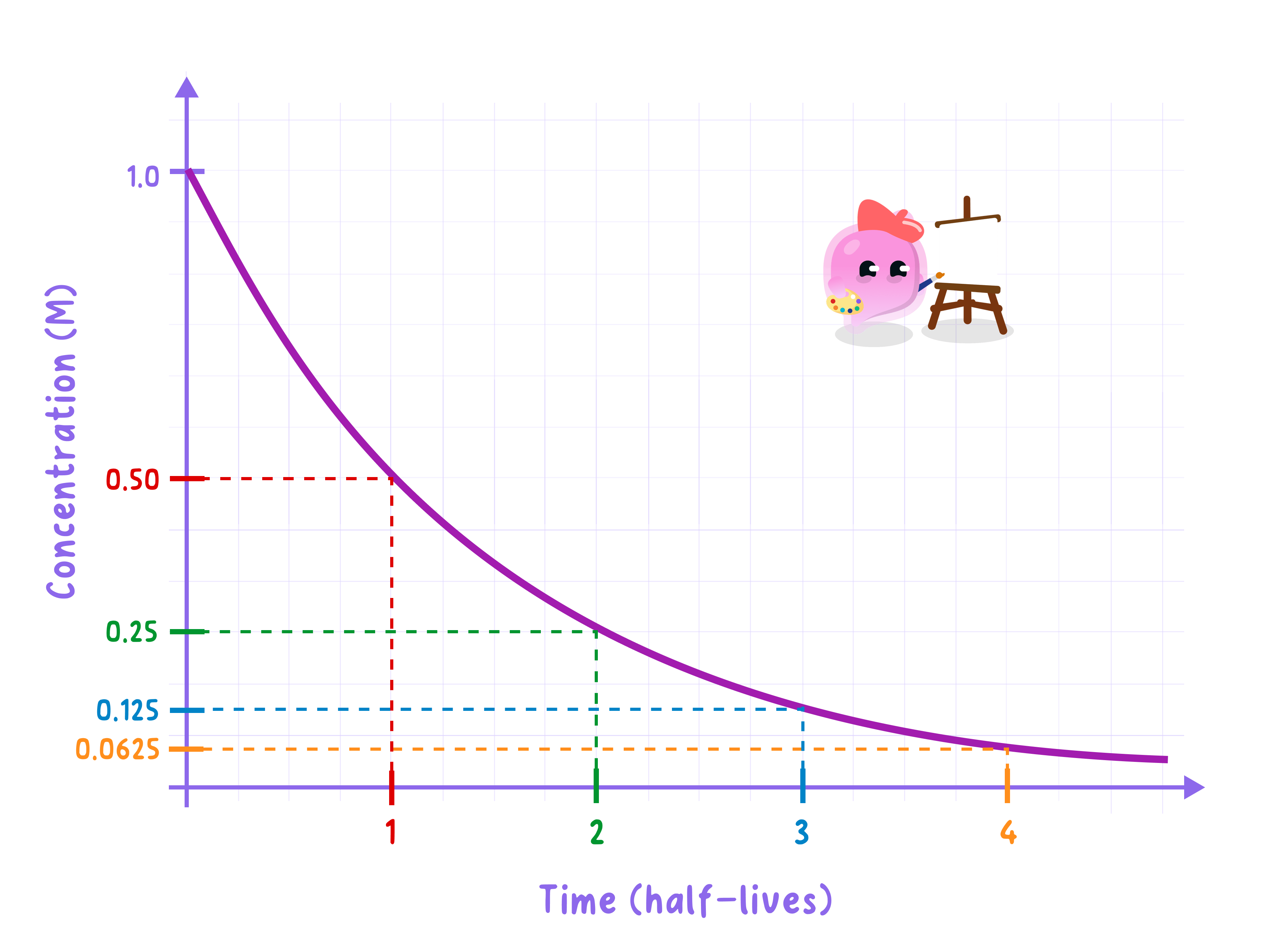
After one half-life, half the original nuclei are left; after two, a quarter; after three, an eighth.
-
The pattern generalises to any number of half-lives nnn.
fraction remaining=(12)nwhere n=time elapsedhalf-life \text{fraction remaining} = \left(\frac{1}{2}\right)^{n} \qquad \text{where } n = \frac{\text{time elapsed}}{\text{half-life}} fraction remaining=(21)nwhere n=half-lifetime elapsed -
Each halving takes the same length of time, so the sample never quite runs out: half of whatever is left always survives the next interval.
-
The nuclei that have decayed have not vanished, of course; they have become nuclei of the daughter, so the number of daughter nuclei rises as the number of parent nuclei falls.
Reading a half-life off a decay curve
- A decay curve plots count rate on the vertical axis against time on the horizontal axis, and it always falls steeply at first and then flattens.
- To read the half-life off the graph, work through three steps.
- Take the count rate at the start and halve it.
- Draw a line across from that halved value to the curve, then straight down to the time axis.
- The time you read off is the half-life, because that is how long the count rate took to fall by half.
- Repeat the construction starting from a different point on the curve and average your answers, since the halving interval should come out the same wherever you begin.
Subtract the background before you halve anything
- Real readings from a detector always include background radiation as well as the source.
- The giveaway on a graph is the tail: an uncorrected curve levels off at the background count rate rather than heading towards zero.
- Halving an uncorrected reading gives a half-life that is too long, because part of what you halved was never going to decay away.
- So subtract the background count rate from every reading first, and only then halve and read across.
- If the background figure is not given directly, look for a reading taken with no source present, or read the value the tail of the curve settles at.
Common Mistake
- Do not read half-life as the time for the whole sample to decay, or as half of that time; it is the time for half the nuclei to go.
- Do not expect two half-lives to leave nothing; they leave a quarter.
- Do not halve a raw reading when a background figure has been given; correct first, every time.
- Do not think a bigger sample takes longer to halve; the half-life does not depend on how much you started with.
- Do not omit the time unit from your answer, since a half-life without seconds, minutes or years is incomplete.
Exam technique
- Scan the question for a background value before you touch the numbers, because that single check is the difference between full marks and a wrong half-life.
- On a graph question, draw your construction lines on the grid; they are usually credited even if the final value is slightly out.
- For a "how much is left" calculation, count the half-lives first and write nnn down, rather than halving repeatedly in your head and losing track.
- If the question asks for the detector reading rather than the source's activity, remember to add the background back on at the end.
Self review
- Define the half-life of an isotope.
- What fraction of the original nuclei is left after three half-lives?
- Describe how to find a half-life from a decay curve.
- Why must background radiation be subtracted before a half-life is worked out?
- A source has a corrected count rate of 800800800 counts / minute and a half-life of 555 hours. What is the corrected count rate 151515 hours later?
