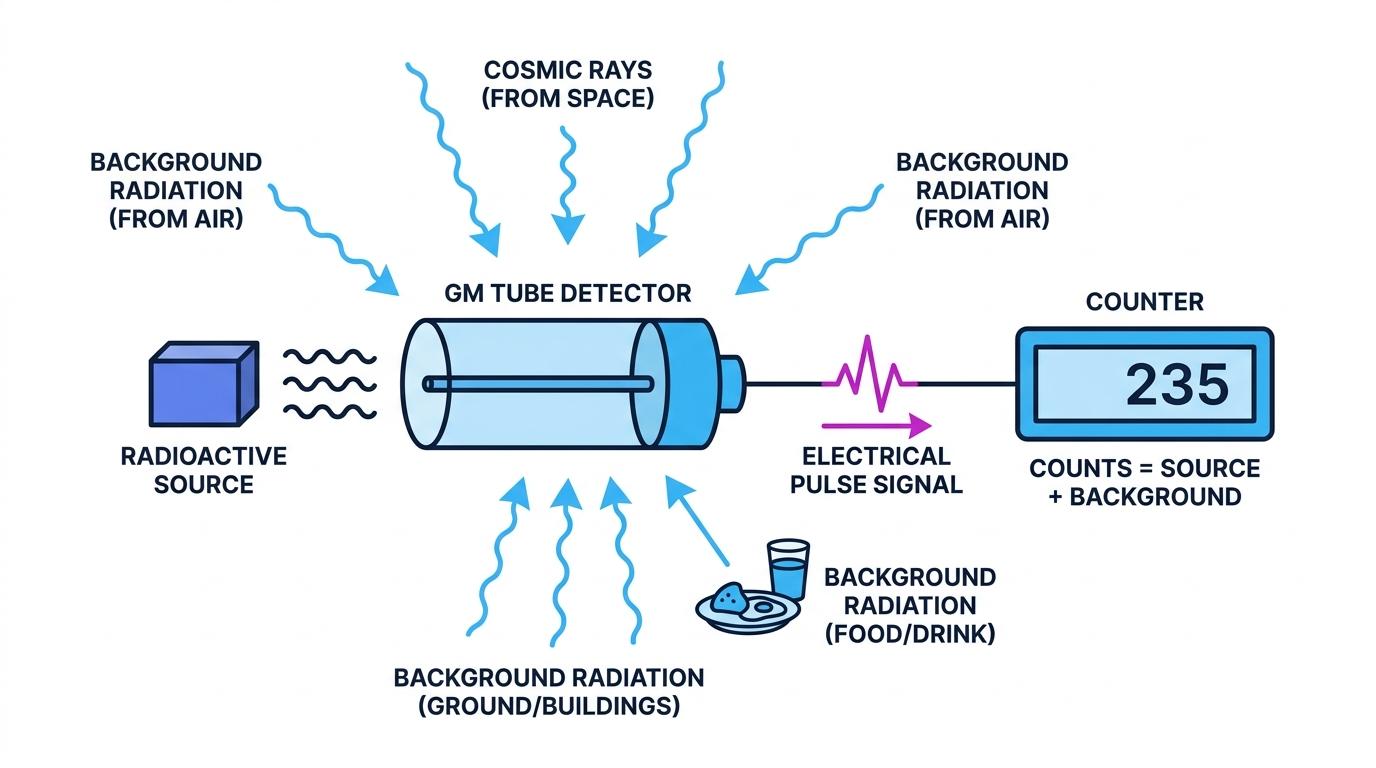
Background radiation is there before you switch any source on
Definition
Background radiation
The ionising radiation that is present around us all the time, coming from the environment rather than from the source being investigated.
- Set a detector down in an empty room with no radioactive source anywhere near it and it will still register counts, steadily, all day.
- Those counts are background radiation, and it is present everywhere on Earth, although the level varies from place to place.
- It is mostly natural and at a low level, so it is not something you can switch off or avoid.
- Every reading taken from a source therefore includes background as well, which is why it has to be measured and allowed for.
Four sources make up most of the background
- Radon gas in the air is usually the largest single contributor.
- Radon is a radioactive gas produced by uranium in the ground, and because it is a gas it seeps up out of the rock and collects indoors.
- Levels are highest in areas built on granite, such as parts of Cornwall and Aberdeenshire, where homes are sometimes fitted with under-floor fans to vent it.
- Rocks and buildings contribute because the ground contains naturally radioactive isotopes, and stone and concrete carry those isotopes into the walls around you.
- Food and drink contribute because plants take up radioactive isotopes from the soil, so every meal contains traces of them.
- Potassium-40 is the usual example, and it is why a banana is very slightly radioactive.
- Cosmic rays are high-energy particles arriving from the Sun and from beyond the Solar System.
- The atmosphere absorbs a large share of them, so the count rate is noticeably higher up a mountain or in an aircraft at cruising altitude.
- A smaller part of the background is artificial, coming mainly from medical uses such as X-rays and scans.
Detecting radiation: a detector, a counter and a count rate
Definition
Count rate
The number of counts recorded per unit time, measured in counts / s or counts / minute.
count rate=number of countstime taken \text{count rate} = \frac{\text{number of counts}}{\text{time taken}} count rate=time takennumber of counts- Ionising nuclear radiation cannot be seen or felt, so it is measured with a detector connected to a counter.
- The usual detector is a Geiger–Müller tube, in which each particle or ray entering the tube ionises the gas inside and produces a brief pulse of current.
- The counter registers each pulse as one count, so the total tells you how much radiation arrived while it was switched on.
- A raw total is not much use on its own, because 300300300 counts means something different over a minute than over an hour, so the count is divided by the time to give a count rate.
- Decay is random, so two identical one-minute measurements of the same source rarely give the same number.
- Counting over a longer time and repeating the measurement then averaging both reduce the effect of that randomness.
Subtracting the background gives the count rate from the source alone
Definition
Corrected count rate
The count rate due to the source alone, found by subtracting the background count rate from the measured count rate.
corrected count rate=measured count rate−background count rate \text{corrected count rate} = \text{measured count rate} - \text{background count rate} corrected count rate=measured count rate−background count rate- The detector cannot tell where a count came from, so a reading taken next to a source is the source plus the background.
- The procedure has three steps.
- With every source removed to a safe distance, record the counts over a long interval and work out the background count rate.
- Bring the source into position and record the measured count rate in the same units.
- Subtract one from the other to get the corrected count rate.
- Both rates must be in the same units before you subtract, so convert one of them if the counts were taken over different lengths of time.
- This correction matters most for a weak or nearly decayed source, where the background is a large fraction of what the detector picks up.
Common Mistake
- Do not subtract raw counts from each other unless both were collected over the same time; convert to count rates first.
- Do not describe background radiation as man-made pollution; most of it comes from natural sources.
- Do not treat a varying count as a broken detector; radioactive decay is random, so the numbers fluctuate.
- Do not answer "the air" or "the ground" when asked for sources; name radon gas, rocks and buildings, food and drink, and cosmic rays.
Exam technique
- A "state two sources" question is marked by the list rule, so give exactly the number asked for; a wrong extra can cancel a right one.
- Always write the unit with a count rate, as counts / s or counts / minute, because a bare number often loses the mark.
- If a table of readings appears in a question, check the first row for a background measurement taken with no source, because that is your signal to correct every other value.
- When asked how to make a measurement more reliable, name counting for longer and repeating and averaging, and link them to the randomness of decay.
Self review
- What is meant by background radiation?
- Name four sources that make a significant contribution to background radiation.
- How is ionising nuclear radiation detected and counted?
- A detector records 180180180 counts in 333 minutes. What is the count rate?
- How do you find the corrected count rate from a source, and why is the correction needed?