Emission from a nucleus is spontaneous and random in direction
Definition
Ionising radiation
Radiation carrying enough energy to knock electrons out of the atoms it passes through, leaving those atoms as charged ions.
- An unstable nucleus emits radiation spontaneously, meaning nothing outside the nucleus sets it off.
- Heating the sample, cooling it, crushing it or reacting it chemically makes no difference at all, because those things affect the electrons and never reach the nucleus.
- The emission is also random: you cannot say which nucleus in a sample will decay next, or when any particular one will go.
- The direction is random too, so radiation leaves a source in all directions rather than in a beam, which is why a detector reads less as you move it further away.
- All three types are described as ionising, and how strongly each one ionises is what drives almost everything else about its behaviour.
Three types of emission, and what each one actually is
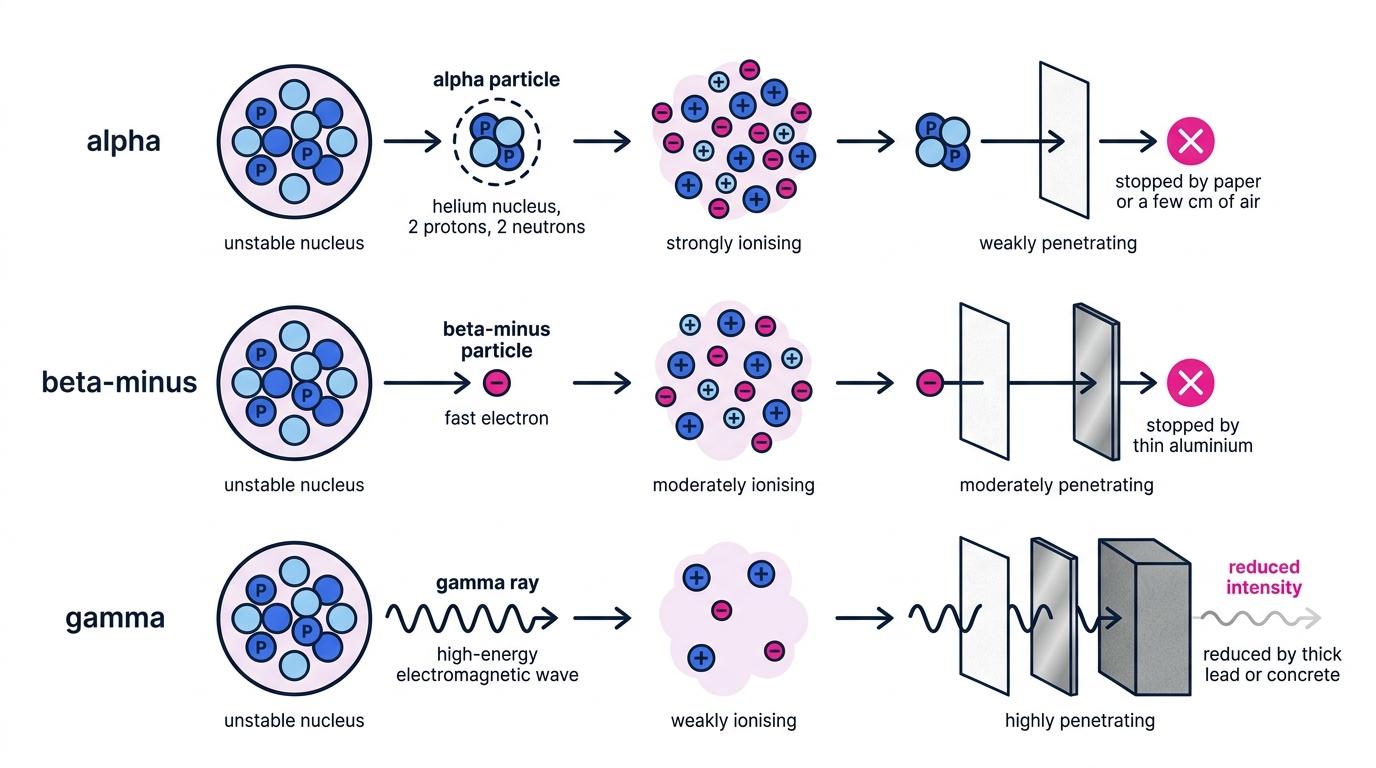
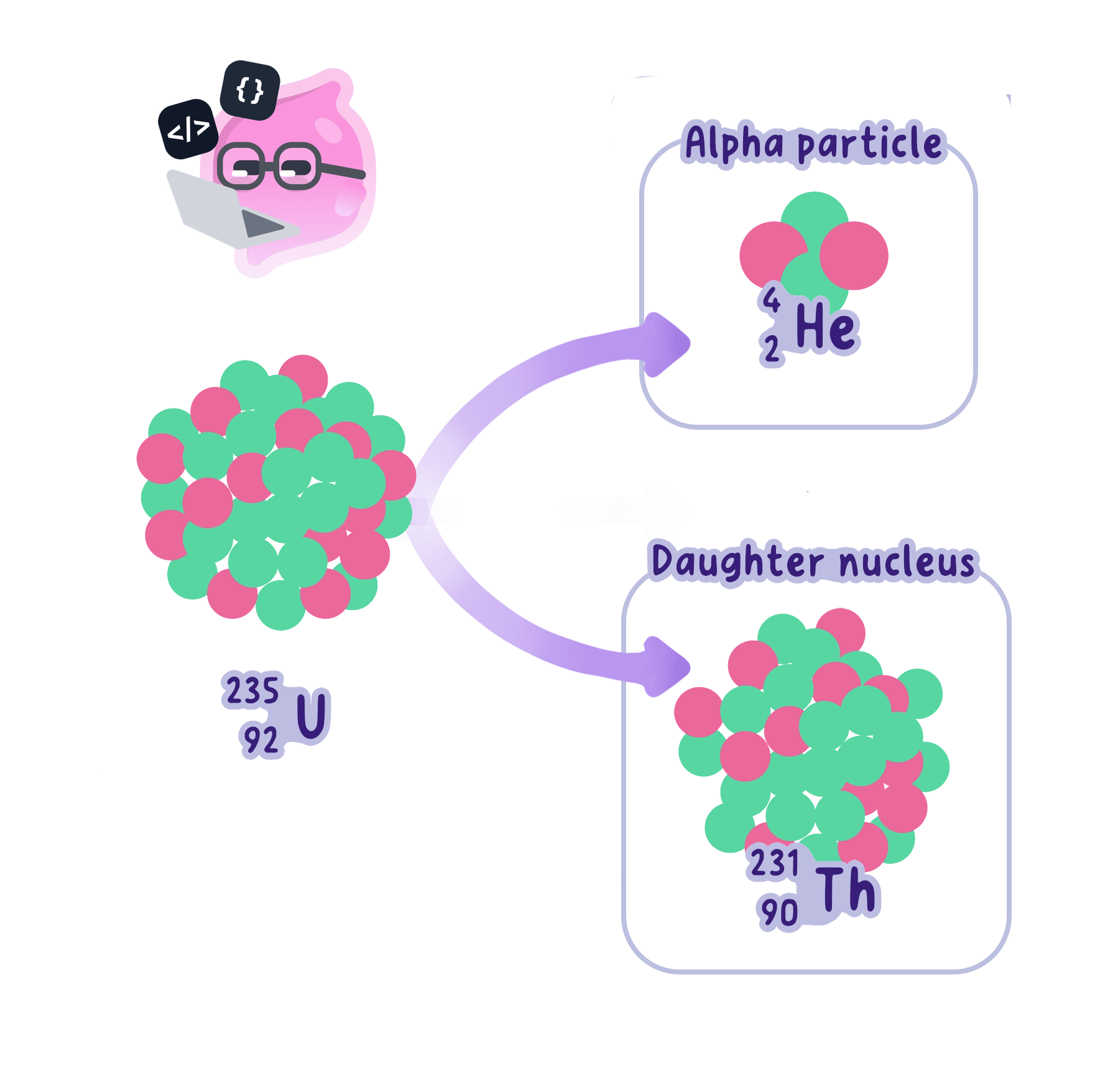
- An alpha particle (α\alphaα) is a helium nucleus, thrown out of the nucleus as a single lump.
- It is made of two protons and two neutrons, so it has a relative charge of +2+2+2 and a relative mass of 444, written 24α^{4}_{2}\alpha24α.
- It is by far the heaviest of the three and the slowest, travelling at roughly a twentieth of the speed of light.
- A beta particle (β\betaβ) is a fast-moving electron created and emitted by the nucleus.
- It has a relative charge of −1-1−1 and almost no mass, written −10β^{0}_{-1}\beta−10β.
- It comes out very fast, at up to about 99%99\%99% of the speed of light, far quicker than an alpha particle.
- It is not one of the orbiting electrons; it is produced inside the nucleus at the moment of decay.
- Gamma radiation (γ\gammaγ) is not a particle at all but an electromagnetic wave of very high frequency and very short wavelength.
- It has no charge and no mass, and it travels at the speed of light like every other electromagnetic wave.
- It is often emitted straight after an alpha or beta emission, carrying away energy the nucleus still has left over.
Penetrating power: paper, aluminium and lead
- Each type gets a characteristic distance through matter before it is absorbed, and those distances are the standard way of telling them apart.
- Alpha is the least penetrating: a few centimetres of air stops it, and so does a single sheet of paper or thin card.
- Beta is more penetrating: it goes straight through paper and travels perhaps a metre through air, but a few millimetres of aluminium absorbs it.
- Gamma is the most penetrating: it passes through paper and aluminium easily, and needs several centimetres of lead or a few metres of concrete to cut it down.
- Gamma is never completely stopped by a shield, only reduced, so thicker lead means a lower count rate rather than a zero one.
Ionising effect runs in exactly the opposite order
- Alpha is the most strongly ionising, stripping electrons from very large numbers of atoms along a short track.
- Beta is moderately ionising, producing far fewer ions per centimetre than alpha does.
- Gamma is the most weakly ionising of the three, and often travels a long way through a material without interacting at all.
- The two lists are mirror images: the most ionising type is the least penetrating, and the least ionising type is the most penetrating.
- The link is energy loss: every ion an emission creates costs it some of its energy, so a strongly ionising emission runs out of energy after a very short distance.
Common Mistake
- Do not describe a beta particle as an orbiting electron that escaped; it is created in the nucleus during the decay.
- Do not call gamma "a gamma particle"; it is an electromagnetic wave with no charge and no mass.
- Do not write that lead "stops" gamma radiation; lead reduces it.
- Do not assume the most penetrating type is the most dangerous in every situation; alpha is the least penetrating but the most ionising.
- Do not say that heating a source speeds up its decay; emission is spontaneous and cannot be influenced from outside.
Exam technique
- Absorber questions are worked one row at a time: decide what each absorber removes before deciding what the source emits.
- The mark most often lost is treating a source as emitting only one type; a source can emit two or three types at once.
- For "state the nature of" questions, give the identity and the charge: "a helium nucleus, charge +2+2+2" rather than just "a big particle".
- Learn the three absorbers as a set, paper, aluminium, lead, since almost every identification question is built on them.
Self review
- What does it mean to say that radioactive emission is spontaneous and random in direction?
- State the nature and charge of an alpha particle, a beta particle and gamma radiation.
- Name the material that absorbs each of the three emissions.
- Put the three emissions in order of ionising effect, from strongest to weakest.
- A count rate is unchanged by paper but falls sharply behind aluminium. Which emission is present?