Fission: a heavy nucleus splits into two smaller ones
Nuclear fission
The splitting of a large unstable nucleus into two smaller nuclei, releasing energy and usually two or three neutrons.
-
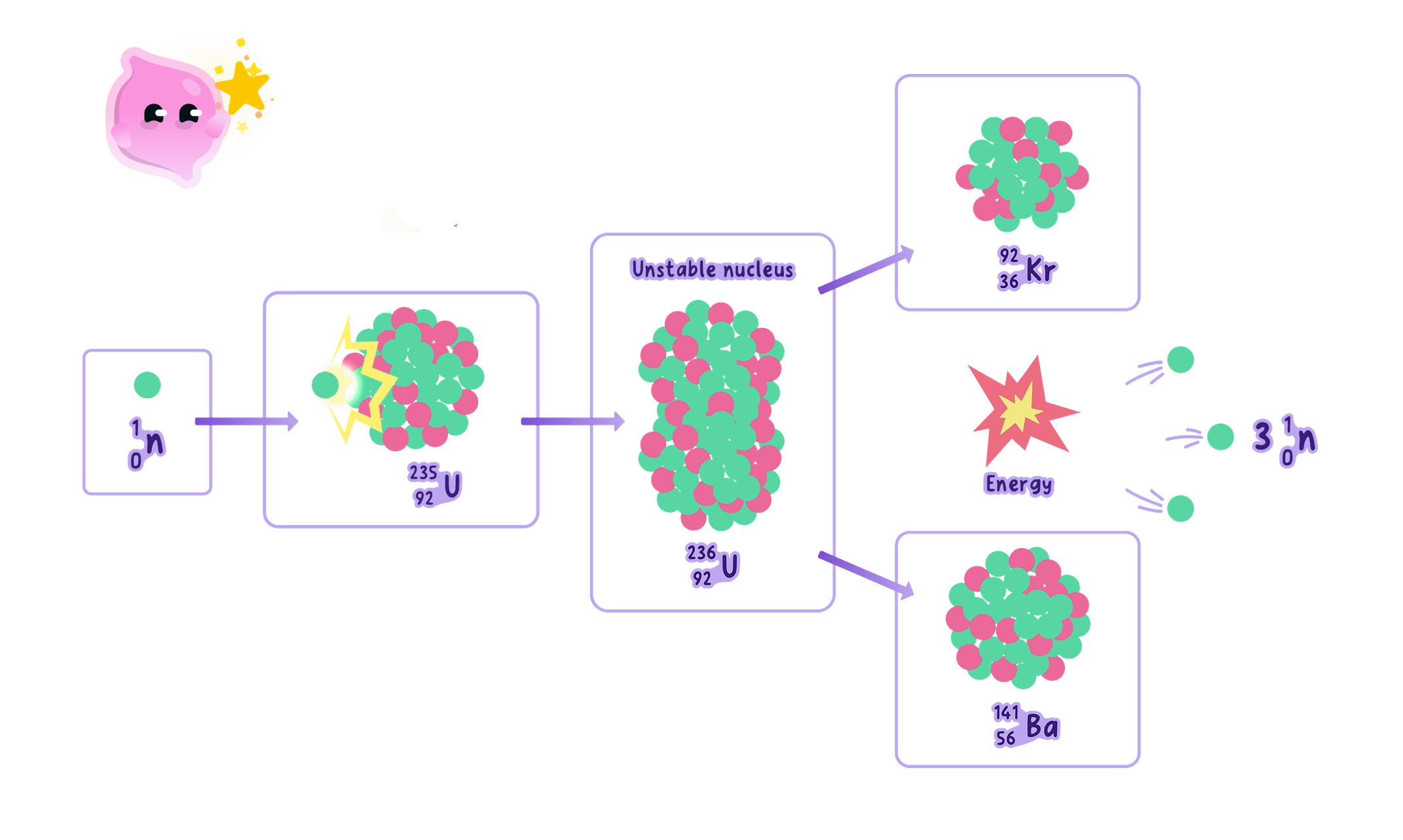
Very heavy nuclei are only just holding themselves together, so a small disturbance is enough to break one apart.
-
The disturbance is usually a slow-moving neutron, which works well because it has no charge and so is not repelled as it approaches the positive nucleus.
-
The nucleus absorbs the neutron, becomes even more unstable, and splits into two daughter nuclei of roughly comparable size, plus a few spare neutrons.
-
A typical fission of uranium-235 is written as a nuclide equation.
92235U+01n→56141Ba+3692Kr+3 01n ^{235}_{92}\text{U} + {}^{1}_{0}\text{n} \rightarrow {}^{141}_{56}\text{Ba} + {}^{92}_{36}\text{Kr} + 3\,{}^{1}_{0}\text{n} 92235U+01n→56141Ba+3692Kr+301n -
Both totals balance across the arrow: the nucleon numbers give 235+1=141+92+3235 + 1 = 141 + 92 + 3235+1=141+92+3, and the proton numbers give 92+0=56+3692 + 0 = 56 + 3692+0=56+36.
-
Those spare neutrons can go on to split further uranium nuclei, so one fission triggers others in a chain reaction.
-
Fission is not a decay you have to wait for: it is induced by firing a neutron in, which is what makes it controllable in a reactor.
Fusion: two light nuclei join to make a heavier one
Nuclear fusion
The joining together of two light nuclei to form a single heavier nucleus, releasing energy.
-
Fusion runs the process in the opposite direction: instead of a heavy nucleus breaking up, two light nuclei merge.
-
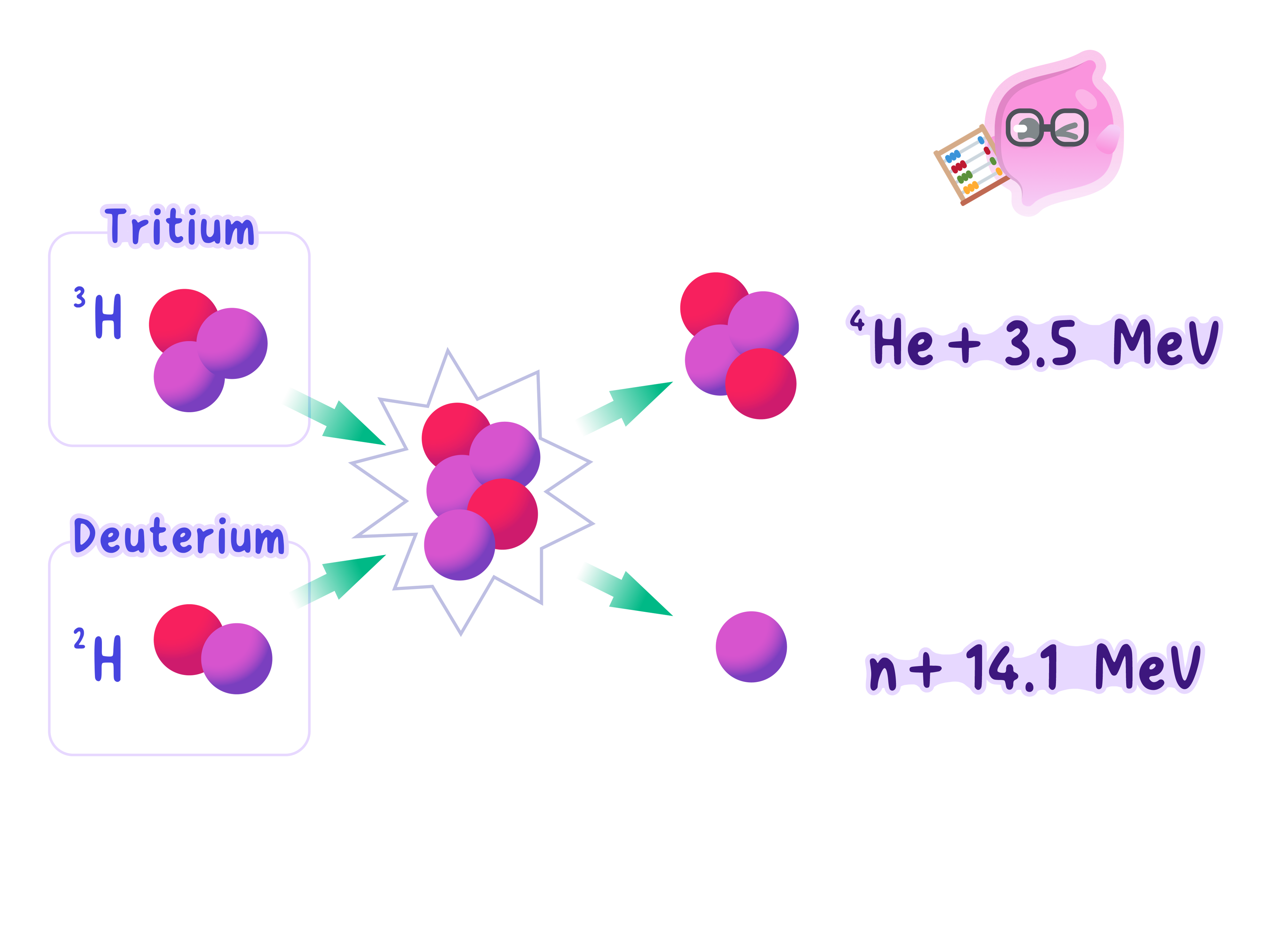
The standard example joins two isotopes of hydrogen, deuterium and tritium.
12H+13H→24He+01n {}^{2}_{1}\text{H} + {}^{3}_{1}\text{H} \rightarrow {}^{4}_{2}\text{He} + {}^{1}_{0}\text{n} 12H+13H→24He+01n -
Again the numbers balance: 2+3=4+12 + 3 = 4 + 12+3=4+1 for the nucleon numbers, and 1+1=2+01 + 1 = 2 + 01+1=2+0 for the proton numbers.
-
Fusion is far harder to achieve than fission, because both nuclei are positively charged and repel each other strongly as they get close.
-
Overcoming that repulsion needs extremely high temperatures to give the nuclei enough speed, and extremely high pressures to make collisions frequent enough.
-
Those conditions exist in the core of a star, which is why fusion is the energy source of the Sun but is still difficult to sustain on Earth.
Where the energy comes from: a small loss of mass
- In both processes, the total mass of everything produced is slightly less than the total mass of everything that went in.
- That missing mass has been converted into energy, which appears mostly as the kinetic energy of the fast-moving products.
- The mass lost is a tiny fraction of the total, but the energy it releases per nucleus is enormous compared with any chemical reaction such as burning.
- Nucleon number and proton number are still conserved in the equation, because those are counts of particles rather than measurements of mass.
- Splitting the heaviest nuclei and joining the lightest both move the material towards nuclei that are more stable, and that is why energy comes out of two processes that look like opposites.
- Do not mix the two words up: fission splits a heavy nucleus and fusion fuses two light ones.
- Do not call fission a type of radioactive decay; it has to be started by an absorbed neutron.
- Do not say the nucleus splits into two identical halves; the two daughter nuclei are different elements.
- Do not write that mass is destroyed or that nucleons disappear; a small amount of mass becomes energy while the number of nucleons stays the same.
- Do not claim fusion needs high temperature "to melt the nuclei"; the heat is there to overcome electrostatic repulsion.
- Balance nuclide equations by writing the top row first and the bottom row second, treating them as two separate sums, and remember to count every spare neutron.
- The mass and energy description is marked qualitatively, so say "the total mass decreases slightly and the lost mass is released as energy" and do not attempt any numbers.
- If a question mentions a chain reaction, the mark is for saying the released neutrons cause further fissions, not simply that energy is released.
- Use the words "splitting" and "joining" explicitly when defining the two processes, since a description of the apparatus around them scores nothing.
- Describe what happens in nuclear fission, starting from the absorbed neutron.
- Why is a neutron, rather than a proton, used to start fission?
- Write a balanced nuclide equation for the fusion of deuterium and tritium.
- Why does fusion require very high temperatures and pressures?
- Describe, without using values, what happens to the total mass in both fission and fusion.
