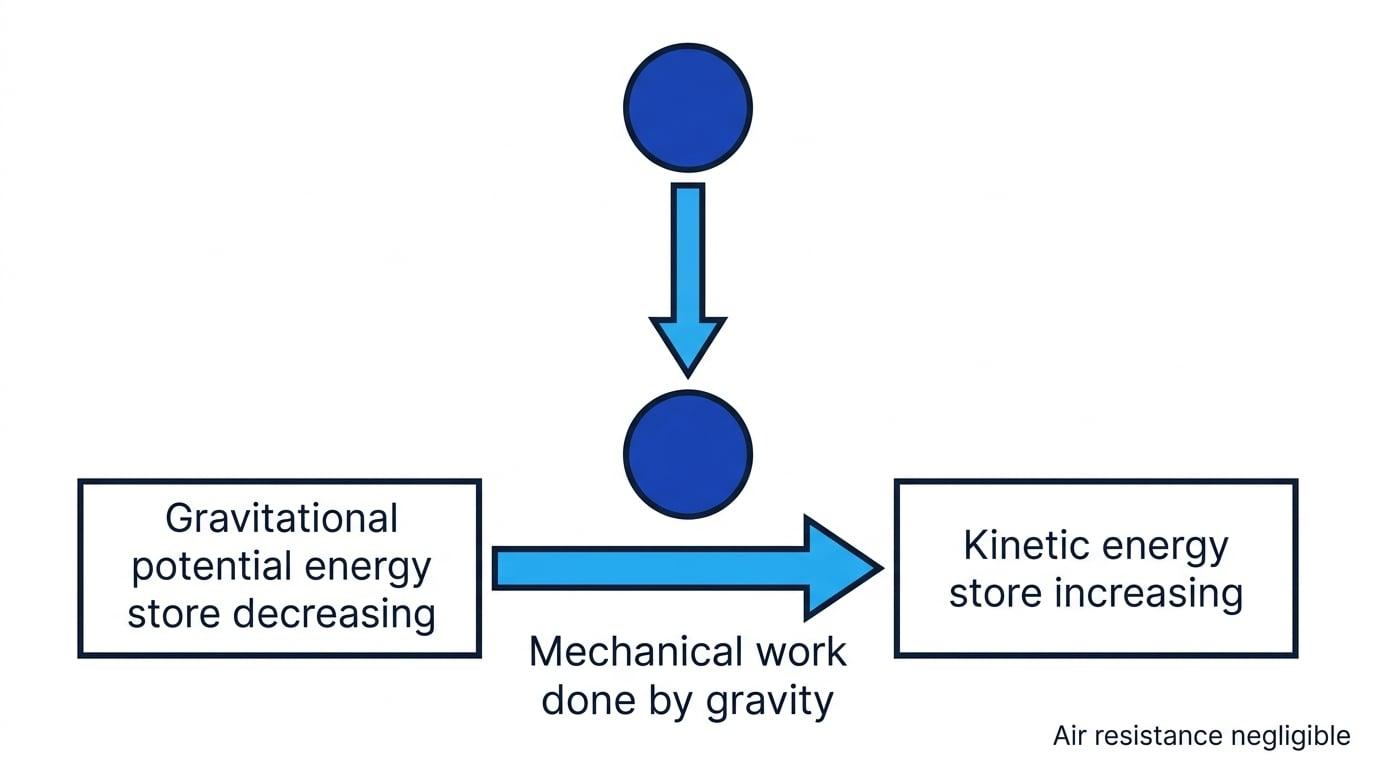
Energy is stored, and events move it between stores
Definition
Energy store
A way in which a system holds energy, so that the energy can later be transferred to a different store.
- Energy is never created or used up. It sits in a store, and events shift it from one store to another.
- Naming the stores properly is what makes an energy answer work, because you cannot say where energy has gone until you have decided what you are looking at.
- There are seven stores you need to know.
- Kinetic: held by anything that is moving, from a sprinter to a molecule of air.
- Gravitational potential: held by a mass because of its height in a gravitational field.
- Chemical: held in the bonds of fuels, foods and batteries.
- Elastic (strain): held by anything stretched, squashed or twisted, such as a drawn bow or a compressed spring.
- Nuclear: held in the nucleus of an atom, released in fission and fusion.
- Electrostatic: held by charges that are separated, for example on a charged rod or across a thundercloud.
- Internal (thermal): the total kinetic and potential energy of all the particles inside an object.
- A store is a property of an object or a system, not a thing that flows. The label answers the question "where is the energy sitting right now?".
Common Mistake
- There is no "movement energy", "heat energy", "light energy" or "sound energy" store. Light and sound are ways of transferring energy, not places where it sits.
- Internal energy is the correct name for the store inside a hot object. The word "heat" describes the transfer, not the store.
- Do not confuse internal energy, measured in joules, with temperature, measured in degrees Celsius. Two objects at the same temperature can hold very different amounts of internal energy.
Four ways energy gets from one store to another
Definition
Energy transfer
The movement of energy from one store to another, which happens by forces doing mechanical work, by electrical work, by heating, or by waves.
- Mechanical working is transfer by a force moving something through a distance. Pushing a trolley, stretching a spring and lifting a box all shift energy this way.
- Electrical working is transfer by an electric current. A current in a kettle element or a motor moves energy from a chemical or an electrical supply into another store.
- Heating is transfer caused by a temperature difference, from the hotter object to the colder one. It happens by conduction, convection and thermal radiation.
- Waves transfer energy without transferring matter. This covers electromagnetic waves such as light and infrared, sound waves, and other waves such as water waves.
- Some transfers are useful and some are wasted, but the wasted energy is not destroyed. It usually ends up dissipated in the internal energy store of the surroundings, spread out so thinly that it can no longer be used.
- Every event can be written as a chain: name the starting store, name the transfer, name the finishing store, and repeat.
Example
- A footballer kicks a stationary ball, which flies up and lands on a roof.
- Chemical store in the player's muscles, transferred by a force doing mechanical work on the ball, into the ball's kinetic store.
- Kinetic store of the ball, transferred by the force of gravity doing mechanical work as the ball rises, into the ball's gravitational potential store.
- Throughout the flight, some energy is transferred by mechanical working against air resistance into the internal store of the air, and a little is carried away as sound at the moment of the kick.
Example
- An electric kettle boils water.
- Chemical store in the power station fuel, transferred by electrical working through the mains, into the internal store of the water.
- The kettle's casing and the surrounding air also warm up slightly, so part of the transfer ends in the internal store of the surroundings and is wasted.
Exam technique
- Write the chain with the words "store" and "transferred by" in it. An answer such as "chemical store, transferred by electrical working, to internal store" scores; "electricity turns into heat" does not.
- Name a store on both ends of every transfer. Leaving one end out is the commonest way to lose a mark in this topic.
- When asked where wasted energy goes, say it is dissipated to the internal energy store of the surroundings, and add the mechanism, such as friction or air resistance.
Self review
- List the seven energy stores.
- State the four ways in which energy can be transferred between stores.
- Name the store that a stretched catapult holds energy in.
- Describe the energy stores and transfers for a battery-powered torch that is switched on.
- Explain why "heat energy" is not the name of an energy store.