Gravitational field strength: the force on each kilogram
Definition
Gravitational field strength
The force per unit mass acting on an object placed in a gravitational field.
g=Wm g = \frac{W}{m} g=mWwhere ggg is the gravitational field strength in N/kg\text{N/kg}N/kg, WWW is the weight in N\text{N}N and mmm is the mass in kg\text{kg}kg.
- "Per unit mass" means per kilogram, and that phrase is what earns the mark; "the pull of gravity" scores nothing.
- There is no formula sheet, so recall the equation and be ready to rearrange it into W=mgW = mgW=mg and m=W/gm = W/gm=W/g.
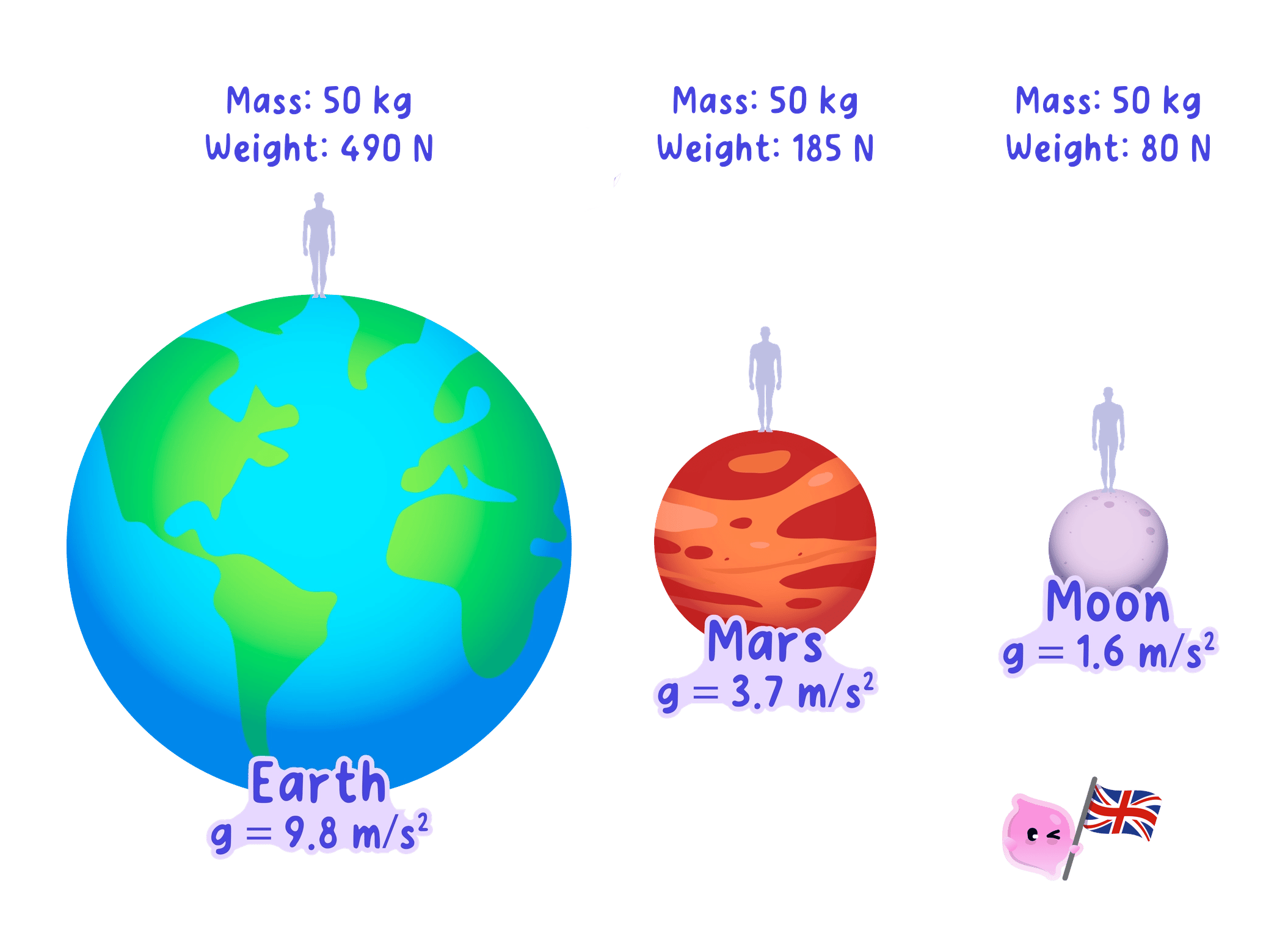
- Near the Earth's surface g≈9.8 N/kgg \approx 9.8\ \text{N/kg}g≈9.8 N/kg, though some questions tell you to use 10 N/kg10\ \text{N/kg}10 N/kg; always use the value given.
- On the Moon g≈1.6 N/kgg \approx 1.6\ \text{N/kg}g≈1.6 N/kg, about six times weaker, which is why the same object weighs about six times less there.
Why g is also the acceleration of free fall
- Gravitational field strength is equivalent to the acceleration of free fall: these are the same number written in different units, not two quantities that happen to match.
- Since 1 N=1 kg×1 m/s21\ \text{N} = 1\ \text{kg} \times 1\ \text{m/s}^21 N=1 kg×1 m/s2, dividing a force in newtons by a mass in kilograms leaves m/s2\text{m/s}^2m/s2, so N/kg\text{N/kg}N/kg and m/s2\text{m/s}^2m/s2 are the same unit written two ways.
- An object in free fall has only its weight acting, W=mgW = mgW=mg, so mg=mamg = mamg=ma and therefore a=ga = ga=g; the mass cancels, which is why all objects fall at the same rate when there is no air resistance.
Key Idea
A field strength of 9.8 N/kg9.8\ \text{N/kg}9.8 N/kg and an acceleration of 9.8 m/s29.8\ \text{m/s}^29.8 m/s2 are the same fact stated two ways, because N/kg\text{N/kg}N/kg and m/s2\text{m/s}^2m/s2 are the same unit.
Weight as the effect of a gravitational field
Definition
Gravitational field
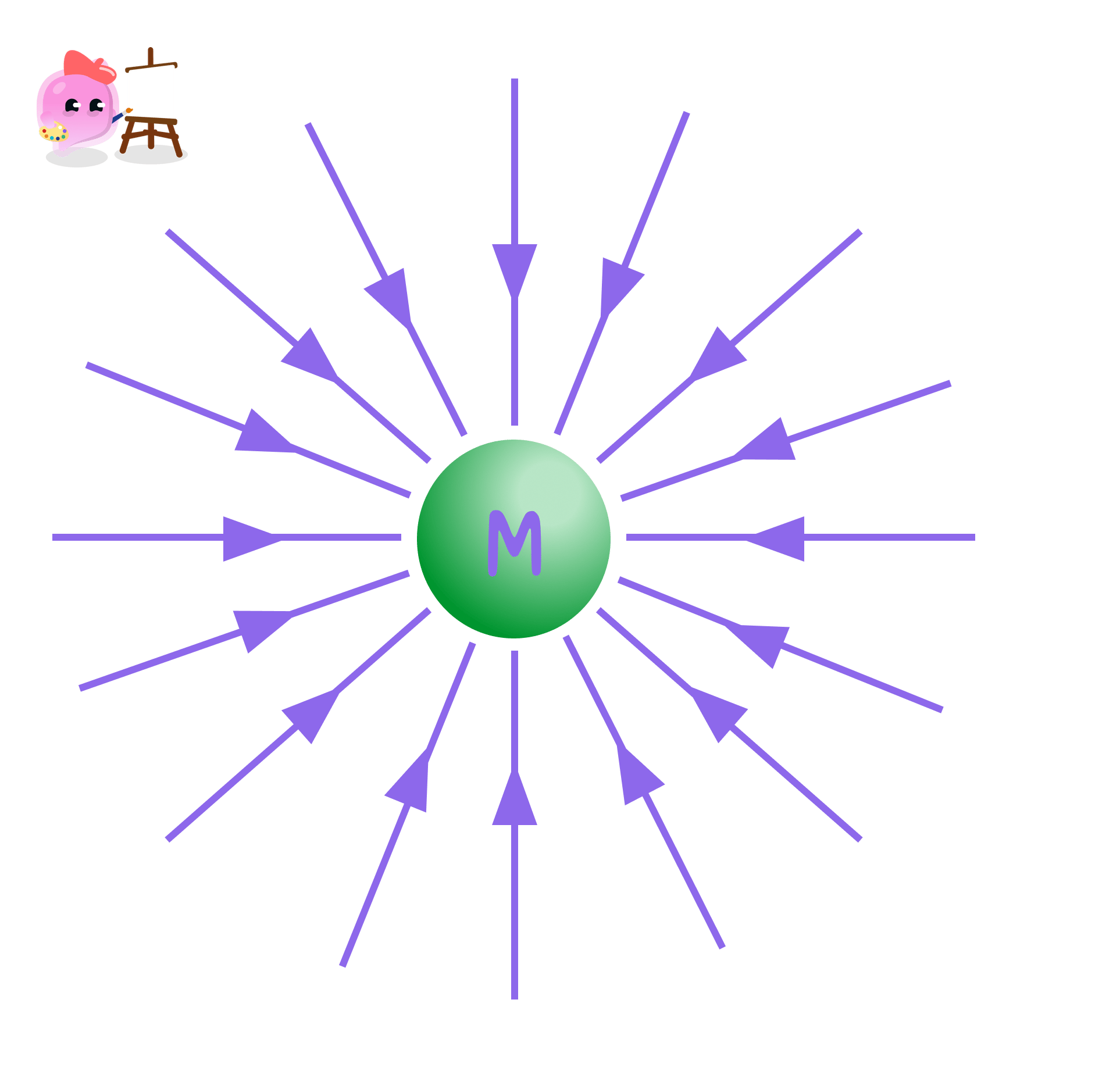
A region of space in which a mass experiences a force.
- Weight is not something an object carries by itself: it is the effect of a gravitational field on a mass.
- Every mass creates a field around it; a second mass placed in that field feels a force, and that force is its weight.
- The field decides the weight: move a fixed mass into a stronger field and its weight rises, into a weaker one and its weight falls; the mass never changes.
- The field belongs to the place, not the object: ggg states how many newtons each kilogram would feel there, whether or not anything is present.
- Near the Earth's surface the field is uniform, directed vertically downwards, so weight acts straight down and ggg is effectively constant over the heights met here; far away the field is radial and weakens with distance.
Common Mistake
- Do not call ggg "gravity". Mark schemes want "gravitational field strength" (N/kg\text{N/kg}N/kg) or "acceleration of free fall" (m/s2\text{m/s}^2m/s2).
- Mass does not change with location. On the Moon it is the weight and the field strength that fall; ask which of WWW, mmm and ggg the question has actually changed.
- "No gravity" is wrong for an object on the Moon or an astronaut in orbit: a field and a gravitational force still act, and in orbit that force is what keeps the astronaut going round.
- Heavier objects do not fall faster with no air resistance: the mass cancels, so everything in free fall in the same field accelerates at ggg.
Exam technique
- Write the equation from recall first; it can earn a mark on its own when the arithmetic slips, and it keeps an error-carried-forward mark available.
- Convert grams to kilograms before substituting, and always attach the unit: a weight quoted in kg\text{kg}kg is marked wrong.
- For a two-planet question the route is almost always: find the mass with m=W/gm = W/gm=W/g, keep that mass, then apply the other ggg.
- For define gravitational field strength, "force per unit mass" is the mark.
Self review
- Define gravitational field strength, and give its unit.
- Write the equation linking ggg, WWW and mmm, and rearrange it to make weight the subject.
- Why is a field strength of 9.8 N/kg9.8\ \text{N/kg}9.8 N/kg the same as an acceleration of 9.8 m/s29.8\ \text{m/s}^29.8 m/s2?
- A rock weighs less on the Moon than on Earth; which of WWW, mmm and ggg have changed?
- What is a gravitational field?
