

What you'll learn
- How to recognise and use mathematically similar solid shapes.
- How length, surface area and volume change using scale factors.
- How to work backwards from surface area to length, or from area to volume.
- How to solve frustum questions by subtracting cone volumes.
1. The key idea: similar solids
Two 3D shapes are mathematically similar if they have exactly the same shape, but may be different sizes. All matching lengths are enlarged or reduced by the same multiplier.
Scale factor
The linear scale factor is the multiplier from one length on a shape to the matching length on a similar shape.
For example, if a radius changes from 4 cm to 10 cm, the linear scale factor is:
104=2.5\frac{10}{4} = 2.5410=2.5The matching parts are called corresponding lengths. For example, radius matches radius, height matches height, diameter matches diameter, and length matches length.
Here is the big picture: lengths scale once, areas scale twice, and volumes scale three times.

The three scale factors
If the linear scale factor is kkk, then:
- Area scale factor is k2k^2k2
- Volume scale factor is k3k^3k3
Finding the surface area of a larger similar cone
Two similar cones have base radii 5 cm and 15 cm. The smaller cone has total surface area 70 cm². Find the total surface area of the larger cone.
-
Find the linear scale factor from the smaller cone to the larger cone:
k=155=3k = \frac{15}{5} = 3k=515=3 -
Square the linear scale factor to get the area scale factor:
k2=32=9k^2 = 3^2 = 9k2=32=9 -
Multiply the smaller surface area by the area scale factor:
70×9=63070 \times 9 = 63070×9=630 -
The surface area of the larger cone is 630 cm².
Using the length scale factor for area
If a length doubles, the surface area does not double. It becomes 4 times as large, because 22=42^2 = 422=4.
2. Surface area uses the square of the scale factor
Surface area is a 2D measurement wrapped around a 3D object. That means it depends on two length directions at once.
For similar shapes:
area scale factor=k2\text{area scale factor} = k^2area scale factor=k2This works for curved surface area, total surface area, or the area of a matching face, as long as the shapes are similar.
A cylinder with double the height
Two similar cylinders are shown. Cylinder B is twice as tall as cylinder A. Cylinder A has total surface area 180 cm². Find the total surface area of cylinder B.
-
Because the cylinders are similar, if the height doubles, every length doubles. So the linear scale factor is:
k=2k = 2k=2 -
Find the area scale factor:
k2=22=4k^2 = 2^2 = 4k2=22=4 -
Multiply the surface area of cylinder A by 4:
180×4=720180 \times 4 = 720180×4=720 -
The total surface area of cylinder B is 720 cm².
Check the direction
Before multiplying, ask: “Am I going from smaller to larger, or larger to smaller?” If you go from larger to smaller, you divide by the scale factor instead.
3. Volume uses the cube of the scale factor
Volume is a 3D measurement, so it depends on three length directions. That is why volume changes by the cube of the linear scale factor.
For similar shapes:
volume scale factor=k3\text{volume scale factor} = k^3volume scale factor=k3Finding the volume of a larger similar cylinder
Two similar cylinders have lengths 4 cm and 6 cm. The smaller cylinder has volume 80 cm³. Find the volume of the larger cylinder.
-
Find the linear scale factor from the smaller cylinder to the larger cylinder:
k=64=32k = \frac{6}{4} = \frac{3}{2}k=46=23 -
Cube the linear scale factor to get the volume scale factor:
k3=(32)3=278k^3 = \left(\frac{3}{2}\right)^3 = \frac{27}{8}k3=(23)3=827 -
Multiply the smaller volume by the volume scale factor:
80×278=27080 \times \frac{27}{8} = 27080×827=270 -
The volume of the larger cylinder is 270 cm³.
Squaring instead of cubing for volume
For volume, do not use k2k^2k2. Surface area uses k2k^2k2, but volume uses k3k^3k3.
4. Working backwards from area to length
Sometimes you are given two surface areas and need to find a missing length. In that case, start by finding the area scale factor, then square root it to get the linear scale factor.
Area back to length
If the area scale factor is known, then:
k=area scale factork = \sqrt{\text{area scale factor}}k=area scale factorUsing surface areas to find a missing height
Two similar cones P and Q have total surface areas 30 cm² and 120 cm². Cone P has height 5 cm. Find the height of cone Q.
-
Find the area scale factor from P to Q:
12030=4\frac{120}{30} = 430120=4 -
Square root the area scale factor to find the linear scale factor:
k=4=2k = \sqrt{4} = 2k=4=2 -
Multiply the height of cone P by the linear scale factor:
5×2=105 \times 2 = 105×2=10 -
The height of cone Q is 10 cm.
Square root for lengths
When you are given areas but asked for a length, remember: area to length means square root.
5. Linking surface area and volume
A common exam style is: you are given the surface areas of two similar solids, plus the volume of one, and you need the volume of the other.
The method is:
- Use the surface areas to find the area scale factor.
- Square root to get the linear scale factor.
- Cube to get the volume scale factor.
- Multiply or divide the volume.
Finding a volume from two surface areas
Two geometrically similar solids X and Y have surface areas 500 cm² and 1125 cm². The volume of X is 1600 cm³. Find the volume of Y.
-
Find the area scale factor from X to Y:
1125500=2.25\frac{1125}{500} = 2.255001125=2.25 -
Square root to find the linear scale factor:
k=2.25=1.5k = \sqrt{2.25} = 1.5k=2.25=1.5 -
Cube the linear scale factor to find the volume scale factor:
k3=1.53=3.375k^3 = 1.5^3 = 3.375k3=1.53=3.375 -
Multiply the volume of X by the volume scale factor:
1600×3.375=54001600 \times 3.375 = 54001600×3.375=5400 -
The volume of Y is 5400 cm³.
Cubing the area scale factor
Do not cube 2.25 in this example. The 2.25 is already an area scale factor, not a length scale factor. Square root first, then cube.
6. Frustums: subtracting similar cone volumes
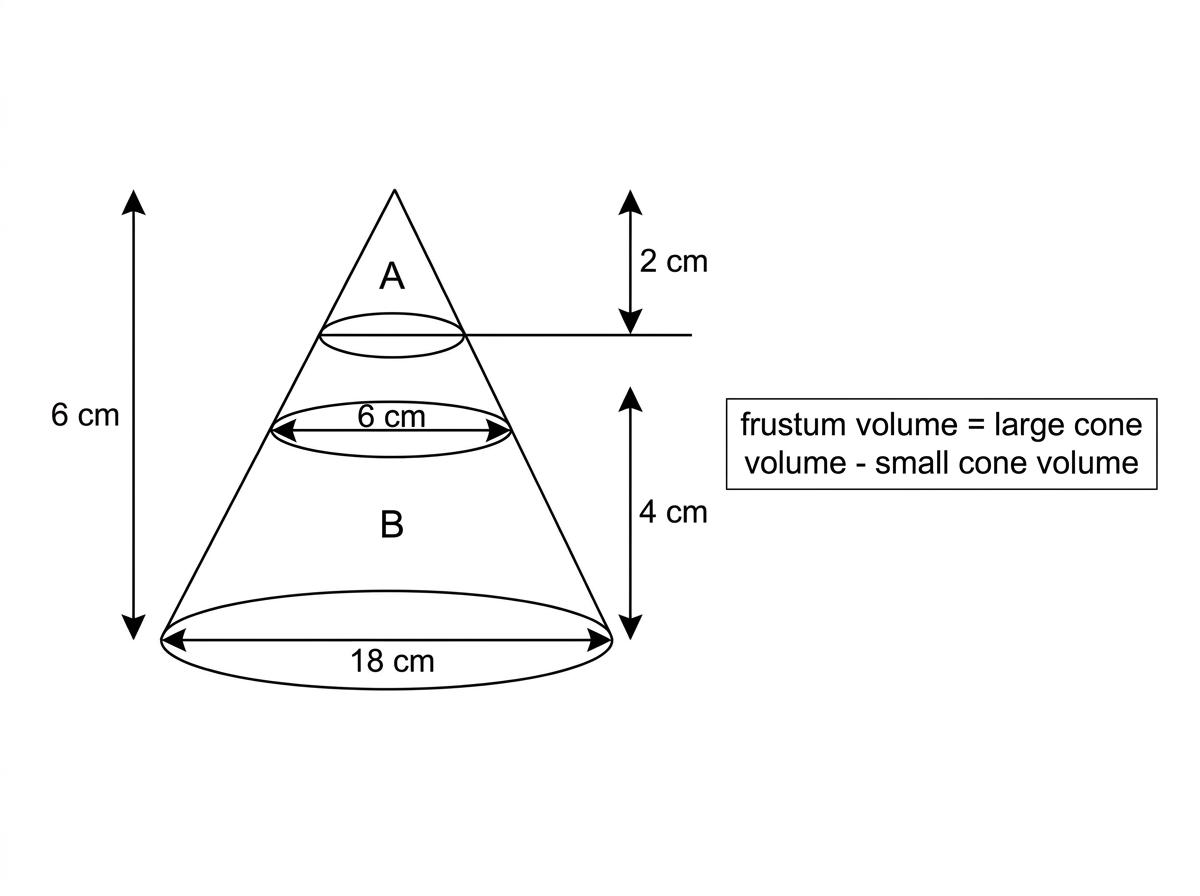
A frustum is what is left when the top of a cone is cut off parallel to the base. In many IGCSE questions, you find the frustum volume by doing:
frustum volume=large cone volume−small cone volume\text{frustum volume} = \text{large cone volume} - \text{small cone volume}frustum volume=large cone volume−small cone volumeFrustum
A frustum is the solid made when a cone or pyramid has its top cut off parallel to its base.
This diagram shows the subtraction idea: the frustum is the large cone with the small cone removed.
To calculate cone volume, use:
V=13πr2hV = \frac{1}{3}\pi r^2hV=31πr2hwhere rrr is the radius and hhh is the perpendicular height.
Volume of a frustum in terms of pi
A large cone has height 9 cm and base diameter 12 cm. A smaller cone at the top has height 3 cm and base diameter 4 cm. Find the volume of the frustum left behind, in terms of pi.
-
Work out the radius of the large cone. The diameter is 12 cm, so the radius is 6 cm.
-
Find the volume of the large cone:
V=13π×62×9=108πV = \frac{1}{3}\pi \times 6^2 \times 9 = 108\piV=31π×62×9=108π -
Work out the radius of the small cone. The diameter is 4 cm, so the radius is 2 cm.
-
Find the volume of the small cone:
V=13π×22×3=4πV = \frac{1}{3}\pi \times 2^2 \times 3 = 4\piV=31π×22×3=4π -
Subtract the small cone from the large cone:
108π−4π=104π108\pi - 4\pi = 104\pi108π−4π=104π -
The volume of the frustum is 104π cm³.
Use radius, not diameter
The cone volume formula uses radius. If you are given a diameter, halve it before substituting into V=13πr2hV = \frac{1}{3}\pi r^2hV=31πr2h.
7. Choosing the right multiplier
Here is a quick decision guide:
- Asked for a length? Use kkk.
- Asked for an area or surface area? Use k2k^2k2.
- Asked for a volume? Use k3k^3k3.
- Given areas but need length? Use a square root.
- Given volumes but need length? Use a cube root.
Two-part similar cylinder question
Two similar cylinders P and Q have total surface areas 100π cm² and 900π cm². Cylinder P has length 6 cm and volume 150π cm³. Find the length and volume of cylinder Q.
-
Find the area scale factor from P to Q:
900π100π=9\frac{900\pi}{100\pi} = 9100π900π=9 -
Square root to get the linear scale factor:
k=9=3k = \sqrt{9} = 3k=9=3 -
Use the linear scale factor to find the length of Q:
6×3=186 \times 3 = 186×3=18 -
Cube the linear scale factor to find the volume scale factor:
k3=33=27k^3 = 3^3 = 27k3=33=27 -
Multiply the volume of P by 27:
150π×27=4050π150\pi \times 27 = 4050\pi150π×27=4050π -
The length of Q is 18 cm and the volume of Q is 4050π cm³.
In the exam
- Write down the linear scale factor first whenever possible, and label its direction clearly.
- If you are given surface areas, square root before using it on lengths or cubing it for volumes.
- Check whether the question wants an exact answer in terms of π, and do not round if it does.
Check yourself
- If the length scale factor is 4, what are the area and volume scale factors?
- If two similar solids have surface areas in the ratio 25:64, what is the length ratio?
- In a frustum question, which two cone volumes do you subtract?
