Revision notes for CIE IGCSE Maths Parallel and Perpendicular Lines. Open the guide for explanations and worked examples. Written against the CIE IGCSE Maths (0580) specification, so the content matches what's examinable rather than general Maths background.
Parallel and Perpendicular Lines
What you'll learn
- How to recognise the gradient and y-intercept of a straight line.
- How to write equations of lines that are parallel or perpendicular.
- How to rearrange equations before comparing gradients.
- How to use two points on a line to prove relationships or find a missing value.
1. Start with the form y=mx+cy=mx+cy=mx+c
Most straight-line questions become much easier when the equation is written in the form:
y=mx+cy=mx+cy=mx+cHere, the coefficient of xxx tells you the slope of the line, and the constant term tells you where the line crosses the y-axis.
Definition
Gradient and y-intercept
- The gradient is the steepness of a line. In y=mx+cy=mx+cy=mx+c, the gradient is mmm.
- The y-intercept is where the line crosses the y-axis. In y=mx+cy=mx+cy=mx+c, the y-intercept is ccc, so the line passes through (0,c)(0,c)(0,c).
Example
Reading a line equation
For the line y=4x−7y=4x-7y=4x−7:
-
Compare it with y=mx+cy=mx+cy=mx+c.
-
The number multiplying xxx is 4, so m=4m=4m=4.
-
The constant term is -7, so c=−7c=-7c=−7.
-
The line has gradient 4 and crosses the y-axis at (0,−7)(0,-7)(0,−7).
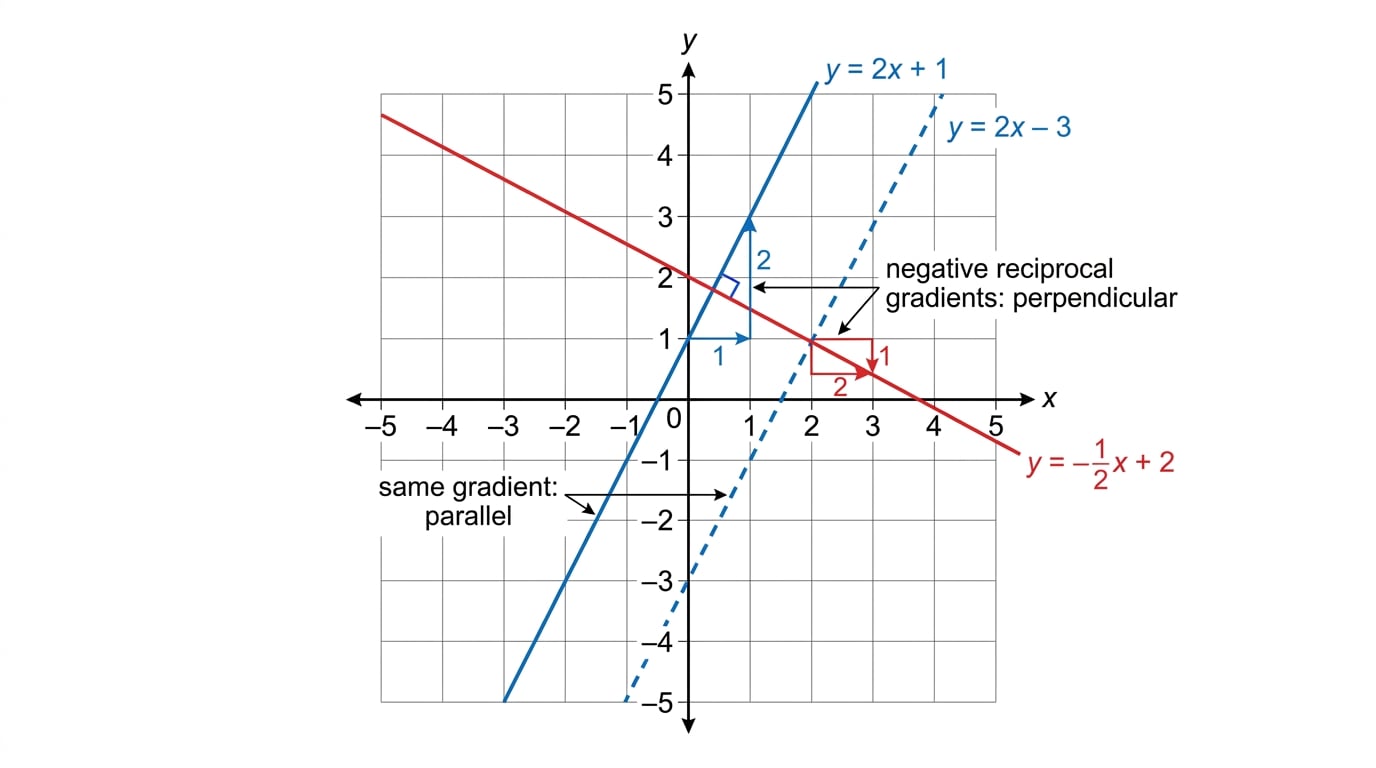
The diagram below shows the key idea visually: parallel lines have the same gradient, while perpendicular lines meet at 90°.
2. Parallel lines
Parallel lines go in exactly the same direction. They never meet, unless they are actually the same line.
Key Idea
Parallel gradients
Parallel straight lines have the same gradient. The y-intercept may be different, but the value of mmm is the same.
So any line parallel to y=3x+2y=3x+2y=3x+2 must also have gradient 3. For example, y=3x−5y=3x-5y=3x−5 is parallel to it.
Example
Writing a parallel line through a y-axis point
Find the equation of the line parallel to y=12x+6y=\frac{1}{2}x+6y=21x+6 that passes through (0,−3)(0,-3)(0,−3).
-
The original line is already in the form y=mx+cy=mx+cy=mx+c.
-
Its gradient is m=12m=\frac{1}{2}m=21.
-
A parallel line has the same gradient, so start with:
y=12x+cy=\frac{1}{2}x+cy=21x+c -
The point (0,−3)(0,-3)(0,−3) is on the y-axis, so the y-intercept is -3.
-
Therefore the equation is y=12x−3y=\frac{1}{2}x-3y=21x−3.
Common Mistake
Changing the wrong part
For a parallel line, keep the gradient the same. You change the y-intercept only if the line crosses the y-axis somewhere else.
3. Perpendicular lines
Perpendicular lines meet at a right angle, which is 90°.
Definition
Perpendicular lines
Two lines are perpendicular if they meet at 90°. For non-horizontal lines, their gradients are negative reciprocals.
A reciprocal means “flip the fraction”. A negative reciprocal means “flip it and change the sign”.
For example:
- The negative reciprocal of 12\frac{1}{2}21 is -2.
- The negative reciprocal of −3-3−3 is 13\frac{1}{3}31.
- The negative reciprocal of 45\frac{4}{5}54 is −54-\frac{5}{4}−45.
Key Idea
Perpendicular gradients
If two non-horizontal lines are perpendicular, their gradients multiply to give -1:
m1m2=−1m_1m_2=-1m1m2=−1Example
Writing a perpendicular line through a y-axis point
Find the equation of the line perpendicular to y=14x−5y=\frac{1}{4}x-5y=41x−5 that passes through (0,6)(0,6)(0,6).
-
The original line has gradient m=14m=\frac{1}{4}m=41.
-
The negative reciprocal of 14\frac{1}{4}41 is -4, so the perpendicular gradient is m=−4m=-4m=−4.
-
Start with the new line:
y=−4x+cy=-4x+cy=−4x+c -
The line passes through (0,6)(0,6)(0,6), so c=6c=6c=6.
-
The equation is y=−4x+6y=-4x+6y=−4x+6.
Common Mistake
Forgetting the negative sign
For perpendicular lines, do not just flip the fraction. You must also change the sign. The perpendicular gradient to 23\frac{2}{3}32 is −32-\frac{3}{2}−23, not 32\frac{3}{2}23.
Common Mistake
Horizontal and vertical lines
The negative reciprocal rule assumes both lines can be written in the form y=mx+cy=mx+cy=mx+c. A horizontal line such as y=4y=4y=4 is perpendicular to a vertical line such as x=2x=2x=2.
4. Rearranging first
Sometimes the equation is not already written as y=mx+cy=mx+cy=mx+c. Before comparing gradients, rearrange it so that yyy is the subject.
Example
Finding a parallel line after rearranging
Find the equation of the line parallel to 2x+5y=102x+5y=102x+5y=10 that passes through (0,4)(0,4)(0,4).
-
Rearrange the original equation into y=mx+cy=mx+cy=mx+c form:
2x+5y=105y=−2x+10y=−25x+2\begin{aligned} 2x+5y&=10\\ 5y&=-2x+10\\ y&=-\frac{2}{5}x+2 \end{aligned}2x+5y5yy=10=−2x+10=−52x+2 -
The gradient is m=−25m=-\frac{2}{5}m=−52.
-
A parallel line has the same gradient, so use:
y=−25x+cy=-\frac{2}{5}x+cy=−52x+c -
The line passes through (0,4)(0,4)(0,4), so c=4c=4c=4.
-
The equation is y=−25x+4y=-\frac{2}{5}x+4y=−52x+4.
Common Mistake
Not dividing every term
When you divide to make yyy the subject, divide every term. For example, from 5y=−2x+105y=-2x+105y=−2x+10, you get y=−25x+2y=-\frac{2}{5}x+2y=−52x+2.
5. Comparing several lines
If you are given a list of line equations, do not try to compare the whole equations at once. Just find each gradient.
Example
Finding parallel and perpendicular pairs
Here are five lines:
- Line A: y=2x+1y=2x+1y=2x+1
- Line B: 3y=x−63y=x-63y=x−6
- Line C: 2y=4x−52y=4x-52y=4x−5
- Line D: y=−3x+2y=-3x+2y=−3x+2
- Line E: y+x=5y+x=5y+x=5
Find one parallel pair and one perpendicular pair.
-
Line A is already in y=mx+cy=mx+cy=mx+c form, so its gradient is 2.
-
Rearrange Line B:
3y=x−6⇒y=13x−23y=x-6 \Rightarrow y=\frac{1}{3}x-23y=x−6⇒y=31x−2 -
Rearrange Line C:
2y=4x−5⇒y=2x−522y=4x-5 \Rightarrow y=2x-\frac{5}{2}2y=4x−5⇒y=2x−25 -
Line D has gradient -3.
-
Rearrange Line E:
y+x=5⇒y=−x+5y+x=5 \Rightarrow y=-x+5y+x=5⇒y=−x+5 -
Lines A and C are parallel because they both have gradient 2.
-
Lines B and D are perpendicular because 13×(−3)=−1\frac{1}{3}\times(-3)=-131×(−3)=−1.
6. When a line is given by two points
If you are given two points instead of an equation, first calculate the gradient.
Definition
Gradient between two points
For points (x1,y1)(x_1,y_1)(x1,y1) and (x2,y2)(x_2,y_2)(x2,y2), the gradient is:
m=y2−y1x2−x1m=\frac{y_2-y_1}{x_2-x_1}m=x2−x1y2−y1This means “change in y divided by change in x”.
Example
Equation of a parallel line from two points
Line A passes through (2,1)(2,1)(2,1) and (6,13)(6,13)(6,13). Find the equation of the line parallel to A that passes through (3,4)(3,4)(3,4).
-
Find the gradient of Line A:
m=13−16−2=124=3m=\frac{13-1}{6-2}=\frac{12}{4}=3m=6−213−1=412=3 -
A parallel line has the same gradient, so use:
y=3x+cy=3x+cy=3x+c -
Substitute the point (3,4)(3,4)(3,4) into the equation:
4=3(3)+c⇒c=−54=3(3)+c \Rightarrow c=-54=3(3)+c⇒c=−5 -
The equation is y=3x−5y=3x-5y=3x−5.
Example
Equation of a perpendicular line from two points
Line A passes through (1,4)(1,4)(1,4) and (5,6)(5,6)(5,6). Find the equation of the line perpendicular to A that passes through (−2,3)(-2,3)(−2,3).
-
Find the gradient of Line A:
m=6−45−1=24=12m=\frac{6-4}{5-1}=\frac{2}{4}=\frac{1}{2}m=5−16−4=42=21 -
The perpendicular gradient is -2, because 12×(−2)=−1\frac{1}{2}\times(-2)=-121×(−2)=−1.
-
Use the form y=−2x+cy=-2x+cy=−2x+c.
-
Substitute the point (−2,3)(-2,3)(−2,3):
3=−2(−2)+c⇒c=−13=-2(-2)+c \Rightarrow c=-13=−2(−2)+c⇒c=−1 -
The equation is y=−2x−1y=-2x-1y=−2x−1.
Tip
When the point is not on the y-axis
If the point is not of the form (0,c)(0,c)(0,c), you cannot read off the y-intercept. Substitute the coordinates into y=mx+cy=mx+cy=mx+c to find ccc.
7. Showing lines are parallel or perpendicular
In “show that” questions, you need to calculate both gradients and then write a clear conclusion.
Example
Showing two lines are parallel
Line A passes through (0,2)(0,2)(0,2) and (4,10)(4,10)(4,10). Line B passes through (−1,−1)(-1,-1)(−1,−1) and (2,5)(2,5)(2,5). Show that the lines are parallel.
-
Find the gradient of Line A:
mA=10−24−0=84=2m_A=\frac{10-2}{4-0}=\frac{8}{4}=2mA=4−010−2=48=2 -
Find the gradient of Line B:
mB=5−(−1)2−(−1)=63=2m_B=\frac{5-(-1)}{2-(-1)}=\frac{6}{3}=2mB=2−(−1)5−(−1)=36=2 -
The gradients are equal.
-
Therefore Line A and Line B are parallel.
8. Finding a missing value
For missing coordinate questions, write the gradient involving the unknown, then use the parallel or perpendicular rule.
Example
Finding a missing coordinate using perpendicular gradients
Line A passes through (2,7)(2,7)(2,7) and (5,1)(5,1)(5,1). Line B passes through (−1,3)(-1,3)(−1,3) and (k,5)(k,5)(k,5). The lines are perpendicular. Find kkk.
-
Find the gradient of Line A:
mA=1−75−2=−63=−2m_A=\frac{1-7}{5-2}=\frac{-6}{3}=-2mA=5−21−7=3−6=−2 -
The perpendicular gradient is 12\frac{1}{2}21, because −2×12=−1-2\times\frac{1}{2}=-1−2×21=−1.
-
Write the gradient of Line B using the unknown coordinate:
mB=5−3k−(−1)=2k+1m_B=\frac{5-3}{k-(-1)}=\frac{2}{k+1}mB=k−(−1)5−3=k+12 -
Set the gradient of Line B equal to 12\frac{1}{2}21 and solve:
2k+1=12⇒4=k+1⇒k=3\frac{2}{k+1}=\frac{1}{2}\Rightarrow 4=k+1\Rightarrow k=3k+12=21⇒4=k+1⇒k=3
Tip
Parallel versus perpendicular missing values
For parallel lines, set the gradients equal. For perpendicular lines, set the second gradient equal to the negative reciprocal of the first.
Exam technique
In the exam
-
Rearrange each equation into y=mx+cy=mx+cy=mx+c before comparing gradients.
-
For parallel lines, look for the same gradient.
-
For perpendicular lines, flip the gradient and change the sign, or check that m1m2=−1m_1m_2=-1m1m2=−1.
-
If a line passes through (0,c)‘,readoffthey−intercept;otherwisesubstitutethepointinto(0,c)`, read off the y-intercept; otherwise substitute the point into (0,c)‘,readoffthey−intercept;otherwisesubstitutethepointintoy=mx+c$.
-
In “show that” questions, always write a final sentence explaining why the lines are parallel or perpendicular.
Self review
Check yourself
- What is the gradient of a line perpendicular to y=−45x+1y=-\frac{4}{5}x+1y=−54x+1?
- How would you find ccc for a line with gradient 3 passing through (2,−1)(2,-1)(2,−1)?
- If two lines have gradients 23\frac{2}{3}32 and 32\frac{3}{2}23, are they parallel, perpendicular, or neither?

Recap questions
Test yourself with 5 quick questions on this guide. Answer them all correctly to complete it.
You've reached the end
Test yourself on this topic, or move on to the next guide.
How was this guide?