What you'll learn
- How Alice Walker presents the speaker’s love for her father through memory and everyday actions.
- How the poem’s free verse, short lines and shifts in time shape its meaning.
- How to analyse key images such as money, cooking, truth and fire.
- How to use this poem confidently in an Edexcel IGCSE anthology comparison.
The poem at a glance
“Poem at Thirty-Nine” is spoken by an adult daughter reflecting on her father. The speaker misses him deeply, but the poem is not only sad. It shows how his influence continues in the way she cooks, writes, tells the truth, saves money and welcomes others.
The title places the speaker at a specific age: thirty-nine. This matters because she is no longer a child. She can now look back with a more mature understanding of her father: he was loving and influential, but also tired, imperfect and sometimes hurt by her choices.
Core meaning
Walker presents grief as something that can become gratitude: the speaker misses her father, but she also recognises that his values and habits live on in her.
Speaker, situation and relationship
The speaker is the voice speaking in the poem. In this poem, the speaker sounds personal and reflective, remembering her father after his death or absence. She begins directly: “How I miss my father.” The simplicity of the sentence makes the emotion feel honest and unforced.
The relationship is loving, but not idealised. The father taught her useful skills — “Writing deposit slips and checks” — and moral lessons — “telling the truth” — but there is also a hint of difficulty: “many of my truths / must have grieved him”. Walker makes the relationship feel real because it contains affection, regret, independence and respect.
Do not flatten the father
Avoid writing that the father is simply “kind” or simply “strict”. The poem is more subtle: he is loving, tired, practical, generous, possibly shaped by hardship, and remembered with both tenderness and regret.
Form and structure
Form and structure
- Form means the type or overall shape of a poem, such as sonnet, ballad or free verse.
- Structure means how the poem is organised: the order of ideas, stanza breaks, repeated phrases, shifts in time and changes in tone.
The poem is written in free verse, which means it has no regular rhyme scheme or fixed metre. A rhyme scheme is a pattern of rhymes at the ends of lines; metre is a regular pattern of stressed and unstressed syllables. Walker’s free verse makes the poem sound like natural thought or memory rather than a formal tribute.
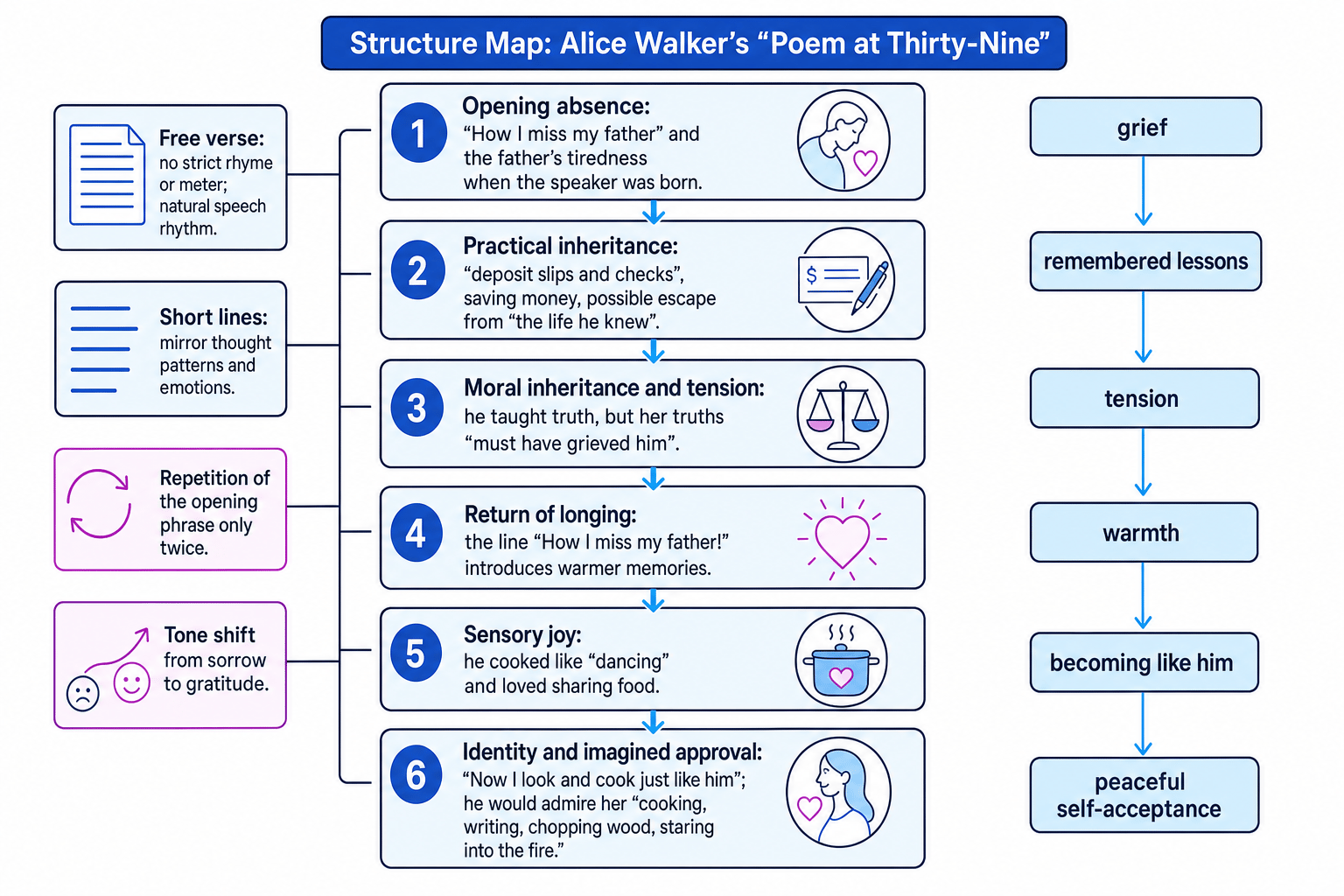
The poem moves through a clear emotional journey:
- Missing the father.
- Remembering practical lessons about money.
- Remembering moral lessons about truth.
- Recalling his joyful cooking.
- Recognising that she has become like him.
- Imagining that he would admire her now.
The diagram below shows this movement from grief towards self-acceptance.
Short lines and line breaks
Walker uses very short lines, for example:
“so tired / when I was / born.”
This slows the reader down. The line breaks make the memory feel fragmented, as if the speaker is thinking carefully and emotionally. The phrase “so tired” also suggests that the father’s life was already difficult when she arrived.
The poem often uses enjambment, which means a sentence or phrase continues over a line break without stopping. This creates a flowing, conversational rhythm, as though the speaker is moving naturally from one memory to another.
Repetition
The phrase “How I miss my father” appears at the start and returns later as “How I miss my father!” The exclamation mark intensifies the feeling, but the second time it also introduces warmer memories of cooking and sharing food. So the repetition does not simply repeat sadness; it shows grief changing into affectionate remembrance.
Tracking the tone shift
-
Compare the first “How I miss my father.” with the later “How I miss my father!”. The full stop feels plain and mournful, while the exclamation mark feels more emotionally open.
-
Notice what follows each phrase. The first leads into his tiredness when she was born; the second leads into lively memories of cooking, “dancing” and “good food”.
-
This structural repetition shows that grief is not fixed. The speaker still misses him, but the poem gradually transforms loss into warmth, gratitude and connection.
Language and imagery
Imagery is language that creates vivid pictures or sensations in the reader’s mind. Walker’s imagery is powerful because it is based on ordinary life: forms, money, food, cooking, wood and fire.
Money and escape
The father teaches the speaker to use “deposit slips and checks”. These are ordinary financial objects, but Walker makes them emotionally important. The speaker learns to see “bits of paper / as a way / to escape / the life he knew”.
The phrase “bits of paper” makes money and financial documents seem small and unimpressive, but “escape” gives them huge significance. They represent independence, education, planning and survival. The father’s love is practical: he gives his daughter tools that may help her avoid the hardship he experienced.
Truth and pain
The father also teaches her that “telling the truth / did not always mean / a beating”. This is a striking line because it suggests fear, punishment or violence in the background of life. However, the wording “did not always mean” is cautious rather than simple. Truth is valuable, but it can still hurt.
The speaker admits that “many of my truths / must have grieved him”. This makes her independent voice important. She has become honest and self-directed, but that independence may have caused pain. Walker presents truth as morally necessary, yet emotionally complicated.
Cooking as love, art and freedom
The warmest imagery in the poem comes through cooking. The father “cooked like a person / dancing / in a yoga meditation”. This is a simile, a comparison using “like” or “as”. It combines movement and calm: “dancing” suggests energy and joy, while “yoga meditation” suggests peace and concentration.
The phrase “craved the voluptuous / sharing / of good food” is sensuous and generous. “Voluptuous” suggests rich physical pleasure, while “sharing” shows that food is not just about eating: it is about community, care and love.
Food becomes a motif, which means a repeated image or idea that helps develop a theme. The father’s cooking becomes a way of understanding his personality, and later the speaker’s own identity.
Analysing the cooking imagery
-
Start with the simile “cooked like a person / dancing / in a yoga meditation”. The comparison joins two different ideas: energetic movement and spiritual calm.
-
Link this to the father’s character. Walker presents him as creative and joyful, not only as a tired or practical man.
-
Connect the image to the speaker’s development. When she says “Now I look and cook just like him”, cooking becomes inherited identity: she carries his spirit through her own actions.
Life as seasoning
One of the poem’s most memorable images is:
“seasoning none of my life / the same way twice”
This is a metaphor, which means a direct comparison where one thing is described as another. Here, life is imagined as food being seasoned. The speaker suggests that she lives creatively and unpredictably, refusing to repeat herself exactly.
The phrase also connects cooking to writing and identity. Like a cook adding different ingredients, the speaker shapes her life with freedom and imagination.
Fire as a final symbol
The poem ends with the speaker “staring into the fire.” A symbol is an object or image that represents a wider idea. Fire may suggest warmth, memory, creativity, survival and contemplation. The ending is quiet rather than dramatic, giving the poem a peaceful, reflective close.
Tone
Tone means the emotional attitude or mood of the speaker’s voice. The tone of “Poem at Thirty-Nine” shifts across the poem.
At first, the tone is mournful and intimate: “How I miss my father.” It then becomes reflective as the speaker thinks about money, truth and the past. In the cooking section, the tone becomes warmer and more celebratory. By the end, the tone is calm and self-assured: “He would have grown / to admire / the woman I’ve become.”
That final statement is important. The speaker does not ask whether she is worthy of admiration; she imagines it confidently. The poem ends with self-acceptance, as if remembering her father helps her understand and value herself.
A strong tone sentence
Instead of saying “the tone is sad”, try: “The tone begins as grief-stricken but gradually becomes warmer and more grateful as the speaker recognises her father’s continuing influence.”
Main themes
Parent-child love
The poem presents love through practical care rather than sentimental language. The father teaches, cooks, shares and provides. His love is shown through action.
Memory and grief
The speaker’s memories are not in neat chronological order. They arrive as fragments: money, truth, cooking, fire. This makes the poem feel like real remembering.
Inheritance and identity
The speaker inherits more than physical resemblance. She inherits habits, values and ways of living. “Now I look and cook just like him” shows that her father remains present in her identity.
Independence and truth
The speaker values honesty, even when it causes conflict. The poem suggests that becoming independent can be painful for both parent and child, but it is also part of growing up.
Creativity and generosity
The final list — “cooking, writing, chopping wood, / staring into the fire” — brings together domestic work, artistic creativity, physical labour and reflection. Walker presents the speaker as whole, capable and self-defined.
Key quotations to learn
| Quotation | Method | What it suggests |
|---|---|---|
| “How I miss my father.” | Direct opening, simple sentence | Establishes grief and emotional honesty. |
| “so tired / when I was / born” | Short lines, fragmented memory | Suggests hardship and the father’s exhaustion. |
| “deposit slips and checks” | Everyday financial imagery | Shows practical teaching and survival skills. |
| “bits of paper / as a way / to escape” | Symbolic imagery | Money, education or planning become routes to freedom. |
| “telling the truth / did not always mean / a beating” | Stark language, enjambment | Suggests fear, discipline and the moral importance of honesty. |
| “cooked like a person / dancing” | Simile | Presents the father as joyful, graceful and creative. |
| “seasoning none of my life / the same way twice” | Extended cooking metaphor | Shows the speaker’s freedom, originality and inherited creativity. |
| “He would have grown / to admire / the woman I’ve become” | Conditional phrasing, reflective structure | Suggests imagined reconciliation and self-acceptance. |
How to compare this poem for AO3
In the Edexcel anthology comparison, AO3 rewards links and connections between poems. For this poem, useful comparison angles include:
- How parent-child relationships are presented: loving, difficult, distant, protective or controlling.
- How memory shapes the speaker’s identity.
- Whether grief is presented as destructive, healing or complicated.
- How ordinary objects or domestic actions reveal deep emotion.
- How the poem’s structure moves through time, especially from past memory to present understanding.
When comparing, keep returning to Walker’s distinctive method: she uses plain, everyday images to reveal complex love.
In the exam
-
Remember that Component 1 is closed book, so learn a small set of short, accurate quotations such as “How I miss my father”, “deposit slips and checks”, and “seasoning none of my life”.
-
For AO2, do not just name techniques. Explain how Walker’s free verse, short lines, similes and metaphors shape the reader’s understanding of grief, inheritance and identity.
-
For AO3, compare ideas and methods together: for example, how this poem’s warm domestic imagery presents memory differently from the other poem you choose.
Check yourself
- How does Walker make the father seem both loving and imperfect?
- Why is cooking such an important image in the poem?
- How does the tone change between the opening and the final stanza?
