What you'll learn
- How to identify the main themes in To Kill a Mockingbird and connect them to key moments.
- How Harper Lee develops themes through character, setting, symbolism and narrative voice.
- How to use short, accurate quotations in closed-book Edexcel IGCSE essays.
- How to write about theme while still analysing language, form and structure.
What is a theme?
A theme is a big idea that runs through a whole text. It is not usually a one-word topic like “racism” or “childhood”; in an essay, you need to turn it into a sharper argument, such as: Lee shows that racist prejudice corrupts the justice system and damages innocent people.
Theme
A theme is a recurring idea or message explored across a text, developed through plot, character, setting, symbols and narrative voice.
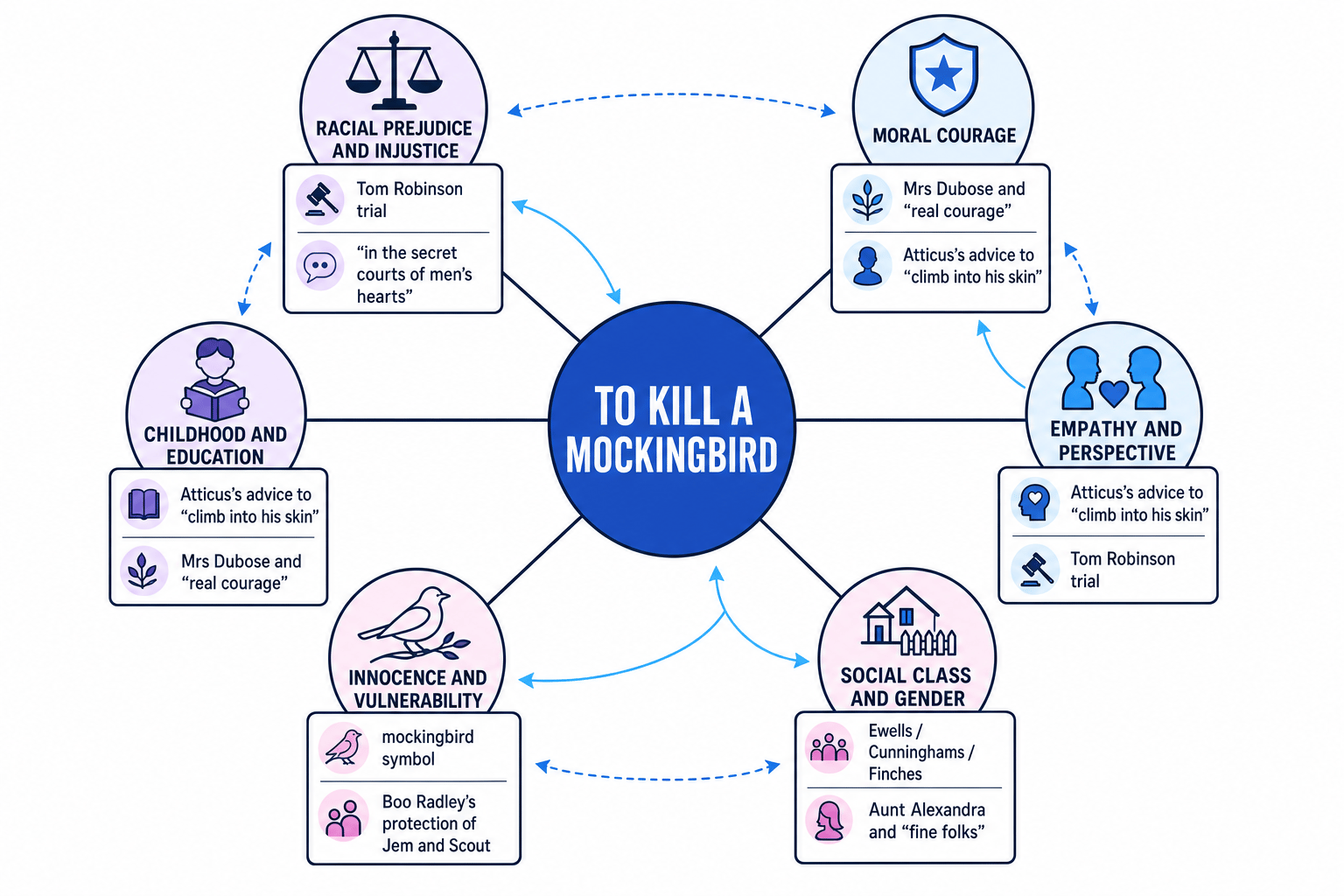
In To Kill a Mockingbird, Lee’s themes overlap. For example, the theme of innocence connects to Tom Robinson, Boo Radley, Jem, Scout and the mockingbird symbol. The theme of justice connects to the court case, but also to everyday moral choices in Maycomb.
This theme web gives you a useful overview of how the main ideas connect.
Racial prejudice and injustice
The most central theme in the novel is racial prejudice: unfair judgement based on race. Lee sets the novel in 1930s Alabama, where segregation and racist attitudes shape social life, law and power. This context matters for AO4 because Tom Robinson’s trial reflects the wider racial injustice of the American South.
Tom is innocent, but Maycomb’s white jury convicts him because he is a Black man accused by a white woman. Lee exposes the gap between the ideal of justice and the racist reality of the courtroom.
A key quotation comes after the trial: “in the secret courts of men’s hearts Atticus had no case.” The metaphor of “courts” suggests that prejudice acts like a hidden legal system inside people’s minds. Even before evidence is heard, many white citizens have already decided Tom is guilty.
Prejudice corrupts justice
Lee shows that the law may appear fair on the surface, but it cannot deliver justice when the people controlling it are ruled by racism.
Tom Robinson as a victim of prejudice
Tom’s testimony reveals his goodness and vulnerability. His statement that he “felt right sorry for her” is morally kind, but socially dangerous: in Maycomb’s racist hierarchy, a Black man showing pity for a white woman is treated as unacceptable.
Mr Gilmer repeats “You felt sorry for her?” to make Tom seem arrogant. The repeated question turns compassion into supposed guilt. Lee uses courtroom dialogue to show how racism twists ordinary human decency into evidence against Tom.
Analysing racial injustice
-
Start with the theme argument: Lee presents Tom’s trial as a test of Maycomb’s justice system, and the town fails because prejudice matters more than evidence.
-
Select precise evidence: the narrator says “in the secret courts of men’s hearts Atticus had no case.” This moves the focus from the official courtroom to people’s inner prejudice.
-
Analyse the method: the metaphor of “secret courts” suggests hidden judgement. The word “secret” implies these decisions are private, dishonest and made before the trial’s facts can matter.
-
Link to effect and context: the reader sees that Tom is condemned by a racist society, not by truth. Lee criticises the racial injustice of the 1930s American South.
Moral courage
Moral courage means doing what is right even when it is frightening, unpopular or unlikely to succeed. Atticus is the clearest example. He knows defending Tom Robinson will make him hated by many white people in Maycomb, but he accepts the case because his conscience demands it.
Atticus tells Scout: “Simply because we were licked a hundred years before we started is no reason for us not to try to win.” The phrase “licked” means beaten. This shows that courage is not the same as guaranteed success. For Atticus, the moral value is in the attempt.
Lee also uses Mrs Dubose to complicate the idea of courage. Atticus says: “I wanted you to see what real courage is.” He defines courage as knowing “you’re licked before you begin but you begin anyway and you see it through no matter what.” Mrs Dubose’s battle with morphine addiction becomes a smaller, personal version of the same idea.
Moral courage
Moral courage is the strength to act according to conscience, even when you face fear, hostility or defeat.
Atticus’s courage is quiet and principled. He is not heroic because he wins; he is heroic because he refuses to abandon justice.
Childhood, education and growing up
The novel is a bildungsroman, which means a story about a young person growing up and gaining understanding. Scout narrates the novel as an adult looking back on childhood, so the narrative voice combines a child’s directness with adult insight.
At the start, Scout often misunderstands people. She judges Boo Radley through rumours, dislikes Walter Cunningham’s habits, and struggles with school. Gradually, she learns that people are more complicated than Maycomb’s gossip suggests.
Atticus gives her the novel’s key lesson: “You never really understand a person until you consider things from his point of view — until you climb into his skin and walk around in it.” The metaphor of “climb into his skin” makes empathy physical and imaginative. Scout must learn to see beyond herself.
Growing up means learning empathy
Lee presents maturity not as losing innocence completely, but as learning to understand other people’s experiences more generously.
Education inside and outside school
Lee contrasts formal schooling with moral education. Scout’s teacher, Miss Caroline, often misunderstands Maycomb’s social realities. By contrast, Atticus teaches Scout through conversation, example and patience.
This matters because the novel suggests that real education is not just reading or rules. It is learning justice, empathy and self-control.
Writing only about school
Do not reduce the theme of education to Scout’s classroom. The most important “lessons” in the novel happen through Atticus, Calpurnia, Miss Maudie, the trial and Scout’s changing view of Boo Radley.
Empathy and perspective
Empathy means the ability to understand or share another person’s feelings. Lee presents empathy as the opposite of prejudice. Prejudice makes people judge from a distance; empathy asks them to imagine another person’s life.
Scout’s final understanding of Boo Radley is one of the novel’s most important moments. At the end, she stands on the Radley porch and sees the street from Boo’s point of view. This structurally completes Atticus’s earlier advice about “climb[ing] into his skin.”
This ending is powerful because Scout does not just repeat Atticus’s lesson; she lives it. Boo changes from a frightening local legend into a vulnerable human being who has protected the children.
Track the structure
A strong theme paragraph can mention where a moment appears in the novel. Scout’s final view from the Radley porch is important because it completes a lesson introduced near the beginning.
Innocence and the mockingbird symbol
A symbol is an object, character or image that represents a larger idea. The mockingbird is the novel’s main symbol of innocence.
Atticus says: “it’s a sin to kill a mockingbird.” Miss Maudie explains why: “Mockingbirds don’t do one thing but make music for us to enjoy.” They do no harm, so harming them is morally wrong.
Tom Robinson is a “mockingbird” figure because he is innocent and helpful, yet destroyed by prejudice. Boo Radley is another: he is gentle and protective, yet the town turns him into a monster through gossip. Heck Tate protects Boo at the end because dragging him into public attention would be, as Scout says, “sort of like shootin’ a mockingbird.”
Symbolism
Symbolism is when a person, object, place or action represents a wider idea beyond its literal meaning.
The mockingbird symbol helps Lee connect several themes at once: innocence, vulnerability, justice and moral responsibility.
Social class, gender and Maycomb’s hierarchy
Maycomb is organised by strict social rankings. The Finches are respected, the Cunninghams are poor but proud, and the Ewells are treated as disgraceful. Lee shows that class affects how people are judged, but race is even more powerful in Maycomb’s hierarchy.
Aunt Alexandra represents traditional ideas about family status. She believes in “fine folks” and wants Scout to behave like a conventional Southern lady. Scout’s resistance to dresses, politeness rituals and “ladylike” behaviour reveals another theme: gender expectations.
However, Lee does not present womanhood simply as weak. Miss Maudie is intelligent and morally clear. Calpurnia is disciplined and loving. After the trial, Aunt Alexandra also shows quiet emotional strength when she continues hosting the missionary circle despite distress over Tom’s death.
Forgetting gender
Many essays focus only on race and justice. Those are central, but Lee also explores how Maycomb controls people through class expectations, family reputation and gender roles.
Coexistence of good and evil
Lee does not present Maycomb as entirely evil. It contains kindness, humour and community, but also cruelty, hypocrisy and violence. This mixture is important.
Characters such as Atticus and Miss Maudie show moral goodness. Bob Ewell represents ignorance, racism and revenge. More interestingly, some characters contain contradictions: Aunt Alexandra can be snobbish but caring; Mrs Dubose can be racist but courageous; Mayella is both victimised and responsible for accusing Tom.
Jem struggles deeply after the guilty verdict because he wants the world to be fair. His loss of innocence shows that growing up involves recognising evil without giving up on goodness.
Turning themes into essay arguments
For Edexcel IGCSE, To Kill a Mockingbird is assessed through your close knowledge of the text and context. Because this is a closed-book prose question, you need short, accurate quotations that you can remember and use flexibly.
A good theme paragraph should not just name a theme. It should make a clear point, use evidence, analyse a method, explore the reader’s response, and link to Lee’s wider message.
A useful paragraph shape
Point → Evidence → Method → Effect → Link to theme/context
For example, on the theme of courage:
Lee presents moral courage as doing what is right despite almost certain defeat. Atticus tells Scout that “we were licked a hundred years before we started,” but insists that this is “no reason for us not to try to win.” The informal verb “licked” makes defeat sound blunt and unavoidable, while “try” shifts the focus from success to moral effort. This encourages the reader to admire Atticus not because he can defeat Maycomb’s racism, but because he refuses to let racism decide his conscience. Through Atticus, Lee criticises a society where justice depends on individuals brave enough to oppose prejudice.
In the exam
-
Turn the theme into an argument: instead of “prejudice is shown”, write what Lee suggests about prejudice and its effects.
-
Use short quotations you can analyse closely, such as “secret courts”, “real courage”, “climb into his skin” and “sin to kill a mockingbird”.
-
Link methods to meaning: mention metaphor, symbolism, narrative voice or structure only when you can explain how they shape the reader’s understanding of the theme.
Check yourself
-
Which two characters can be seen as “mockingbirds”, and why?
-
How does Scout’s view of Boo Radley change from the beginning to the end of the novel?
-
Why does Lee make Atticus defend Tom even though he knows he is unlikely to win?
