What you'll learn
- What context means for To Kill a Mockingbird — and how Edexcel rewards it.
- How the novel’s 1930s Alabama setting shapes racism, poverty, law and gender roles.
- Why the 1960 publication date matters.
- How to use context in essays without turning your answer into a history lesson.
What “context” means
Context
Context means the circumstances surrounding a text: the historical events, social attitudes, laws, beliefs, author’s background and literary traditions that help shape its meaning.
For Edexcel IGCSE, To Kill a Mockingbird is studied in Component 1, Section C: Modern Prose, which is closed book. You need secure textual knowledge and precise references. This section focuses on AO1 — close understanding and an informed personal response — and AO4 — the relationship between the text and its context.
Context is not a separate paragraph of facts. It should help you explain why Lee presents Maycomb as she does and how readers respond to injustice, prejudice and moral courage.
Context must serve interpretation
The best context sentence answers: “How does this historical or social fact deepen my reading of this moment in the novel?”
Two time periods: setting and publication
Setting and publication context
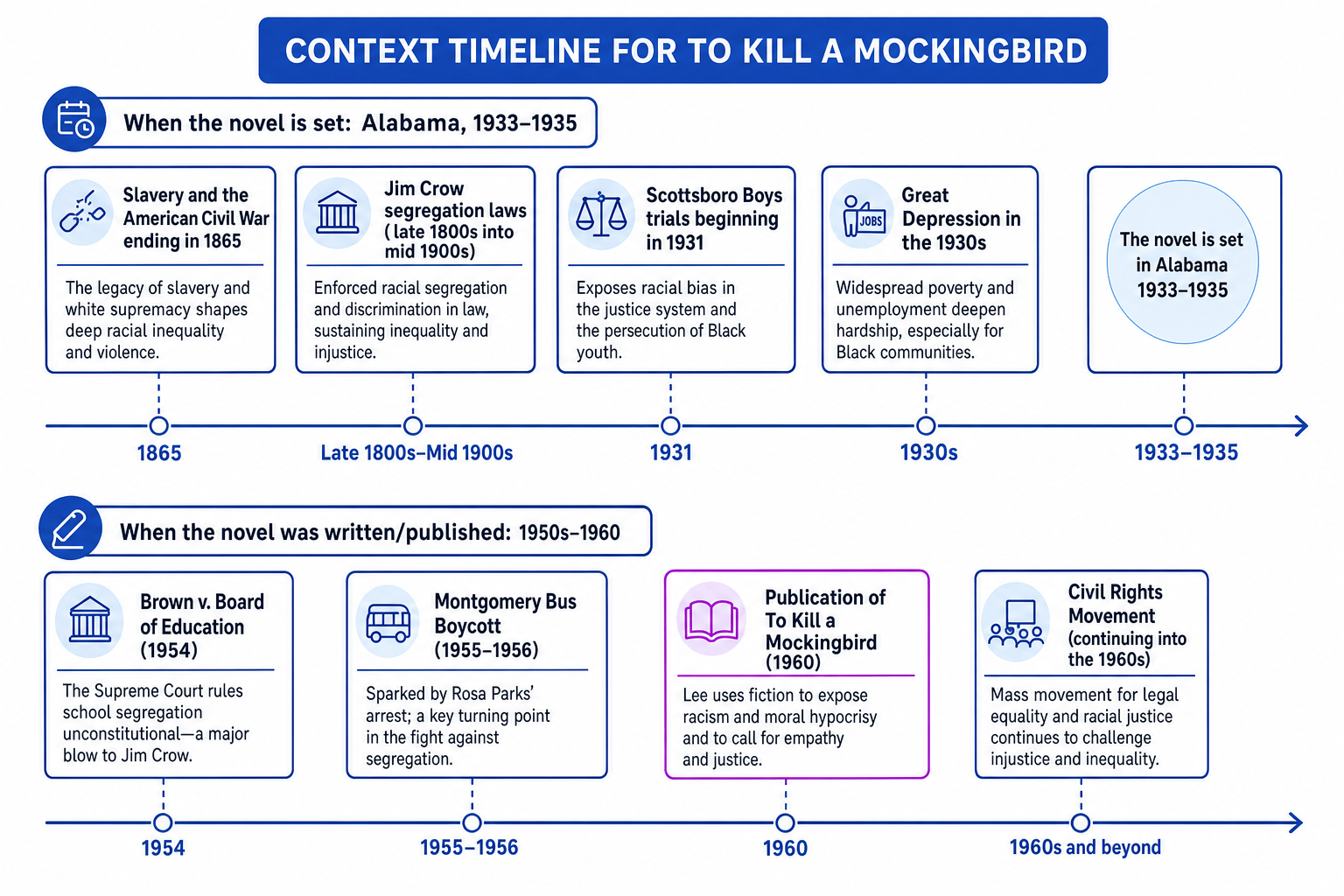
The setting is when and where the story takes place. The publication context is the time when the text was written and first read by its audience.
The novel is set in fictional Maycomb, Alabama, during the Great Depression of the 1930s. Scout remembers Maycomb as “an old town” and “a tired old town”, where there was “nothing to buy and no money to buy it with”. This immediately connects the town’s slow pace and social tensions to economic hardship.
However, Harper Lee published the novel in 1960, during the American Civil Rights Movement, when segregation and racial injustice were being challenged publicly. So the novel looks back at the 1930s from a later moment of social pressure and change.
This timeline helps you keep the novel’s setting separate from the period in which Lee was writing.
Jim Crow, segregation and racial injustice
Jim Crow laws
Jim Crow laws were laws and customs in the American South that enforced racial segregation and maintained white control over Black citizens from the late nineteenth century into the mid-twentieth century.
Segregation and white supremacy
Segregation means the enforced separation of racial groups. White supremacy is the racist belief system that white people are superior and should dominate society.
This context is central to Tom Robinson’s trial. Tom is accused by Mayella Ewell, a white woman, and his word is treated as worthless against hers despite the evidence. Atticus later tells Jem: “In our courts, when it’s a white man’s word against a black man’s, the white man always wins.”
Lee shows that the legal system claims to be fair, but in Maycomb it is corrupted by racism. Atticus exposes the racist stereotype behind the case when he refers to “the evil assumption” that “all Negroes lie” and that Black men are “not to be trusted around our women”. The repeated “all” shows how prejudice turns individual people into a false category.
Reading legal context in Atticus’s speech
-
Start with the context: in the Jim Crow South, Black defendants could be denied fair treatment by white juries and racist assumptions.
-
Connect that context to the text: Atticus says the case depends on “the evil assumption” that Black people are immoral and untrustworthy.
-
Analyse Lee’s method: the repeated generalisation “all” exposes how racism works by replacing evidence with stereotype.
-
Link to meaning: Lee presents Tom’s conviction not as a failure of facts, but as a failure of society’s conscience.
History dump
Do not write a long paragraph about Jim Crow and then forget the novel. A strong answer keeps returning to Lee’s characters, quotations and methods.
The Scottsboro Boys and the trial plot
In 1931, the Scottsboro Boys — nine Black teenagers in Alabama — were falsely accused of raping two white women. Their trials became a major symbol of racial injustice because of weak evidence, all-white juries and the wider racism of the legal system.
Tom Robinson’s trial is not a simple copy of the Scottsboro case, but it clearly echoes the same historical fears and injustices: a Black man is accused of sexual violence against a white woman, and the courtroom becomes a stage for the town’s racism.
This helps you understand why the trial is so powerful. Lee is not just writing about one unfair verdict. She is criticising a whole culture in which law, race and reputation are deeply unequal.
Poverty, class and the Great Depression
Great Depression
The Great Depression was a severe economic crisis during the 1930s, causing unemployment, poverty and hardship across America.
Maycomb’s poverty shapes the way people judge each other. Atticus says the Cunninghams are farmers and that “the crash hit them hardest”. This shows that even respectable families are struggling.
But Lee also shows that poverty does not erase racial privilege. The Ewells are poor and socially despised, yet Mayella’s whiteness still gives her power over Tom. Scout calls Mayella “the loneliest person in the world”, which invites some pity, but the novel does not excuse her lie or its consequences.
Using poverty context without excusing prejudice
-
Identify the economic context: the Depression makes Maycomb anxious, poor and socially divided.
-
Apply it to Mayella: her isolation makes Scout see her as “the loneliest person in the world”, so Lee complicates the reader’s response to her.
-
Contrast class with race: Mayella is poor, but Tom is Black in a racist society, so the court values her accusation over his truth.
-
Draw the conclusion: Lee shows that class hardship matters, but racism remains the more powerful force in the trial.
Gender roles and “Southern womanhood”
Patriarchy
Patriarchy is a social system in which men hold most power and women are expected to follow restrictive roles.
Scout is pressured to behave like a “lady”. Aunt Alexandra’s view that Scout “could not possibly hope to be a lady” if she wore “breeches” reflects narrow expectations for girls in Maycomb.
This gender context also matters in the trial. White Southern culture often idealised white women as pure and in need of protection. Atticus argues that Mayella has broken “a rigid and time-honored code” by kissing Tom. Because society cannot tolerate that truth, Tom is made to suffer.
Context explains, but does not excuse
Context helps explain why Maycomb thinks and behaves as it does. It does not make racism, sexism or injustice acceptable — Lee’s novel exposes and criticises them.
Religion and moral hypocrisy
Hypocrisy
Hypocrisy means claiming to have moral beliefs while behaving in a way that contradicts them.
Maycomb is shaped by Southern Christian culture, but Lee often contrasts genuine compassion with public respectability. Miss Maudie criticises people who are so busy worrying about “the next world” that they fail to “live in this one”.
This context is useful when writing about the missionary circle or the town’s judgement of others. Lee suggests that real morality is not about social status or religious performance, but about empathy and justice.
Harper Lee and the Civil Rights era
Harper Lee was born in Monroeville, Alabama, and knew the atmosphere of small-town Southern life. Her father was a lawyer, and this legal background helped shape the novel’s interest in courts, conscience and public duty.
The novel’s 1960 publication is crucial. It appeared after Brown v Board of Education in 1954, when the US Supreme Court ruled school segregation unconstitutional, and after the Montgomery Bus Boycott of 1955–56. Readers would have recognised the novel’s challenge to segregation and racial prejudice.
A sophisticated response can also notice the novel’s limits. Tom Robinson and Calpurnia are often filtered through Scout’s and Atticus’s perspectives, so the novel powerfully attacks racism while still reflecting the viewpoint of a white-authored 1960 text.
Careful quotation choices
The novel contains racist language. In essays, you can often refer to “Lee’s use of racist slurs” without reproducing the most offensive words. Choose precise quotations that help your argument.
Literary context: Southern Gothic and coming-of-age
Southern Gothic
Southern Gothic is a literary tradition that uses unsettling settings, secrets, violence and social decay to expose problems in the American South.
Maycomb looks ordinary, but Lee gradually reveals fear, cruelty and injustice beneath the surface. The Radley house has “rain-rotted shingles”, making it seem decayed and mysterious. This Gothic atmosphere reflects a town that hides moral corruption behind respectability.
Bildungsroman
A bildungsroman is a coming-of-age story in which a young character develops morally or emotionally.
Scout’s childhood perspective is important because she learns to question the adult world. Atticus’s advice — “climb into his skin and walk around in it” — becomes a moral lesson in empathy. Lee uses a child narrator to make Maycomb’s prejudices seem both ordinary to the town and shocking to the reader.
Using literary context in analysis
-
Identify the literary context: Southern Gothic often reveals hidden corruption inside a respectable community.
-
Link it to setting: the Radley house’s “rain-rotted shingles” create a sense of decay and secrecy.
-
Extend the idea: Maycomb’s real darkness is not Boo Radley, but the racism and fear exposed by Tom’s trial.
-
Link to Lee’s purpose: the Gothic atmosphere helps Lee show that evil can exist inside familiar, everyday places.
Writing about context well
A strong context sentence is usually short and tightly linked to the text:
- Weak: “In the 1930s there was racism in America.”
- Stronger: “By setting Tom’s trial in the Jim Crow South, Lee shows how a courtroom that claims to represent justice can still be controlled by racist assumptions.”
Try to build your paragraphs like this: point → evidence → method → effect → context link. Even though the main assessment focus is AO1 and AO4, mentioning Lee’s methods — such as symbolism, contrast, narrative voice or irony — helps make your interpretation sharper.
In the exam
-
Use context only when it changes your reading of a character, scene or quotation.
-
Remember that To Kill a Mockingbird is closed book in Component 1, so learn short, accurate quotations such as “the crash hit them hardest” and “the evil assumption”.
-
Avoid vague phrases like “back then everyone was racist”; be precise about Jim Crow, segregation, gender roles or Depression poverty.
-
Keep linking back to Lee’s purpose: she exposes prejudice and asks readers to judge Maycomb’s moral failures.
Check yourself
-
Can you explain the difference between the 1930s setting and the 1960 publication context?
-
How does Jim Crow context help explain Tom Robinson’s conviction?
-
Why is Mayella both a victim of poverty and a participant in racial injustice?
