When studying Harper Lee's 1960 novel To Kill a Mockingbird for your Edexcel IGCSE English Literature exam, it is vital to remember that characters are not real people. Instead, they are deliberate artistic creations—constructs designed by the author to convey specific thematic messages.
What you'll learn
- How Harper Lee constructs characters to represent key social and moral ideas in the 1930s American South.
- The structural function of Scout's unique narrative voice in tracing a journey of moral development.
- How to analyze character relationships and "foils" to unlock deeper thematic meanings.
Character as a Literary Construct
To achieve high marks in your closed-book exam, you must move beyond simply describing what characters do. You need to analyze how and why Lee presents them in specific ways.
Characterization
Characterization is the literary method by which an author builds a character's personality, values, physical appearance, and voice. Authors use dialogue, actions, internal thoughts, and other characters' reactions to craft this representation.
Lee writes from the perspective of the late 1950s, looking back at the mid-1930s. This was a time of severe economic hardship (the Great Depression) and deeply entrenched racial segregation under Jim Crow laws in the Southern United States. By analyzing how different characters navigate Maycomb’s rigid social hierarchy, we can see how Lee uses them to critique the historical injustices of her society.
Scout Finch: The Naive Protagonist
Jean Louise "Scout" Finch is the focal point of the novel. Her growth from a hot-tempered six-year-old into a more empathetic young girl structures the text as a classic bildungsroman.
Bildungsroman
A bildungsroman is a novel that focuses on the psychological, moral, and social growth of the protagonist from youth to adulthood.
The Dual Narrative Voice
One of Lee's most effective structural techniques is the use of a dual narrative voice. The story is narrated by an adult Scout looking back on her childhood, but it is told largely through the unfiltered, naive eyes of her younger self.
This technique serves several purposes:
- Defamiliarization: Because child-Scout does not fully understand the adult world's prejudices, her innocent observations expose the sheer absurdity and cruelty of racial and social biases.
- Humor and Irony: The gap between what child-Scout sees and what the reader (and adult-Scout) understands creates dramatic irony. For example, when she unintentionally diffuses the lynch mob at the jailhouse by politely asking Walter Cunningham Sr. about his "entailments," she has no idea how close she is to extreme violence.
- Moral Progression: The narrative mirrors Scout's gradual understanding of her father's central lesson:
"You never really understand a person until you consider things from his point of view... until you climb into his skin and walk around in it." (Chapter 3)
Atticus Finch: The Moral Compass
Atticus Finch stands as the moral anchor of Maycomb. He is a rare figure of absolute integrity in a town blinded by prejudice.
Atticus as a Model of Integrity
Atticus lives by the same moral code in public as he does in private. As Miss Maudie observes, "Atticus Finch is the same in his house as he is on the public streets" (Chapter 5). He represents the ideal of blind justice and empathetic parenting.
Lee constructs Atticus as a counter-cultural figure through several key methods:
- The "Dry" Lawyer: Atticus fights with intellect and language rather than physical force. Unlike other Southern men of his era, he does not hunt, drink, or boast.
- Symbolism of his Glasses: Atticus's physical vulnerability is symbolized by his poor eyesight and glasses. Ironically, while he is physically "blind" in one eye, he is the only character who truly "sees" the moral truth of Tom Robinson's innocence. When he drops his glasses before shooting the mad dog (Tim Johnson), it foreshadows how he must cast aside his civilized, intellectual nature to confront the raw, destructive prejudice of Maycomb.
Character Foils and the Maycomb Hierarchy
To highlight specific character traits and themes, Lee pairs characters as foils.
Foil
A foil is a character whose qualities contrast sharply with those of another character, thereby highlighting and emphasizing the distinctive traits of both.
The following character-relationship map illustrates how characters are grouped to highlight the novel's central themes:
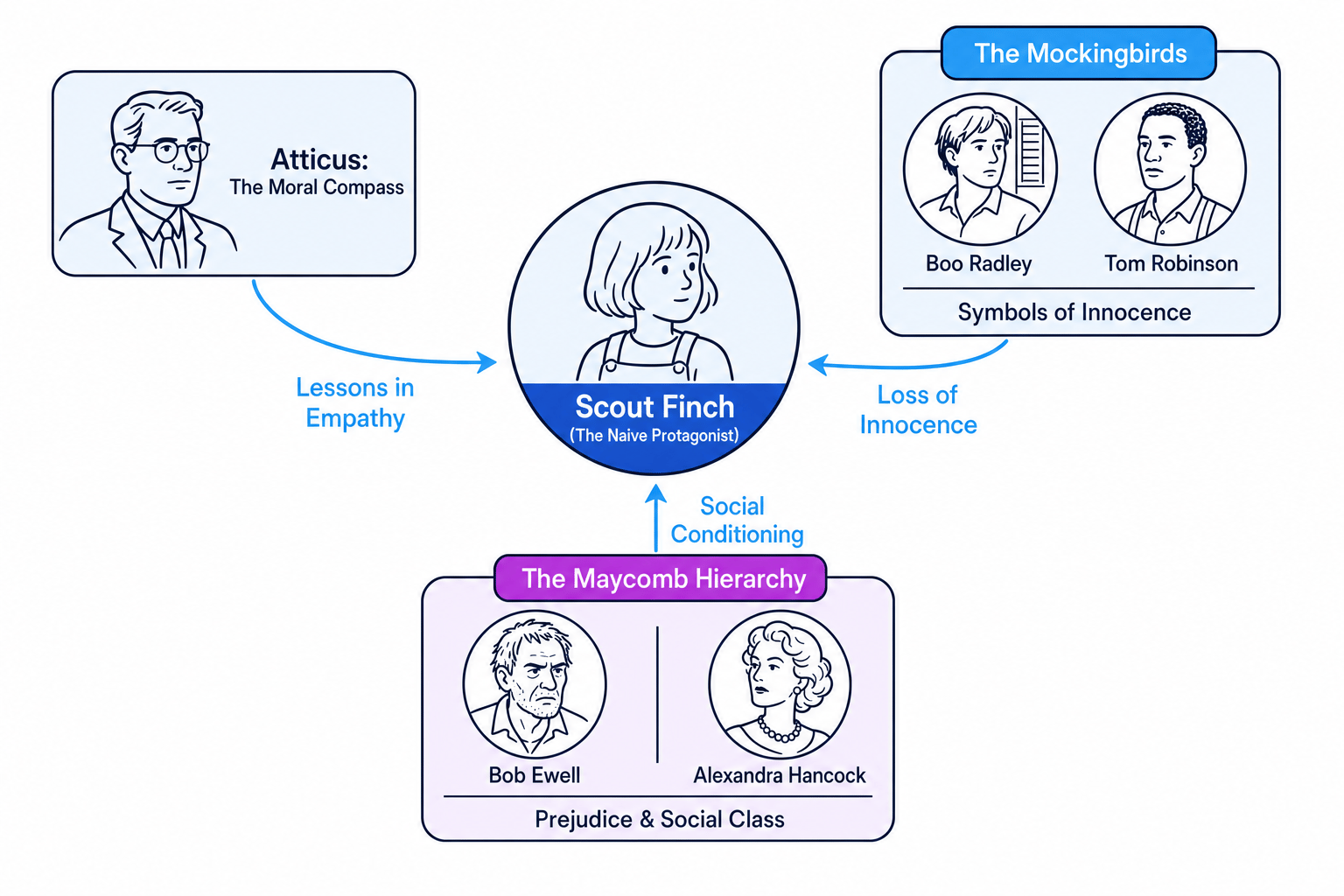
1. The Mockingbirds: Tom Robinson and Boo Radley
Both Tom and Boo are innocent, vulnerable individuals who are targeted by the predatory elements of Maycomb. They are connected by the central mockingbird motif. As Miss Maudie explains:
"Mockingbirds don't do one thing but make music for us to enjoy... they don't do one thing but sing their hearts out for us. That's why it's a sin to kill a mockingbird." (Chapter 10)
- Tom Robinson is the literal victim of racial injustice. His kindness to Mayella Ewell is twisted into a capital crime because of the color of his skin.
- Arthur "Boo" Radley is the victim of social isolation and cruel gossip. He is shut away from a world he is too gentle to inhabit, yet he remains a protective, quiet guardian to Scout and Jem.
2. Social Extremes: The Cunninghams vs. The Ewells
Lee uses Maycomb's white working class to show that poverty does not automatically dictate moral character.
- The Cunninghams (poor farmers) represent pride, independence, and a basic code of honor. They pay their debts with crops and refuse charity they cannot pay back.
- The Ewells (the "disgrace of Maycomb for three generations") represent the lowest tier of white society. Bob Ewell is abusive, illiterate, and relies on systemic racism to maintain a false sense of superiority over Black citizens like Tom Robinson.
3. Maternal Influences: Miss Maudie vs. Aunt Alexandra
Because Scout has grown up without a mother, she is influenced by two contrasting female figures:
- Aunt Alexandra represents traditional Southern womanhood, social class rigidity, and family heritage. She initially tries to force Scout into wearing dresses and acting like a "lady."
- Miss Maudie Atkinson represents progressiveness, open-mindedness, and nature. She respects the children as equals and helps Scout understand Atticus’s integrity and the community's flaws.
Confusing Tom and Boo's Functions
Do not treat Tom Robinson and Boo Radley as identical symbols. While both are "mockingbirds," Tom's tragedy is public, racial, and systemic, whereas Boo's struggle is private, psychological, and domestic. Distinguishing between their situations shows the examiner a highly sophisticated understanding of the novel's structure.
Worked Example: Developing a Character Analysis Paragraph
In your closed-book Edexcel exam, you must show how Lee uses language and structure (AO2) to present a character, while linking your points directly to the historical context of the American Deep South (AO4).
Below is a step-by-step walkthrough of how to construct a high-scoring analytical paragraph on Boo Radley’s development at the end of the novel.
Analyzing Boo Radley's Transformation
Analyze how Harper Lee presents the character of Boo Radley in the final chapters of the novel.
-
Step 1: Formulate a precise thesis point (AO1).
Start by explaining Boo’s shift from a gothic monster into a gentle human protector, highlighting Lee’s structural intention.
Draft: In the final chapters, Lee subverts the Gothic "monster" archetype of Boo Radley, transforming him into a symbol of quiet, vulnerable humanity to emphasize the theme of empathy. -
Step 2: Integrate precise textual evidence (AO1).
Introduce a specific quote that shows Boo's physical appearance and gentleness when Scout finally meets him in Chapter 29.
Draft: When Scout finally meets Boo in the light, she describes him as having "sickly white" hands and hair that was "as feather-like as dust," suggesting a delicate, non-threatening presence far removed from the neighborhood myths. -
Step 3: Analyze language and literary methods (AO2).
Identify and analyze the literary devices and word choices Lee uses to evoke sympathy and show Scout's maturing perspective.
Draft: The simile "as feather-like as dust" uses natural, fragile imagery to evoke a sense of Boo's extreme vulnerability. His "sickly white" skin is a physical manifestation of his long-term confinement, turning what the children once feared as a ghostly apparition into a real, suffering human being who has sacrificed his own safety to protect them. -
Step 4: Link to historical/social context and the author's message (AO4).
Explain how this characterization reflects the broader social context of the 1930s Southern United States and Lee's message.
Draft: Through this physical transformation, Lee critiques the destructive nature of Southern gossip and social exclusion. By showing Scout leading Boo home like a gentleman, Lee highlights that true Southern "chivalry" does not lie in the rigid social codes advocated by characters like Aunt Alexandra, but in quiet, unconditional compassion for the marginalized.
In the exam
- Focus on the prompt: Do not just write a biography of the character. Every paragraph must answer why the writer created them to behave or look a certain way.
- Memorize short, versatile quotes: Since the exam is closed-book, compile a bank of 3–5 short quotes per main character that can be used to discuss different themes (e.g., using "climb into his skin" for both Atticus's morals and Scout's development).
- Integrate context naturally: Never write a separate "context paragraph" at the end. Weave historical details (like the Jim Crow laws when discussing Tom, or Great Depression economics when discussing Walter Cunningham) directly into your language analysis.
Check yourself
- Why does Harper Lee use a child narrator to tell a story about racial violence and social prejudice?
- In what ways does Bob Ewell act as a thematic foil to Atticus Finch?
- What does the physical description of Boo Radley's hands ("sickly white") reveal about his character construct?
