What you'll learn
- How To Kill a Mockingbird is structured around two connected plot strands: Boo Radley and Tom Robinson.
- Why Harper Lee begins with Jem’s broken arm and then moves backwards through memory.
- The key events in the novel, in order, and why each one matters.
- How to use plot knowledge in an Edexcel IGCSE closed-book answer without simply retelling the story.
Plot: more than “what happens”
A plot summary explains the main events of a story in order, but for Literature you also need to understand why those events are arranged that way.
Plot
Plot means the sequence of events in a text, especially how causes and consequences are linked. In an exam, plot knowledge helps you make precise references and explain how characters, ideas and context develop.
In To Kill a Mockingbird, Harper Lee does not just tell a story about a court case. She builds a coming-of-age story in which Scout and Jem gradually learn that Maycomb’s ordinary, respectable surface hides cruelty, prejudice and moral courage.
The big picture
The novel’s plot moves from childhood misunderstanding to moral understanding: Scout begins by fearing Boo Radley, but ends by recognising his humanity.
The novel in one sentence
Scout Finch looks back on her childhood in 1930s Maycomb, Alabama, when her father Atticus defends Tom Robinson, a Black man falsely accused of rape, while Scout and Jem slowly discover the truth about their mysterious neighbour Boo Radley.
The opening: Jem’s broken arm
The novel begins near the end of the story: “When he was nearly thirteen, my brother Jem got his arm badly broken at the elbow.” Lee then takes us back to explain how this happened.
Frame narrative and flashback
A frame narrative is a story told from a later point in time, looking back on earlier events. A flashback is a movement back to events that happened before the main narrative moment.
This matters because the whole novel is shaped by memory. Scout is both a child inside the events and an older narrator looking back with more understanding.
Why start with Jem’s arm?
Reading the opening as structure
-
The first sentence tells us the ending involves Jem being injured, so the reader expects the plot to explain the cause of that injury.
-
The novel then moves backwards to childhood games, school, Boo Radley and Maycomb society, showing that the attack at the end is connected to much earlier events.
-
This structure makes the plot feel like an investigation: the reader slowly discovers how childish fear, racism, public violence and private courage all lead to the final Halloween night.
The two plot strands
Lee builds the novel around two main plot strands.
Plot strand
A plot strand is one line of action within a story. A novel can have several strands that run alongside each other and connect later.
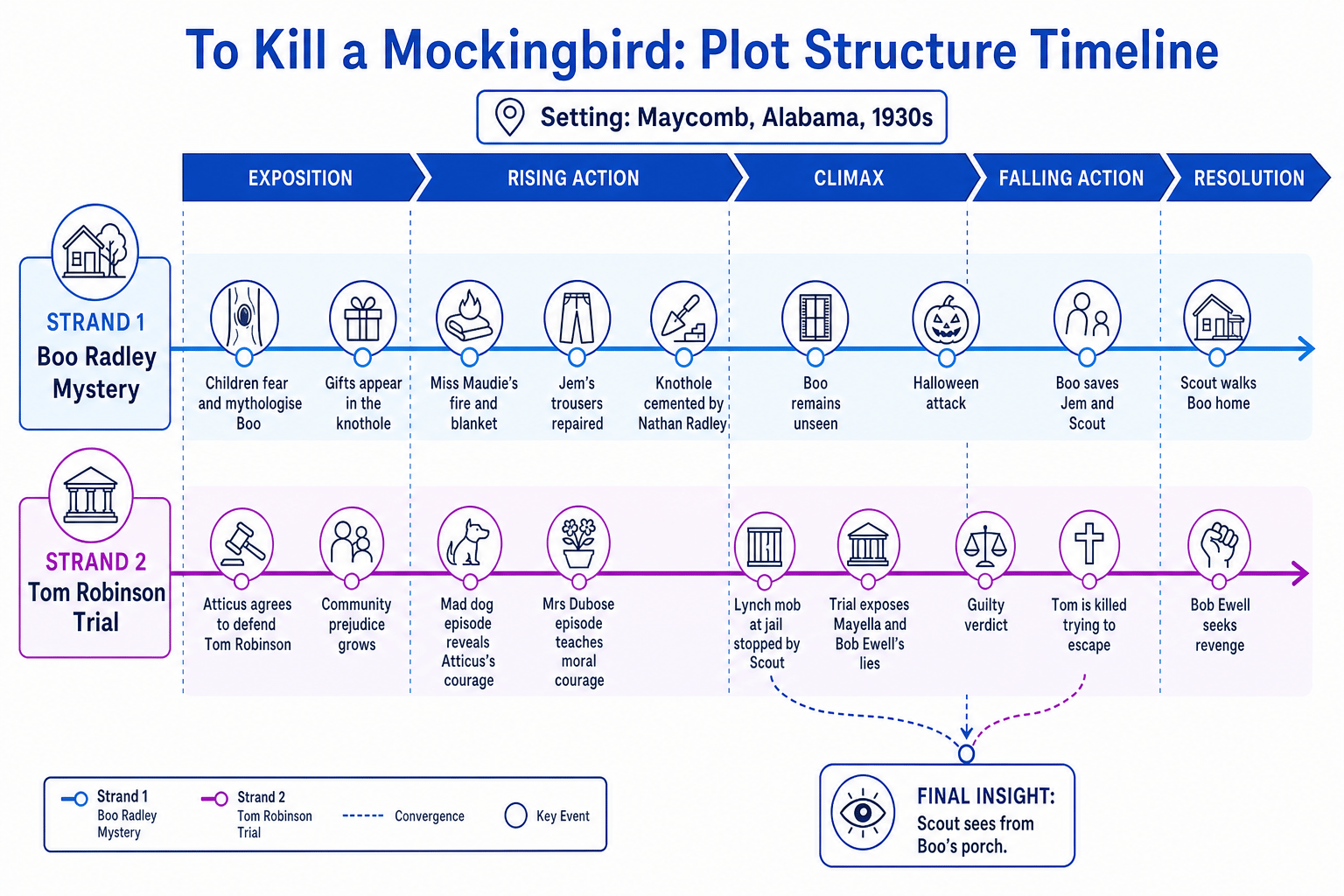
The first strand is the children’s fascination with Boo Radley. The second is Atticus’s defence of Tom Robinson. At first they seem separate, but they mirror each other: both Boo and Tom are judged by Maycomb before people truly know them.
Part One: Maycomb, childhood, and first lessons
Maycomb is introduced
The setting is Maycomb, Alabama, during the Great Depression. Scout calls it a “tired old town”, and the reference to people being told they had “nothing to fear but fear itself” places the story in the 1930s, during economic hardship.
This context matters for Edexcel because To Kill a Mockingbird is assessed partly through AO4: the relationship between the text and its context. Maycomb is segregated, hierarchical and deeply racist, so the trial does not happen in a neutral society.
Boo Radley becomes a childhood mystery
Scout, Jem and Dill are fascinated by Arthur “Boo” Radley, who has not been seen outside for years. They imagine him as frightening and almost supernatural. Their games, dares and stories show how easily people turn another person into a myth.
Important Boo-related events include:
- the children daring each other to touch the Radley house;
- small gifts appearing in the knothole of the tree;
- Jem finding his torn trousers mysteriously mended;
- Scout receiving a blanket during Miss Maudie’s house fire;
- Nathan Radley cementing up the knothole.
These events quietly suggest that Boo is not a monster. He is watching kindly from the margins.
Atticus takes Tom Robinson’s case
Atticus is appointed to defend Tom Robinson and chooses to do it properly, even though Maycomb disapproves. Scout hears insults at school because her father is defending a Black man.
Atticus tells Scout that conscience matters more than popularity: “The one thing that doesn’t abide by majority rule is a person’s conscience.” This prepares us for the trial, where the majority will be wrong.
The mad dog and Mrs Dubose
Two episodes prepare the reader for the trial.
First, Atticus shoots Tim Johnson, the rabid dog. The scene reveals that Atticus is capable of action, not just words. More importantly, it suggests that Maycomb has a kind of “disease” too: racism.
Second, Mrs Dubose teaches Jem about courage. Atticus explains: “I wanted you to see what real courage is… when you know you’re licked before you begin but you begin anyway and you see it through no matter what.” This becomes a key idea for Atticus’s defence of Tom: he knows he is unlikely to win, but he fights because it is right.
Remember the build-up
Part One is not “just childhood”. It prepares the trial by teaching you about Maycomb’s rumours, social divisions, racism and ideas of courage.
Part Two: the trial becomes central
Calpurnia’s church and Aunt Alexandra
Calpurnia takes Scout and Jem to First Purchase African M.E. Church. This gives the children, and the reader, a clearer view of Maycomb’s Black community and of Tom Robinson’s family. Aunt Alexandra then arrives to impose ideas about family, class and “proper” behaviour.
These chapters widen the plot beyond the Finch household. The trial is not only a legal event; it affects the whole town.
The jailhouse scene
Before the trial, a mob comes to the jail where Tom is being held. Scout innocently speaks to Mr Cunningham: “Hey, Mr. Cunningham.” By reminding him of his individual identity and his son Walter, she breaks the mob atmosphere.
This is a crucial turning point because it shows how easily ordinary people can become violent when they act as part of a group. It also shows Scout’s innocence creating a moral effect she does not fully understand.
The trial: the central public crisis
At the trial, Atticus shows that the evidence against Tom is weak. Mayella Ewell’s injuries suggest she was beaten by someone left-handed, and Bob Ewell is left-handed. Tom’s left arm is disabled, making the accusation physically unlikely.
Tom’s honesty becomes dangerous when he says, “I felt right sorry for her.” In Maycomb’s racist society, a Black man expressing pity for a white woman is treated as socially unacceptable, even though it is morally humane.
Atticus ends by asking the jury: “In the name of God, do your duty.” However, the jury still finds Tom guilty. Jem is devastated because he believed the truth would be enough.
Linking the verdict to meaning
-
Place the verdict after Atticus has exposed the weaknesses in the Ewells’ story, so the conviction cannot be explained by strong evidence.
-
Compare legal truth with social prejudice: the courtroom should represent justice, but Maycomb’s racism controls the outcome.
-
Link the event to context: in the segregated American South of the 1930s, Tom’s race makes him vulnerable before the trial even begins.
-
Use the plot consequence: Jem’s shock shows the collapse of childhood faith in fairness.
After the trial: consequences and revenge
After the guilty verdict, the novel does not immediately end. This is important: Lee shows the consequences of injustice.
Tom Robinson tries to escape from prison and is shot dead. His death confirms that the legal system has failed him completely. Mr Underwood compares it to the “senseless slaughter of songbirds”, strengthening the mockingbird idea: innocent beings are destroyed by cruelty.
Bob Ewell also seeks revenge. He spits at Atticus, harasses Helen Robinson and finally attacks Jem and Scout after the Halloween pageant. This proves that the trial has exposed Bob’s violence rather than ended it.
Calling the ending a simple happy ending
The children survive and Boo is finally understood, but Tom Robinson is dead and Maycomb’s racism remains. The ending offers moral insight, not full justice.
The ending: Boo Radley steps into the plot
On Halloween night, Scout and Jem walk home through the dark after the school pageant. Bob Ewell attacks them. Jem’s arm is broken, fulfilling the event mentioned in the novel’s first sentence.
Boo Radley saves the children. Heck Tate decides to say publicly that Bob Ewell “fell on his knife”, protecting Boo from public attention. Scout understands this decision and says exposing Boo would be “sort of like shootin’ a mockingbird”.
This links the two plot strands. Boo, like Tom, is a vulnerable figure who has been misjudged by society. Unlike Tom, Boo is protected at the end.
Scout on Boo’s porch
The final scene is quiet but deeply important. Scout walks Boo home and stands on his porch. She remembers Atticus’s lesson about understanding other people: “Just standing on the Radley porch was enough.”
The plot has come full circle. The child who once feared Boo now sees the world from his position.
The resolution
The ending resolves the Boo Radley mystery, but it does not resolve the injustice of Tom Robinson’s death. That mixture makes the novel morally serious rather than sentimental.
Using plot in a closed-book exam
For Edexcel IGCSE, To Kill a Mockingbird is in Component 1, so it is closed book. You will not have a clean copy in front of you. This means your plot knowledge needs to be secure enough to support AO1: close knowledge and understanding, with relevant textual references.
You do not need to memorise every chapter. Instead, remember the main sequence:
- Maycomb and Boo are introduced.
- Atticus defends Tom.
- The children learn about courage and prejudice.
- The jail mob threatens Tom.
- The trial exposes the truth but produces a guilty verdict.
- Tom is killed.
- Bob Ewell attacks Jem and Scout.
- Boo saves them.
- Scout finally understands Boo’s perspective.
In the exam
-
Locate the moment precisely: say whether it comes before the trial, during the trial, after the verdict, or at the ending.
-
Use short, accurate references rather than long retelling: for example, “In the name of God, do your duty” or “Just standing on the Radley porch was enough.”
-
Link plot to context when relevant, especially Maycomb’s racism, segregation and social hierarchy in the 1930s American South.
-
Explain significance: do not just say what happens; say what the event reveals about childhood, justice, prejudice or moral courage.
Check yourself
- Why does Lee begin with Jem’s broken arm rather than starting with the trial?
- How do the Boo Radley and Tom Robinson plot strands mirror each other?
- What has Scout understood by the time she stands on Boo Radley’s porch?
