What you'll learn
- What To Kill a Mockingbird is about and how its main plot strands fit together.
- How Harper Lee uses Scout’s narration, Maycomb’s setting, and the mockingbird symbol.
- Why context matters for Edexcel IGCSE: especially racism, justice, childhood, and moral courage.
- How to turn overview knowledge into exam-ready analytical points.
The big picture
To Kill a Mockingbird is a 1960 novel by Harper Lee, set in the fictional town of Maycomb, Alabama, during the 1930s. It is narrated by Jean Louise “Scout” Finch, who looks back on her childhood with her brother Jem, her father Atticus, and their neighbour Arthur “Boo” Radley.
The novel begins with a mystery about Jem’s broken arm: “When he was nearly thirteen, my brother Jem got his arm badly broken at the elbow.” From there, Scout traces the events that led up to it, including the children’s fascination with Boo Radley and Atticus’s defence of Tom Robinson, a Black man falsely accused of raping a white woman, Mayella Ewell.
The novel in one sentence
Harper Lee uses a child’s memories of a small Southern town to expose racism, injustice, fear, and prejudice — while also showing how empathy and moral courage can challenge them.
Plot and structure: two stories that connect
At first, the novel seems to be about childhood games and the mystery of Boo Radley. Later, the Tom Robinson trial becomes the central focus. By the end, these two strands connect: Scout finally understands Boo as a real person, not a monster from children’s stories.
Structure
Structure means the way a writer organises a text: the order of events, shifts in focus, beginnings and endings, repeated patterns, and moments of contrast or climax.
The novel has two broad parts:
Part One: childhood and Maycomb
Scout, Jem, and Dill spend their summers playing, imagining Boo Radley as terrifying, and learning lessons from Atticus and other adults. Maycomb is introduced as “an old town” and “a tired old town”, suggesting slowness, tradition, and social stagnation.
Part Two: the trial and moral testing
Atticus defends Tom Robinson, even though the racist community expects Tom to be found guilty. The trial reveals Maycomb’s injustice clearly: truth is less powerful than racial prejudice. Tom is convicted despite the evidence showing he could not have committed the crime.
The ending: Boo becomes human
Bob Ewell attacks Jem and Scout. Boo Radley saves them. Scout finally stands on Boo’s porch and sees the world from his perspective, fulfilling Atticus’s earlier lesson: “You never really understand a person until you consider things from his point of view.”
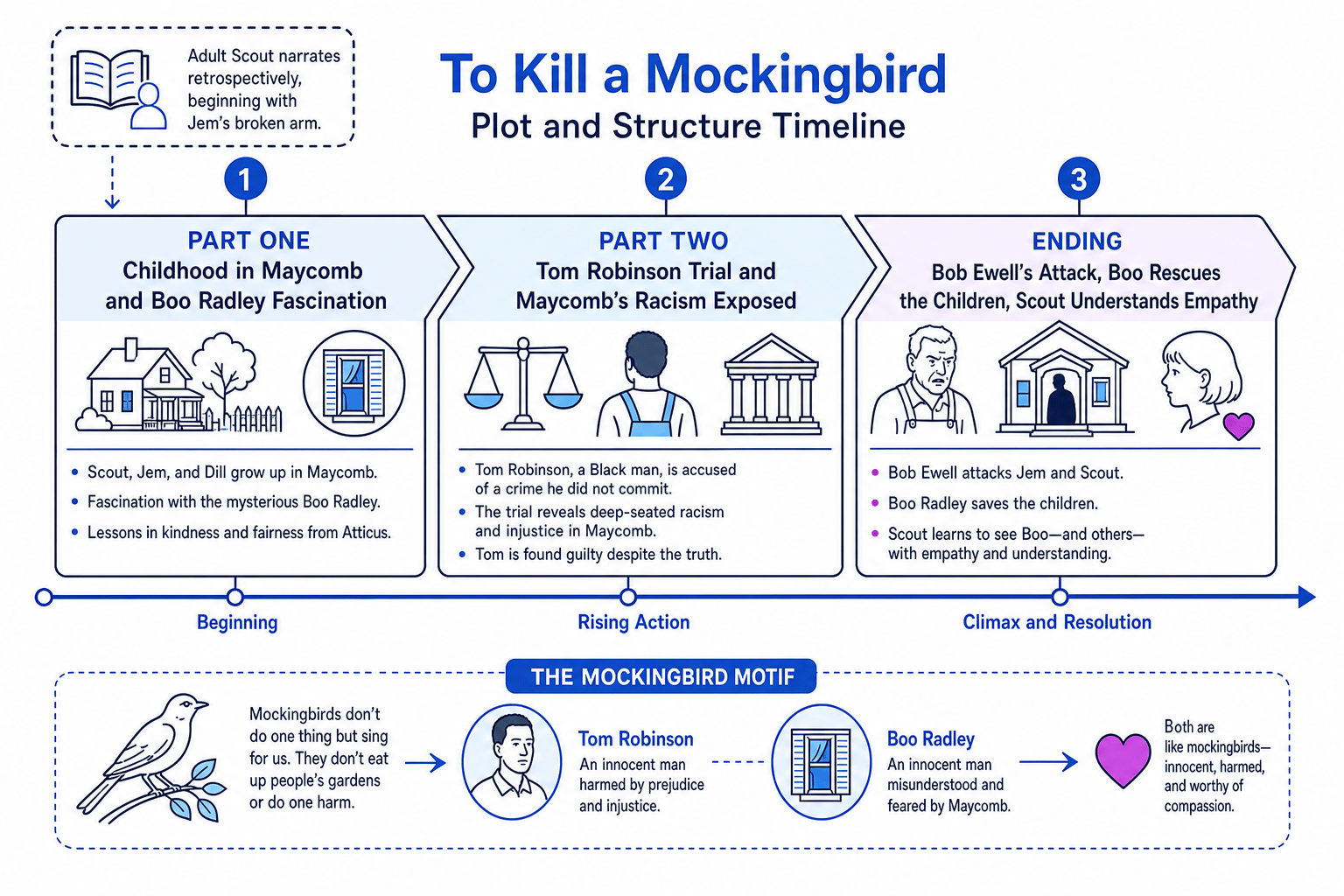
Connecting the two plot strands
- Identify the first plot strand: the children treat Boo Radley as a mystery or monster, showing their childish misunderstanding.
- Identify the second plot strand: Tom Robinson is judged by racist assumptions rather than truth, showing Maycomb’s adult prejudice.
- Connect them through Lee’s message: both Boo and Tom are harmed by false stories told about them.
- Link to the ending: Scout’s sympathy for Boo shows that she has learned Atticus’s lesson about empathy, even though the town fails to apply that lesson to Tom.
Narration: Scout as child and adult
The story is told in the first person, meaning Scout uses “I” and describes events from her own perspective. However, the narration is more complex than it first appears.
First-person retrospective narration
First-person narration means the story is told by a character using “I”. Retrospective narration means the narrator is looking back on past events from a later point in life.
This matters because Scout is both a child in the events and an older narrator remembering them. The child Scout often misunderstands things, but the adult Scout’s language helps the reader see deeper meanings.
For example, Scout describes Maycomb as “a tired old town”. A child might simply notice the heat and slowness, but the adult narrator’s phrase also suggests a community worn down by old habits, old prejudices, and old social rules.
Scout’s voice
When writing about Scout, try to mention the double viewpoint: she is innocent as a child, but the narration often shows adult understanding.
Setting: Maycomb as a small-town society
Maycomb is fictional, but it represents many real features of the American Deep South in the 1930s: racial segregation, poverty, class hierarchy, and strict expectations about behaviour.
Setting
Setting means where and when a text takes place. It includes location, time period, social conditions, and atmosphere.
Maycomb is not just a background. It shapes the plot. The town’s social order decides who is believed, who is respected, and who is excluded. Atticus, as a white lawyer, has status. Tom Robinson, as a Black man, is denied justice. The Ewells are white and poor, but even they are placed above Black citizens in Maycomb’s racist hierarchy.
Lee’s description of Maycomb as “tired” suggests more than physical heat. It implies a town stuck in old ways, especially old prejudices.
Linking setting to meaning
- Start with a precise setting detail: Maycomb is presented as “a tired old town”.
- Analyse the implication of the adjective “tired”: it suggests age, slowness, and lack of progress.
- Connect this to society: the town’s racism is also old and deeply rooted, not just the opinion of one villain.
- Link to the trial: Tom Robinson’s conviction shows that Maycomb’s legal system is shaped by the prejudices of the community.
Context: why the 1930s and 1960 matter
For Edexcel, To Kill a Mockingbird is a modern prose text in Component 1, which is closed book. You need to know the text well and use short, accurate references from memory. The key assessment focus is your understanding of the novel and its context — not just naming historical facts, but showing how context affects meaning.
Context
Context means the circumstances surrounding a text: the historical period it is set in, the period when it was written, and the social ideas that influence it.
The novel is set in the 1930s, during the Great Depression, when many Americans experienced severe poverty. It is also set in the era of Jim Crow laws, which enforced racial segregation in the American South.
However, Lee published the novel in 1960, during the Civil Rights Movement, when activists were challenging racial segregation and demanding equal rights. This means the novel looks back at the 1930s while also speaking to the racial tensions of Lee’s own time.
Bolting on context
Do not write a paragraph of history and then ignore the novel. Context works best when it explains a moment in the text, such as why the jury believes Mayella Ewell over Tom Robinson despite the evidence.
The mockingbird symbol
The title comes from Atticus’s warning: “Shoot all the bluejays you want, if you can hit ’em, but remember it’s a sin to kill a mockingbird.” Miss Maudie explains that mockingbirds “don’t do one thing but make music for us to enjoy” and “don’t do one thing but sing their hearts out for us.”
Symbolism
Symbolism is when a person, object, place, or action represents a larger idea beyond its literal meaning.
In the novel, mockingbirds symbolise innocent people who do no harm but are damaged by cruelty or prejudice. Tom Robinson is the clearest example: he helps Mayella and is destroyed by racism. Boo Radley is also linked to the mockingbird idea because he is gentle and protective, yet he has been feared, gossiped about, and misunderstood.
The title’s meaning
To “kill a mockingbird” means to destroy innocence. Lee uses this symbol to criticise a society that harms vulnerable people instead of protecting them.
Main themes you need to recognise
Theme
A theme is a central idea explored across a text, such as justice, prejudice, innocence, or courage.
Prejudice and racism
The most important social issue in the novel is racism. Tom Robinson is convicted not because the evidence proves his guilt, but because Maycomb’s white society refuses to treat a Black man’s word as equal to a white woman’s.
Justice and injustice
The courtroom should represent fairness, but Lee shows that the law can be corrupted by prejudice. Atticus exposes the truth, but the jury still convicts Tom. This makes the trial one of the novel’s most powerful criticisms of society.
Childhood and growing up
Scout and Jem begin with childish ideas about Boo Radley and simple beliefs about fairness. As the novel develops, they discover that adults and institutions can be deeply unjust. Jem is especially shaken by the verdict because he expects justice to win.
Empathy and moral courage
Atticus teaches Scout to imagine other people’s perspectives. His advice about climbing into someone’s “skin” becomes one of the novel’s central moral lessons. Atticus also shows courage by defending Tom even though he knows he is unlikely to win.
Moral courage
Moral courage means doing what is right even when it is unpopular, dangerous, or unlikely to succeed.
Atticus explains this clearly when he says, “The one thing that doesn’t abide by majority rule is a person’s conscience.” He is not heroic because he wins; he is heroic because he acts according to conscience despite the town’s hostility.
How to think about Atticus in an overview
Atticus Finch is central to the novel’s moral framework. He is calm, principled, and committed to justice. However, strong exam responses avoid treating him as perfect or writing vague praise.
Instead, focus on what Lee uses him to show. Through Atticus, Lee explores conscience, parenting, justice, and resistance to prejudice. His defence of Tom Robinson shows that individual integrity matters, but the verdict also shows that one good person cannot easily fix a corrupt society.
Writing about Atticus
A strong sentence might begin: “Lee presents Atticus as morally courageous, but she also uses the failure of the trial to show the limits of individual goodness in a racist society.”
How to use overview knowledge in essays
In the exam, you should not retell the whole plot. Use overview knowledge to frame an argument. A good paragraph usually moves from point, to evidence, to method, to effect, to a link back to the question.
Building an overview-based paragraph
- Make a focused point: Lee presents Maycomb as a community where prejudice is built into everyday life, not just the courtroom.
- Choose brief evidence: the town is described as “tired”, which suggests stagnation and resistance to change.
- Name the method and analyse it: the adjective implies that Maycomb is physically slow but also morally stuck in old racist attitudes.
- Link to the wider novel: this helps explain why Tom Robinson is convicted despite Atticus revealing the truth.
- Connect to Lee’s purpose: Lee criticises a society that protects tradition and racial hierarchy more strongly than justice.
What to memorise first
Because Component 1 is closed book, you need a small bank of accurate quotations. For an overview, prioritise short quotations that connect to several themes:
- “a tired old town” — Maycomb, setting, stagnation, prejudice.
- “climb into his skin and walk around in it” — empathy, perspective, Atticus’s teaching.
- “it’s a sin to kill a mockingbird” — innocence, symbolism, moral harm.
- “The one thing that doesn’t abide by majority rule is a person’s conscience” — moral courage, Atticus, justice.
- “When he was nearly thirteen, my brother Jem got his arm badly broken” — structure, retrospective narration, foreshadowing.
Foreshadowing
Foreshadowing is when a writer hints at events that will happen later in the text.
The opening reference to Jem’s broken arm foreshadows the ending and makes the novel feel carefully shaped: the story circles back to explain how Jem was injured and what Scout learned.
In the exam
- Start from the question, then choose the parts of the novel that best support your argument — do not simply narrate the plot.
- Use short, accurate quotations and explain how Lee’s methods, such as symbolism, setting, narration, and structure, shape meaning.
- Link context directly to the text: show how racism, segregation, poverty, or 1930s Southern society affects characters and events.
Check yourself
- Why does the novel begin with Jem’s broken arm, even though the attack happens near the end?
- How does Boo Radley’s story connect with Tom Robinson’s story?
- What does Maycomb’s description as “a tired old town” suggest about its society?
