What you'll learn
- How to build a clear essay argument on The Scarlet Letter rather than retelling the plot.
- How to use short quotations accurately in an open-book Component 2 response.
- How to connect Hawthorne’s methods — especially symbolism, structure and imagery — to meaning.
- How to shape model paragraphs that meet AO1, AO2 and AO4 together.
The aim of a strong Scarlet Letter essay
In Edexcel IGCSE English Literature, The Scarlet Letter appears in Component 2, Section B: Literary Heritage. This section is open book, meaning you may use a clean copy of the novel. However, “open book” does not mean “easy quote hunt”. You still need a clear argument, precise references and close analysis.
Your essay should show three things at once:
- AO1: you know the novel well and can write a personal, critical response.
- AO2: you can analyse Hawthorne’s language, form and structure.
- AO4: you can connect the novel to relevant context, especially Puritan society, public shame, sin and moral judgement.
Thesis
A thesis is your central argument: the main idea your whole essay proves. It should answer the question directly and suggest Hawthorne’s wider purpose.
Argument first
A model essay is not a tour of the novel. It is a shaped argument about what Hawthorne is showing and how he makes the reader think or feel.
Use this flowchart as a basic route from question to full essay.
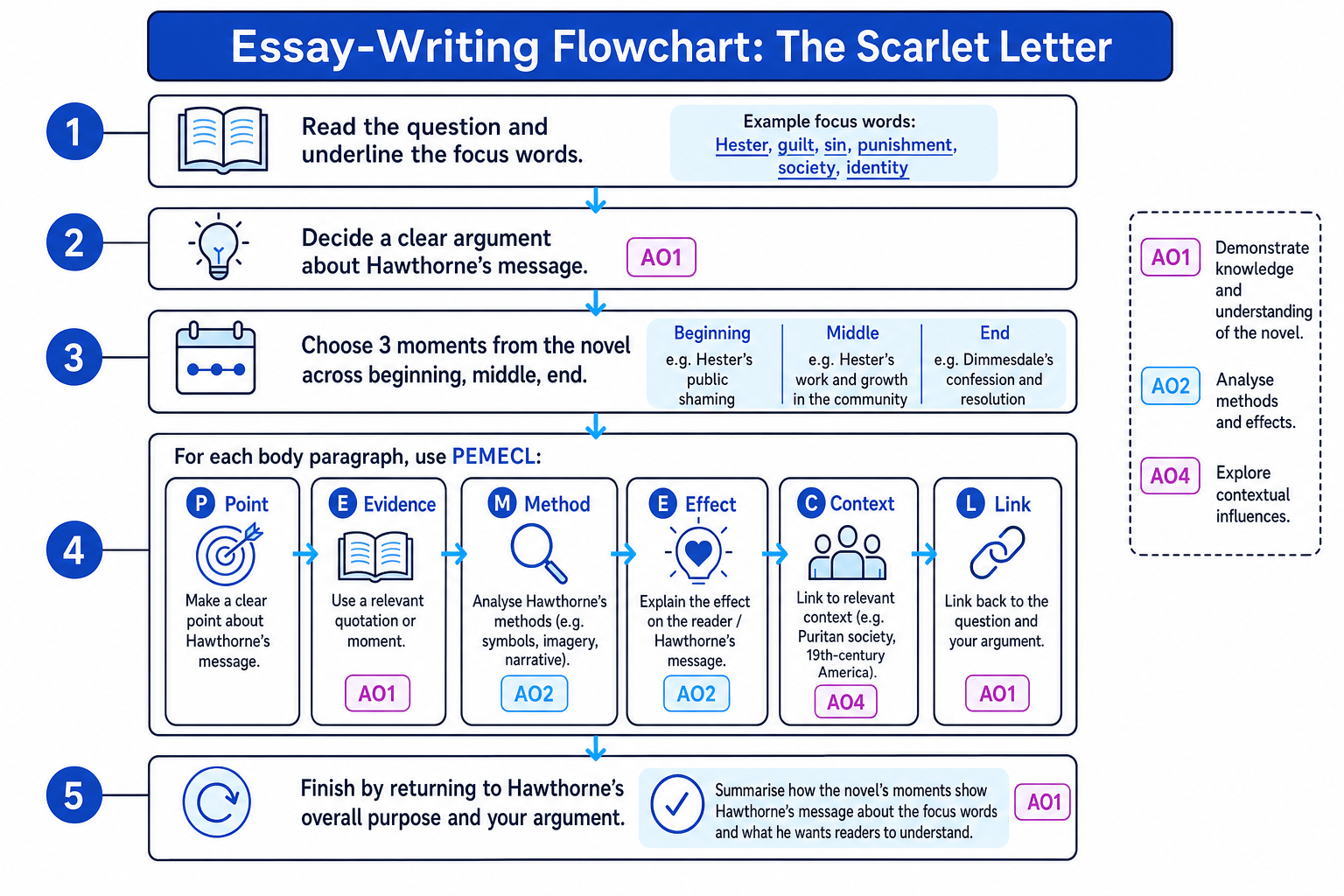
Step 1: Turn the question into an argument
Many Scarlet Letter questions ask you to “explore” a character, theme or symbol. Explore means you should consider how Hawthorne develops the idea across the novel, not just list examples.
For example, a question might ask:
Explore how Hawthorne presents the scarlet letter as a symbol in the novel.
A weak answer would say: “The letter symbolises sin.” That is true, but too simple. A stronger answer notices that the letter’s meaning changes: it begins as public punishment, becomes part of Hester’s identity, and also reflects Dimmesdale’s hidden guilt.
Building a thesis about the scarlet letter
-
Identify the focus of the question: the scarlet letter as a symbol, so the essay must discuss meanings attached to the letter rather than only describing when it appears.
-
Track how the symbol changes across the novel: in Chapter 2 it marks Hester’s shame; in Chapter 13 people say it “meant Able”; by the ending, Hawthorne links it to truth, secrecy and moral identity.
-
Convert that pattern into an argument: Hawthorne presents the scarlet letter as an unstable symbol whose meaning is first imposed by Puritan society but gradually reshaped by Hester’s strength and Dimmesdale’s guilt.
-
Add Hawthorne’s purpose: this suggests Hawthorne criticises any society that tries to reduce a complex human being to one public label.
Step 2: Plan across the whole novel
A good essay usually needs evidence from the beginning, middle and end of the novel. This shows AO1 because you understand the whole text, not just one famous scene.
For The Scarlet Letter, structure is especially important. Hawthorne builds the novel around repeated public and private moments: the scaffold scenes, the forest meeting, Dimmesdale’s confession, and the changing meaning of the letter.
Model essay plan: the scarlet letter as a symbol
| Paragraph | Moment from the novel | Short evidence | Main method | Argument |
|---|---|---|---|---|
| 1 | Hester’s public shame in Chapter 2 | “fine red cloth” and “gold thread” | Symbolism and visual imagery | The letter is meant to punish Hester, but its beauty already challenges society’s attempt to humiliate her. |
| 2 | Hester’s later reputation in Chapter 13 | “They said that it meant Able” | Symbolic shift | Hester partly remakes the meaning of the letter through endurance, work and compassion. |
| 3 | Dimmesdale’s hidden guilt | “Mine burns in secret!” | Contrast and motif | Hawthorne suggests concealed sin can be more spiritually destructive than public shame. |
| Conclusion | Final moral reflection | “Be true! Be true! Be true!” | Repetition | The novel’s final lesson is about truth, not simple punishment. |
Retelling the plot
Do not write one paragraph saying what happens in Chapter 2, then another saying what happens in Chapter 13. Each paragraph needs a clear analytical point about Hawthorne’s message.
Step 3: Analyse methods, not just meanings
A method is a writer’s choice. It might be language, such as imagery or metaphor; form, such as the novel’s moral romance style; or structure, such as repeated scaffold scenes.
Symbolism
Symbolism is when an object, person, place or action represents a larger idea. In The Scarlet Letter, the embroidered “A” symbolises sin, shame, identity, social judgement and eventually moral complexity.
When you name a method, always connect it to effect. Do not simply say “Hawthorne uses symbolism.” Ask: what does the symbol make the reader understand?
Model paragraph structure
A strong paragraph can follow this pattern:
- Point: make a clear claim that answers the question.
- Evidence: embed a short quotation or precise reference.
- Method: name Hawthorne’s choice.
- Effect: explain what the reader understands or feels.
- Context: connect to Puritan values or nineteenth-century reflection where relevant.
- Link: return to the question.
Writing a paragraph on “Able”
-
Begin with an arguable point: Hawthorne shows that the letter’s meaning is not fixed because Hester’s conduct gradually changes how the community reads it.
-
Choose concise evidence: in Chapter 13, the narrator says people “refused to interpret the scarlet A by its original signification” and “said that it meant Able”.
-
Analyse the method: the symbolic letter undergoes a semantic shift, meaning its meaning changes from one idea to another. The capitalised “Able” turns a mark of shame into a sign of strength.
-
Add context carefully: in a Puritan community, public signs of sin are meant to enforce moral obedience, so this change challenges the power of social judgement.
-
Put the ideas together: Hawthorne suggests that identity cannot be permanently controlled by punishment. Although society tries to define Hester by adultery, her “power to do, and power to sympathize” allows her to reshape the symbol into evidence of endurance.
Model essay opening
Here is a strong opening for the symbol question:
Hawthorne presents the scarlet letter as a changing symbol, not a fixed moral label. At first, the Puritan community intends the embroidered “A” to make Hester’s sin visible and permanent. However, as the novel develops, the letter becomes more ambiguous: it marks Hester’s isolation, but also her strength, compassion and independence. Through this shifting symbol, Hawthorne criticises a society that confuses public punishment with true moral understanding.
Notice what this introduction does. It answers the question, covers the whole novel, mentions context, and gives a line of argument. It does not waste time with a biography of Hawthorne or a plot summary.
Context in one sentence
For AO4, attach context to your argument: “Because Puritan Boston treats sin as a public offence, Hawthorne uses the scaffold and the letter to expose the cruelty of communal judgement.”
Model body paragraph
At the start of the novel, Hawthorne presents the scarlet letter as an instrument of public shame, but he also makes it visually powerful rather than merely degrading. In Chapter 2, the letter is made of “fine red cloth” and decorated with “fantastic flourishes of gold thread”, so its beauty clashes with the Puritan aim of humiliation. The rich visual imagery makes the punishment strangely impressive, suggesting that Hester cannot be reduced to the community’s judgement of her. Hawthorne’s narrator also says the letter has “the effect of a spell”, which gives it an almost supernatural force and separates Hester from “ordinary relations with humanity”. In the context of a strict Puritan society, where adultery is treated as both a religious and social crime, the letter is meant to control Hester’s identity. Yet Hawthorne’s description makes the reader see that the symbol is already unstable: it condemns Hester, but it also marks her individuality and resistance.
This paragraph keeps returning to the question. It does not just quote; it analyses how the details work.
Using Dimmesdale in symbol essays
Dimmesdale is useful in many essays because he creates a contrast with Hester. Hester’s shame is public; Dimmesdale’s guilt is hidden. In Chapter 17, he tells Hester, “Mine burns in secret!” This short sentence is powerful because the verb “burns” suggests pain, punishment and spiritual torment.
You can link this to the novel’s structure. Hawthorne repeatedly returns to the scaffold: Hester stands there publicly in Chapter 2; Dimmesdale stands there secretly at night in Chapter 12; he finally confesses there in Chapter 23. This repeated setting is a motif, meaning a recurring image or idea that develops meaning across a text.
Treating the letter as one simple symbol
Avoid saying the letter “just means sin”. Its meanings shift: shame, punishment, isolation, strength, hidden guilt, social control and truth. The best essays explore that complexity.
Model conclusion
A conclusion should not introduce a brand-new argument. It should sharpen your thesis.
Ultimately, Hawthorne uses the scarlet letter to question whether public punishment can ever reveal moral truth. The Puritan community believes the “A” fixes Hester’s identity, but the novel gradually proves that symbols can be reinterpreted and that hidden guilt may be more destructive than visible shame. By ending with the command “Be true! Be true! Be true!”, Hawthorne suggests that honesty and self-knowledge matter more than society’s outward labels.
This works because it returns to the whole novel and Hawthorne’s purpose.
Adapting the same method to other questions
You can reuse the same essay technique for many Scarlet Letter questions.
If the question is about Hester
Your thesis could argue that Hawthorne presents Hester as both punished by and resistant to Puritan society. Useful evidence includes the “fine red cloth” of the letter, her isolation, and the later judgement that the letter “meant Able”.
If the question is about guilt
Your thesis could compare public and private guilt. Hester suffers openly, Dimmesdale’s guilt “burns in secret”, and Chillingworth becomes morally corrupted by revenge.
If the question is about society
Your thesis could argue that Hawthorne presents Puritan society as harsh, watchful and morally confident, but not always truly Christian in mercy. The scaffold, prison door and public judgement are especially useful.
In the exam
-
Spend a few minutes shaping a thesis before you write; your argument should cover the beginning, middle and end of the novel.
-
Use the open-book text to check short, precise quotations, but do not waste time copying long passages.
-
In every paragraph, link method to meaning: explain how Hawthorne’s symbolism, imagery or structure shapes the reader’s view of sin, guilt, identity or society.
Check yourself
-
Can you explain how the meaning of the scarlet letter changes across the novel?
-
Can you write one paragraph that includes evidence, method, effect and context without retelling the plot?
-
Can you connect Dimmesdale’s secret guilt to Hester’s public shame?