What you'll learn
- How to turn a To Kill a Mockingbird question into a clear argument.
- How to build paragraphs that meet Edexcel’s AO1 and AO4 requirements.
- How to use short, accurate quotations in a closed-book exam.
- How to adapt model plans and paragraphs without memorising whole essays.
What a “model essay” is for
A model essay is a strong sample answer that shows you the kind of thinking, structure and evidence an examiner rewards. It is not a script to memorise.
For To Kill a Mockingbird, you are preparing for Pearson Edexcel International GCSE English Literature Component 1, Section C: Modern Prose. This section is closed book, which means you will not have a copy of the novel in the exam. You need short, accurate quotations and confident references to key moments.
Assessment objectives
An assessment objective is a skill the mark scheme rewards. For To Kill a Mockingbird, the main skills are AO1 — a clear, supported personal response to the text — and AO4 — understanding the relationship between the novel and its context.
The main job
A strong essay does not just retell the plot. It argues how Harper Lee presents an idea, character or theme, using precise evidence and relevant context.
Start with the question, not the quotation
Before choosing quotations, work out what the question is really asking.
A thesis is your central argument: the big idea your whole essay proves. A line of argument is the route your essay takes to prove that thesis, paragraph by paragraph.
For example, if the question asks about courage, you should not simply list brave characters. You need to decide what Lee suggests courage means.
Building a thesis about courage
-
Decide Lee’s main idea about courage. In the novel, courage is often moral rather than physical: Atticus says “real courage is” when “you know you’re licked before you begin, but you begin anyway”.
-
Choose moments that prove the idea across the novel. You might use Mrs Dubose’s struggle with morphine, Atticus defending Tom Robinson, and Scout learning to protect Boo Radley.
-
Add context that makes the argument sharper. In a racist 1930s Southern town, Atticus’s defence of Tom is courageous because it challenges the white majority’s values.
-
Turn this into a thesis: Harper Lee presents courage as the decision to do what is morally right even when defeat, criticism or social rejection seem inevitable.
A useful essay shape
A good model essay usually has a short introduction, three focused main paragraphs, and a concise conclusion. Each paragraph should make one clear point, support it with evidence, analyse Lee’s choices, connect to context, and link back to the question.
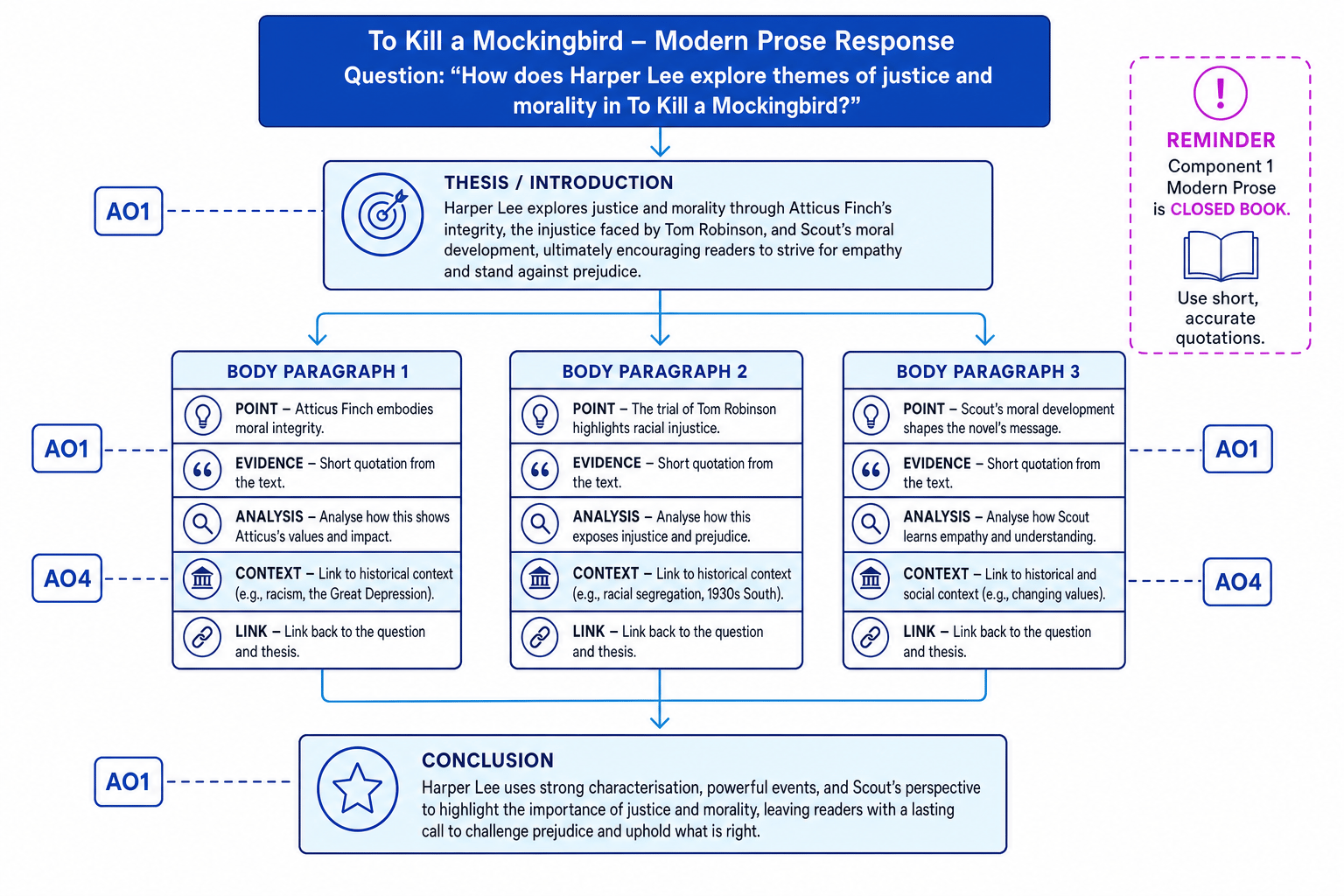
A topic sentence is the first sentence of a paragraph that states the paragraph’s main point. Evidence means a short quotation or precise reference to a moment in the novel. A writer’s method is a deliberate choice Lee makes, such as narrative perspective, symbolism, contrast, dialogue or structure.
Closed-book quotation strategy
Learn flexible “micro-quotes” of a few words: “climb into his skin”, “it’s a sin to kill a mockingbird”, “I felt right sorry for her”, “majority rule”, “real courage”, and “standing on the Radley porch”.
The paragraph method: point, evidence, analysis, context, link
A strong paragraph should feel like a chain of thinking:
- Point — answer the question directly.
- Evidence — use a short quotation or precise reference.
- Analysis — explain how the evidence creates meaning.
- Context — connect the moment to relevant social, historical or cultural ideas.
- Link — return to the question and your thesis.
An embedded quotation is a short quotation woven into your own sentence, rather than dropped in as a separate sentence.
Developing a paragraph about Atticus’s courage
-
Start with a precise point: Lee presents Atticus’s courage as moral independence rather than physical bravery.
-
Choose evidence that proves the point. Atticus tells Scout, “The one thing that doesn’t abide by majority rule is a person’s conscience.”
-
Analyse the wording. The phrase “majority rule” suggests public opinion and democracy, but Atticus separates “conscience” from popularity, showing that morality cannot be decided by the crowd.
-
Add context. In Maycomb, white public opinion is shaped by racial prejudice, so Atticus’s private conscience challenges the town’s social order.
-
Build the final paragraph: Lee presents Atticus’s courage as moral independence rather than physical bravery. When Scout questions why he must defend Tom Robinson if Maycomb disapproves, Atticus replies that “the one thing that doesn’t abide by majority rule is a person’s conscience.” The phrase “majority rule” evokes public judgement, but Lee sets “conscience” outside it, suggesting that right and wrong cannot be decided by popular prejudice. In the context of a segregated 1930s Alabama town, where white opinion controls social and legal power, Atticus’s choice becomes quietly radical. Lee therefore uses Atticus to challenge readers to measure courage by ethical conviction, not by success in court.
Using context without bolting it on
Context means the circumstances surrounding a text: when it is set, when it was written, and the social ideas it responds to. For To Kill a Mockingbird, useful context includes racial segregation in the American South, Jim Crow laws, the Great Depression, gender expectations, and the Civil Rights era in which Lee was writing.
Jim Crow laws were laws and customs in Southern states that enforced racial segregation and inequality after slavery.
Bolted-on context
Avoid adding a disconnected sentence like “This was set in the 1930s.” Context should explain why a moment in the novel matters.
Linking context to Tom Robinson’s trial
-
Choose the exact moment. Tom says, “I felt right sorry for her” about Mayella Ewell, and Mr Gilmer repeats the idea with disbelief.
-
Interpret the moment. Tom’s pity is humane, but in Maycomb it becomes dangerous because it suggests a Black man feeling morally or emotionally “above” a white woman.
-
Connect the context. Under Jim Crow racism, Black people were expected to show deference to white people; Tom’s compassion is twisted into an offence against the racial hierarchy.
-
Form an analytical sentence: Lee exposes the cruelty of Maycomb’s racism when Tom’s simple admission, “I felt right sorry for her,” is treated as shocking. In the context of Jim Crow segregation, his empathy threatens the racial hierarchy, so the trial condemns not his actions but his refusal to fit the town’s racist expectations.
Model essay plan: prejudice
Use this as a flexible pattern, not a memorised answer.
Planning an essay about prejudice
-
Thesis: Lee presents prejudice as a destructive habit of seeing people through labels rather than truth, but she also shows that moral education can challenge it.
-
Paragraph 1 — racial prejudice: Focus on Tom Robinson’s trial. Atticus attacks “the evil assumption” that “all Negroes lie”, exposing how racism has already decided the case before evidence is considered. Link to segregation and white supremacy in the 1930s South.
-
Paragraph 2 — social prejudice: Focus on Maycomb’s class divisions and gossip. Boo Radley is first imagined as a “malevolent phantom”, showing how fear and rumour create prejudice before knowledge.
-
Paragraph 3 — learning to overcome prejudice: Focus on Scout’s development. At the end, “standing on the Radley porch” helps her understand Boo’s perspective, fulfilling Atticus’s lesson about climbing into another person’s “skin”.
-
Conclusion: Return to Lee’s message: prejudice harms innocent people like Tom and Boo, but empathy offers a moral alternative.
What makes the model plan successful?
The plan covers the whole novel rather than staying in one chapter. It also moves from public injustice to private moral growth. That gives the essay a sense of development, which makes your argument feel thoughtful rather than repetitive.
A symbol is something in the novel that represents a larger idea. The mockingbird is a symbol of innocence because, as Miss Maudie explains, mockingbirds “don’t do one thing but make music for us to enjoy”. This can link Tom Robinson and Boo Radley: both are harmed by society despite their innocence.
Do not overuse the title
The mockingbird symbol is powerful, but do not force it into every paragraph. Use it when it genuinely helps your argument about innocence, harm or moral responsibility.
Introductions and conclusions
Your introduction should be short. It should answer the question, name Lee’s overall message, and signal your main route.
For a question about empathy, a strong introduction might be:
Harper Lee presents empathy as the moral centre of To Kill a Mockingbird. Through Atticus’s teaching, Tom Robinson’s trial and Scout’s final understanding of Boo Radley, Lee shows that seeing from another person’s point of view is the only way to challenge prejudice in Maycomb.
Your conclusion should not repeat every paragraph. It should make a final judgement about Lee’s purpose.
A strong conclusion might be:
Ultimately, Lee presents empathy not as a soft emotion but as a demanding moral discipline. By the end of the novel, Scout’s ability to see Boo as a human being suggests that prejudice can be resisted when individuals learn to look beyond fear, gossip and inherited social assumptions.
Plot summary endings
Do not end with “and then Scout walks Boo home”. End with what that moment means: Scout has learned to see Boo from his own perspective.
Adapting, not memorising
The best students do not memorise whole model essays. They memorise flexible material:
- a thesis for each major theme
- three or four key moments
- short quotations
- contextual links
- paragraph structures
For example, Atticus’s “conscience” quotation can support essays on courage, morality, justice, parenting or prejudice. Scout’s “Radley porch” moment can support empathy, maturity, childhood, Boo Radley or moral education.
The swap test
If you can swap the character or theme named in your paragraph and it still mostly works, the paragraph is too general. Make every point specific to the question.
In the exam
-
Spend a few minutes planning a thesis and three paragraph points before you start writing.
-
Use short, accurate quotations or precise references, because To Kill a Mockingbird is examined closed book in Component 1.
-
Make context part of your analysis: explain how racism, segregation, class or gender expectations shape the meaning of the moment.
-
Keep linking back to the question so your essay stays argumentative rather than descriptive.
Check yourself
- Can you turn “How does Lee present courage?” into a thesis rather than a topic?
- Does each main paragraph contain evidence, analysis and a relevant contextual link?
- Are you using model essays as flexible patterns, not memorised scripts?
