What you'll learn
- What Of Mice and Men is about, and why it has such a tight tragic shape.
- How the setting, plot, and main relationships work together.
- Why the Great Depression context matters for Edexcel IGCSE.
- How to approach this closed-book modern prose text with confidence.
Start with the big picture
Of Mice and Men is a 1937 novella by John Steinbeck. It follows George Milton and Lennie Small, two migrant ranch workers travelling through California during the Great Depression. They dream of owning a small farm, but the world around them is hostile, insecure, and often cruel.
The story is set near Soledad in California. “Soledad” means loneliness or solitude in Spanish, which immediately hints at one of the novella’s central concerns: people are desperate for companionship but trapped by poverty, prejudice, and fear.
For Pearson Edexcel International GCSE English Literature, Of Mice and Men appears in Component 1, Section C: modern prose. This section is closed book, so you need secure knowledge of the plot, characters, context, and short, accurate quotations.
Core terms
- A novella is a short novel, usually more focused and compressed than a full-length novel.
- A setting is the time and place in which a story happens.
- Context means the historical, social, and cultural circumstances surrounding a text.
- Structure means how a writer organises events, openings, endings, contrasts, and patterns.
The central idea
Steinbeck presents friendship and hope as precious but fragile in a society that treats vulnerable people as disposable.
The premise: friendship in a lonely world
George and Lennie are unusual because they travel together. Most ranch workers are isolated, moving from job to job with no family, home, or long-term security. George says, “Guys like us, that work on ranches, are the loneliest guys in the world,” but he also insists that he and Lennie are different because “we got a future.”
That “future” is their dream of owning land. Lennie repeats the phrase “live off the fatta the lan’,” making the dream sound simple, physical, and comforting. It is not a grand fantasy of wealth; it is a dream of safety, food, animals, and independence.
The title itself is an allusion, which means a reference to another text, event, or idea. Steinbeck’s title refers to Robert Burns’s poem “To a Mouse,” especially the idea that the best plans of “mice and men” often go wrong.
Reading the title allusion
-
The title points towards Burns’s idea that even carefully made plans can be destroyed by forces beyond our control.
-
George and Lennie’s plan is repeated throughout the novella: they want a “little place” where they can be independent and safe.
-
Because the title already suggests failed plans, Steinbeck prepares us to see the dream as fragile rather than guaranteed. The tragedy is not just that Lennie makes mistakes; it is that the society around him leaves very little room for weakness, difference, or mercy.
The plot: six chapters, one tightening trap
The plot is the sequence of events in a story. In Of Mice and Men, the plot is extremely concentrated: six chapters, a small number of locations, and a clear movement from hope to disaster.
Steinbeck structures the novella almost like a play. Each chapter feels like a staged scene, with a limited setting, sharp dialogue, and a growing sense of pressure.
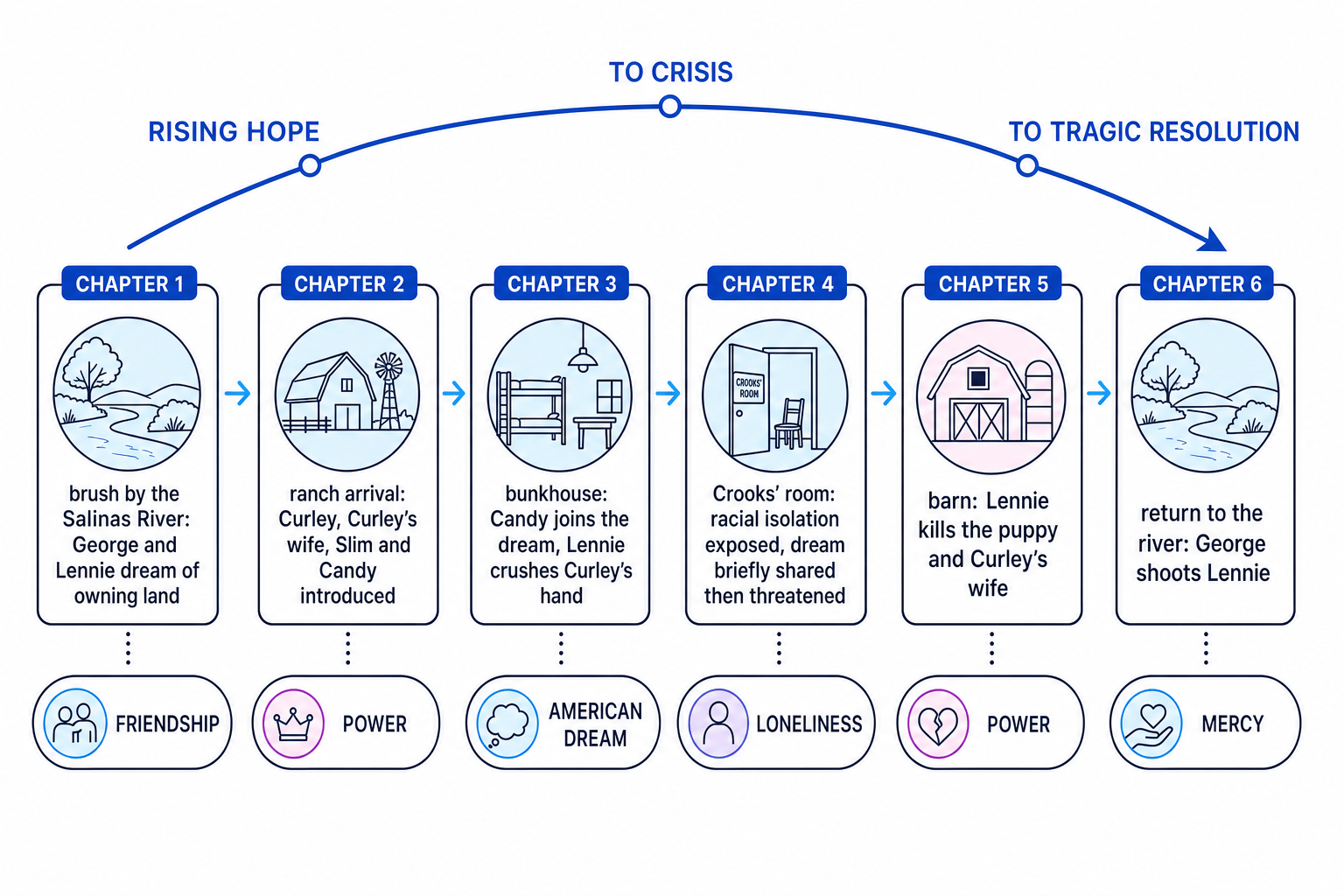
The story begins and ends by the Salinas River. This is called a cyclical structure, where a text returns to a place, image, or situation from the beginning. However, the return is not comforting: the same natural setting becomes the place where George must make his final decision.
Tracking the cyclical structure
-
In Chapter 1, the river is a place of escape. George tells Lennie to return there if he gets into trouble, so the setting is linked with safety and retreat.
-
In Chapter 6, Lennie does return there, but now he is being hunted after killing Curley’s wife. The same place has changed in meaning.
-
The repeated setting makes the ending feel inevitable. Steinbeck shows that George and Lennie have not escaped the harsh world of the ranch; they have been driven back to the beginning with fewer choices than before.
The ranch: a small version of a harsh society
The ranch is a microcosm, meaning a small version of a larger society. Steinbeck uses the ranch to show how power works in 1930s America: some people have authority, while others are pushed aside because of age, race, gender, disability, or poverty.
George and Lennie sit at the centre of the story, but the other characters reveal different kinds of loneliness. Candy fears becoming useless because he is old and disabled. Crooks is segregated because he is Black. Curley’s wife is trapped in a marriage and is never given her own name. Even Curley, who has status as the boss’s son, is insecure and aggressive.
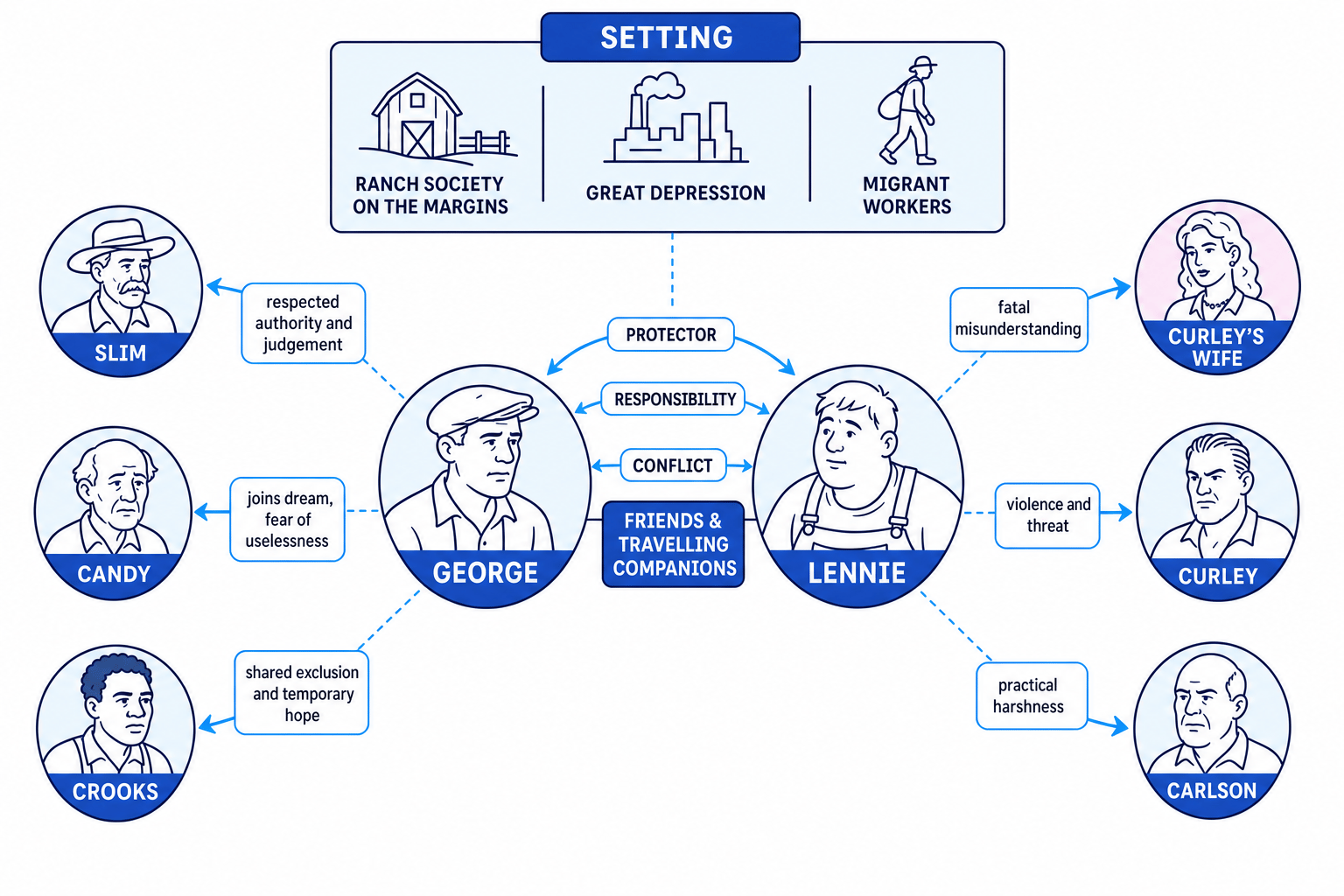
Slim is important because he has moral authority rather than just social power. He understands people clearly and quietly. At the end, he tells George, “You hadda, George,” showing compassion where Carlson shows emotional ignorance: “Now what the hell ya suppose is eatin’ them two guys?”
Oversimplifying characters
Avoid writing that a character is “good” or “bad” only. Steinbeck’s characters often show how a harsh society damages people: Curley is cruel, but also insecure; Curley’s wife is threatening at times, but also lonely and powerless.
Context: why the dream matters
The Great Depression was a severe economic crisis in the 1930s. Many workers were unemployed, poor, and forced to travel for temporary jobs. Steinbeck had direct knowledge of Californian migrant labourers, and the novella reflects that unstable world.
The American Dream is the belief that anyone can achieve success, independence, and prosperity through hard work. In Of Mice and Men, that dream becomes very modest: George and Lennie do not want luxury; they want land, food, animals, and control over their own lives.
Crooks exposes the fragility of this hope when he says, “Nobody never gets to heaven, and nobody gets no land.” His bitter tone shows how many men have repeated the same dream and failed. Candy’s eagerness to join the plan also shows that the dream is not childish; it is a response to real fear.
Linking context to Candy’s fear
-
Candy’s old dog is shot because Carlson sees it as useless. This moment matters because Candy recognises a parallel between the dog’s condition and his own future.
-
In the context of the Great Depression, an old or disabled worker had little protection. If Candy can no longer work, he may lose his place on the ranch.
-
This makes the farm dream emotionally powerful. For Candy, it is not just a pleasant fantasy; it is a possible escape from being discarded.
Context dump
Do not write a whole paragraph about the Great Depression without connecting it to Steinbeck’s characters or choices. Context should explain the meaning of a moment, quotation, or theme.
Steinbeck’s main methods
A method is a deliberate choice a writer makes, such as structure, language, symbolism, or narrative viewpoint. Even though the modern prose question mainly rewards AO1 and AO4, noticing methods helps you write a sharper personal response.
Foreshadowing
Foreshadowing is when a writer plants clues about what will happen later. Lennie’s history of accidentally killing small animals prepares us for the death of the puppy and then Curley’s wife. Candy’s dog also prepares us for the ending: a mercy killing carried out because the future looks unbearable.
Symbolism
Symbolism is when an object, character, place, or event represents a bigger idea. The rabbits symbolise Lennie’s innocent version of the dream, while the farm symbolises freedom and security. Candy’s dog symbolises vulnerability in a society that values usefulness over compassion.
Dialogue and dialect
Dialogue means characters’ spoken words. Dialect means language shaped by region, class, or community. Steinbeck uses informal speech such as “ain’t” and dropped endings like “lan’” to create realism and show the ranch workers’ social world.
Third-person narration
A third-person narrator tells the story using “he,” “she,” or “they,” rather than “I.” Steinbeck’s narrator often feels camera-like: he describes actions and settings clearly but leaves you to judge the emotions underneath.
Learn flexible quotations
Because this is closed book, memorise short quotations that can fit several questions. For example, “we got a future” works for friendship, dreams, loneliness, and hope.
The main themes to carry forward
A theme is a repeated idea or concern in a text. In the overview stage, you do not need every detail yet. Focus on the big patterns.
Loneliness and companionship
Nearly every major character is lonely. George and Lennie’s friendship stands out because it resists that loneliness, even though it is strained and unequal.
Dreams and disappointment
The farm dream keeps people going, but Steinbeck repeatedly questions whether such dreams can survive poverty, prejudice, and violence.
Power and vulnerability
Characters with less power are often threatened: Lennie because of his disability, Crooks because of racism, Candy because of age and disability, and Curley’s wife because of gender.
Mercy and violence
The novella asks difficult questions about mercy. George’s final act is violent, but Steinbeck presents it as emotionally complex rather than simple murder.
Handling offensive language
The novella contains racist and sexist language. In essays, you can usually refer to “racist language” or “sexist attitudes” without reproducing slurs. Focus on what Steinbeck exposes about prejudice and power.
What a strong overview gives you
A strong understanding of the overview helps you avoid random quotation-spotting. You should always be able to explain:
- where a moment happens in the plot
- which relationship or theme it develops
- how it connects to the 1930s context
- why Steinbeck places it where he does
For example, the death of Candy’s dog is not just a sad incident. It prepares the reader for the ending, reveals the ranch’s harsh values, and deepens Candy’s fear of becoming useless.
In the exam
-
Begin with a clear argument about the question, not a plot summary. Use the plot only to support your interpretation.
-
Embed short, accurate quotations from memory, then explain how they reveal character, theme, or context.
-
Keep linking back to Steinbeck’s wider message about loneliness, power, dreams, and human value in Depression-era America.
Check yourself
- How does the Salinas River setting change in meaning between Chapter 1 and Chapter 6?
- Why is the dream of owning land so powerful for George, Lennie, and Candy?
- Which character best shows the loneliness of ranch life, and what short quotation could you use for them?
