What you'll learn
- How to turn an essay question on To Kill a Mockingbird into a clear argument.
- How to plan paragraphs that combine quotation, analysis and context.
- How to use flexible, memorised evidence in a closed-book exam.
- How to avoid vague “theme spotting” and write plans that answer the exact question.
Why essay plans matter for To Kill a Mockingbird
In Edexcel IGCSE English Literature, To Kill a Mockingbird is studied as a modern prose text in Component 1, which is closed book. That means you will not have the novel in front of you, so your essay plan needs to help you use your memory efficiently.
A good plan is not a script. It is a thinking tool: it helps you decide your argument, choose the best moments from the novel, and connect Harper Lee’s ideas to context.
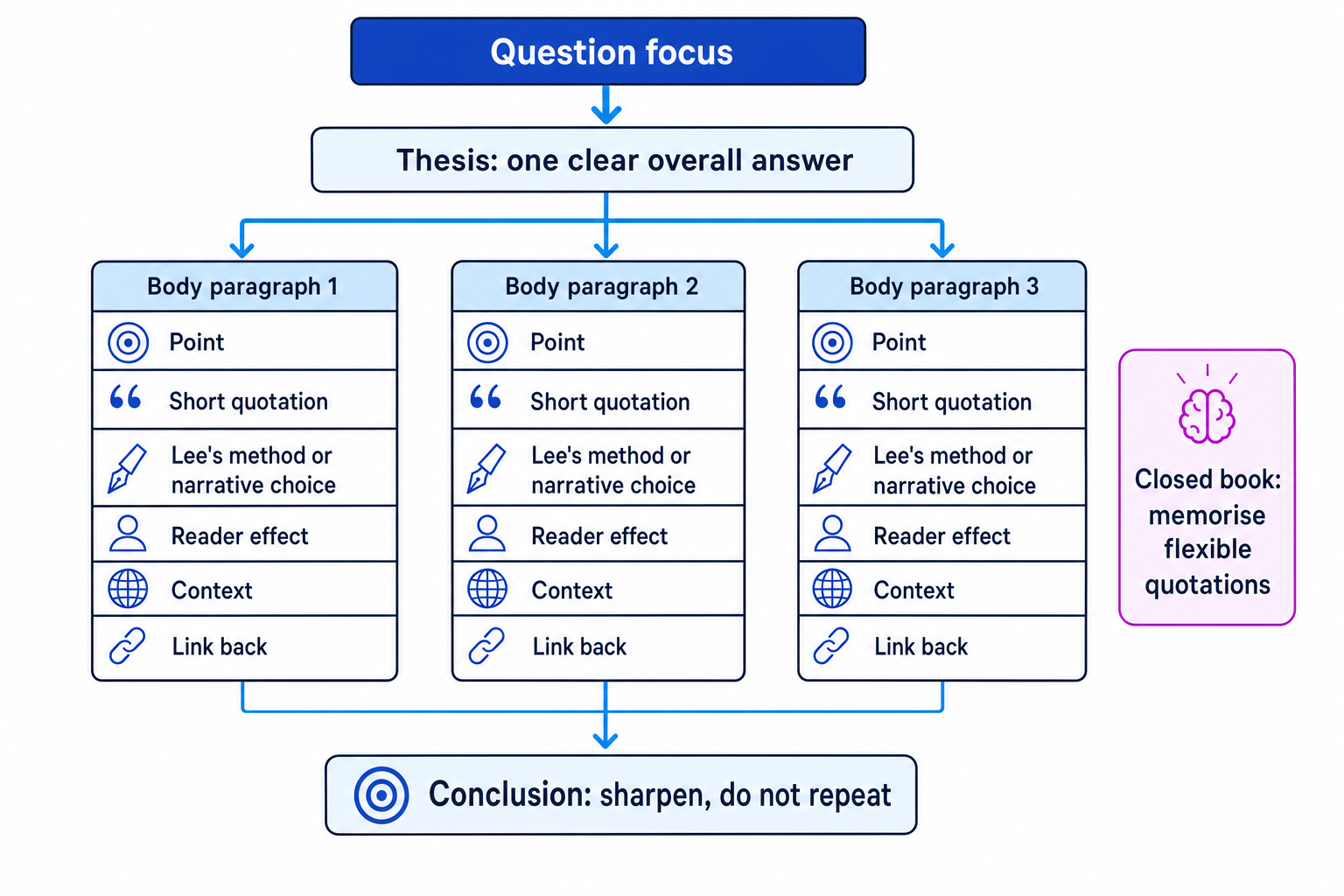
Essay plan
An essay plan is a brief outline of your argument before you begin writing. It should include your overall answer, the order of your main points, key quotations or references, and any relevant contextual ideas.
The big principle
A strong To Kill a Mockingbird essay plan does not simply list characters or themes. It builds an argument about how Lee presents an idea and why that presentation matters.
Start with the question
Most essay questions will ask you about a theme, character, relationship or idea. Your first job is to work out the focus of the question.
A theme is a repeated idea explored across the novel, such as prejudice, justice, courage, childhood, education or moral growth.
A character question asks you to explore how Lee presents a person, such as Atticus, Scout, Jem, Boo Radley or Mayella Ewell.
A presentation question asks about Lee’s choices as a writer: what she shows, what she hides, what she contrasts, and how the reader is encouraged to respond.
Unpacking a question on courage
Question: How does Lee present courage in To Kill a Mockingbird?
-
Identify the key idea: the question is not asking for every brave act in the novel; it is asking what Lee suggests courage really means.
-
Choose a line of argument: Lee presents courage as moral strength rather than physical power, especially through Atticus, Mrs Dubose and the children’s growing understanding.
-
Select moments that develop the idea: Atticus shooting the mad dog shows physical skill, but his explanation that “real courage” is beginning even when “you know you’re licked” shifts the focus to moral endurance.
-
Link to context: in a racially prejudiced 1930s Alabama society, Atticus’s defence of Tom Robinson becomes courageous because he acts according to conscience despite community hostility.
Build a thesis first
A thesis is your overall answer to the question. It usually belongs in your introduction, but you should decide it before planning paragraphs.
A weak thesis says something general:
- Lee shows that prejudice is bad.
A stronger thesis is more specific:
- Lee presents prejudice as a destructive social habit in Maycomb, showing how racism, class judgement and fear of outsiders damage both victims and those who uphold the system.
Notice that the stronger version gives you a direction. It suggests possible paragraphs: racism, class prejudice, fear of Boo Radley, and the moral education of Scout and Jem.
Thesis
A thesis is the central argument of your essay: the main interpretation you will prove through the rest of your answer.
Use Lee’s name in your thesis
Instead of writing “prejudice is shown”, write “Lee presents prejudice…” This reminds you that you are analysing a crafted novel, not just discussing real-life issues.
Plan paragraphs as mini-arguments
Each paragraph should make one clear point that helps prove your thesis. A useful structure is:
- Point — your idea about the question.
- Evidence — a short quotation or precise reference.
- Method — Lee’s technique, such as symbolism, narrative voice, contrast, setting or characterisation.
- Effect — what the reader understands or feels.
- Context — relevant social or historical background.
- Link — return to the question.
Method
A method is a choice made by the writer. In To Kill a Mockingbird, useful methods include first-person narration, symbolism, contrast, foreshadowing, setting, characterisation and courtroom structure.
For this text, Edexcel mainly rewards your close knowledge and understanding of the novel, your personal response, and your ability to connect the text to context. Still, naming Lee’s methods helps make your analysis sharper.
Planning a paragraph on Atticus and courage
-
Start with the argument: Atticus shows courage as loyalty to conscience, not as a desire to win approval.
-
Choose evidence: he says, “before I can live with other folks I’ve got to live with myself”, showing that his moral standards matter more than public opinion.
-
Add method: Lee uses Atticus’s calm, principled dialogue to contrast with Maycomb’s hostile gossip and racism.
-
Explain effect: the reader sees Atticus as morally isolated but admirable, because he refuses to let the majority decide right and wrong.
-
Connect context: in the segregated Deep South, defending a Black man accused by white people would challenge the racist assumptions of the community.
-
Link back: this makes Atticus’s courage ethical and social, not merely personal.
Choose flexible quotations
Because the exam is closed book, you need a small set of quotations that can work for several questions. These are called flexible quotations because you can adapt them to different themes.
Good examples include:
- Atticus: “climb into his skin and walk around in it” — empathy, moral education, Scout’s growth.
- Atticus: “it’s a sin to kill a mockingbird” — innocence, vulnerability, Tom Robinson, Boo Radley.
- Miss Maudie: mockingbirds “don’t do one thing but make music for us to enjoy” — symbolism, innocence, goodness.
- Atticus: “real courage” is when “you know you’re licked before you begin” — courage, conscience, justice.
- Atticus: “The one thing that doesn’t abide by majority rule is a person’s conscience” — morality, individual responsibility.
- Scout: “I think there’s just one kind of folks. Folks.” — childhood, equality, social division.
- Scout: “it’d be sort of like shootin’ a mockingbird” — Boo Radley, innocence, moral maturity.
- Maycomb is a “tired old town” — setting, tradition, stagnation, social attitudes.
Quotation dumping
Do not drop in a quotation and move on. A quotation only helps if you explain what it reveals, how Lee presents it, and how it supports your answer.
Use context without turning the essay into history
Context means the social, historical and cultural circumstances that shape the novel. For To Kill a Mockingbird, important contextual areas include racial segregation in the American South, the legacy of Jim Crow laws, the Great Depression, gender expectations, class divisions, and the Civil Rights era in which Lee was writing.
However, context should not become a separate paragraph of facts. It should be woven into your analysis.
Linking context to Tom Robinson
-
Begin with the textual point: Lee presents Tom Robinson as innocent but trapped by Maycomb’s racist assumptions.
-
Use evidence: Atticus explains that “when it’s a white man’s word against a black man’s, the white man always wins”.
-
Connect context: this reflects the racial inequality of the 1930s Deep South, where legal systems often protected white authority rather than delivering justice.
-
Explain Lee’s purpose: by showing that the trial’s outcome is socially predetermined, Lee criticises a community that claims to value justice while denying it to Black citizens.
A full essay plan: prejudice
Question: How does Lee present prejudice in To Kill a Mockingbird?
Introduction
Thesis: Lee presents prejudice as a deeply rooted part of Maycomb’s society. Through racism, class judgement and fear of difference, she shows how prejudice distorts justice and prevents people from seeing others clearly.
Paragraph 1: Racism and the trial
Point: Lee presents racism as the most damaging form of prejudice in the novel.
Evidence: Atticus says that in court, “when it’s a white man’s word against a black man’s, the white man always wins”.
Method: The courtroom structure exposes the gap between the ideal of justice and the reality of racial bias.
Context: This reflects the segregated society of the 1930s American South, where Black defendants were often denied fair treatment.
Link: Lee shows that prejudice is not just personal dislike; it is built into institutions.
Paragraph 2: Class prejudice in Maycomb
Point: Lee also presents prejudice through Maycomb’s rigid class system.
Evidence: Scout’s early judgement of Walter Cunningham shows how children absorb adult social attitudes.
Method: Lee uses Scout’s child narration to reveal prejudice honestly but also naively, allowing the reader to see how learned these attitudes are.
Context: The Great Depression intensified poverty and social division, especially in rural communities.
Link: Lee suggests that prejudice survives because it is taught as normal.
Paragraph 3: Boo Radley and fear of outsiders
Point: Lee presents prejudice as fear of what people do not understand.
Evidence: At the end, Scout recognises that exposing Boo would be “sort of like shootin’ a mockingbird”.
Method: Boo functions as a symbol of misunderstood innocence; the structure of the novel moves Scout from superstition to empathy.
Context: Maycomb’s suspicion of Boo reflects a closed community that punishes difference.
Link: Lee shows that overcoming prejudice requires imaginative sympathy.
Conclusion
Return to the thesis, but sharpen it: Lee presents prejudice as a social disease that damages Tom, Boo, Scout and the whole community. However, through Scout’s moral development, the novel suggests that empathy can challenge inherited prejudice.
Quick plan shapes for common questions
If the question is about Atticus
Possible thesis: Lee presents Atticus as a moral teacher whose courage lies in conscience, self-control and empathy.
Paragraphs could cover:
- Atticus as a parent teaching Scout to “climb into his skin”.
- Atticus as a lawyer defending Tom despite knowing he is “licked”.
- Atticus as a moral symbol, but also as someone limited by the racist society around him.
If the question is about Scout’s growth
Possible thesis: Lee presents Scout’s childhood as a journey from innocence and quick judgement towards empathy and moral understanding.
Paragraphs could cover:
- Scout’s early misunderstandings of class, race and Boo Radley.
- Lessons from Atticus and Calpurnia about respect and self-control.
- Scout’s final understanding of Boo when she sees the world from his perspective.
If the question is about justice
Possible thesis: Lee presents justice as an ideal that Maycomb claims to value but repeatedly fails to practise.
Paragraphs could cover:
- The courtroom as a symbol of legal fairness.
- Tom Robinson’s conviction as proof of racial injustice.
- Heck Tate’s decision to protect Boo as a more compassionate form of justice.
Conclusions should develop, not repeat
A conclusion should not simply copy your introduction. It should answer the question one final time with a slightly wider view.
For example, in an essay on innocence, you might end by saying that the mockingbird symbol links Tom and Boo, but also challenges the reader to protect vulnerable people in their own society.
In the exam
-
Spend a few minutes planning your thesis and three main paragraphs before you start writing.
-
Use short, accurate quotations rather than trying to remember long passages.
-
Make every paragraph answer the question directly, connect to context, and explain Lee’s purpose.
Check yourself
-
Can you create a thesis for a question on courage, prejudice or justice without writing a full introduction?
-
Can you match five flexible quotations to at least two different themes each?
-
Can you explain the context of Tom Robinson’s trial without writing a separate history paragraph?
