What you'll learn
- What language, form and structure mean in To Kill a Mockingbird.
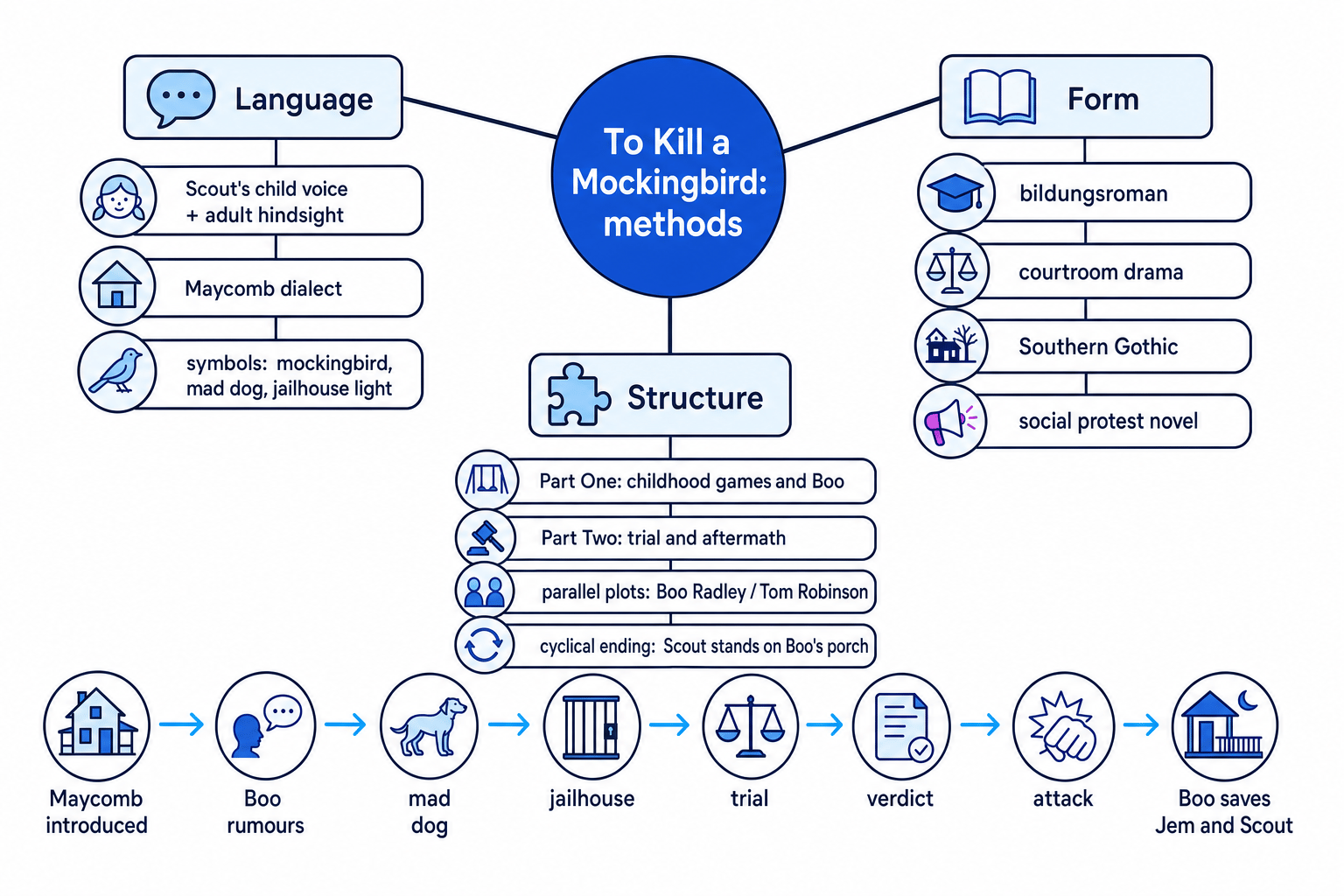
- How Harper Lee uses Scout’s narration, symbolism, dialect and imagery to shape meaning.
- How the novel’s form mixes coming-of-age fiction, courtroom drama and social protest.
- How the structure links Boo Radley’s story with Tom Robinson’s trial.
For Edexcel IGCSE, To Kill a Mockingbird is usually studied as a modern prose text in Component 1 Section C, which is closed book. That means you need short, accurate quotations ready. Even though the prose question mainly rewards close knowledge, personal response and context, analysing Lee’s methods gives your ideas precision and confidence.
The basics: what are language, form and structure?
Language, form and structure
- Language means the writer’s choice of words, images, dialogue and sentence patterns.
- Form means the type of text and the conventions it uses — for example, novel, coming-of-age story, courtroom drama.
- Structure means how the text is organised: the order of events, beginnings and endings, contrasts, repeated patterns and turning points.
A strong response does not just name a technique. It explains how Lee’s choices shape the reader’s view of Maycomb, Scout, Atticus, Tom Robinson and Boo Radley.
Method must connect to meaning
Don’t write “Lee uses symbolism” and stop there. Write what the symbol suggests, how it affects the reader, and how it links to the novel’s bigger concerns: prejudice, innocence, courage and moral education.
Language: Scout’s narrative voice
A narrative voice is the “voice” telling the story. To Kill a Mockingbird is told in the first person, meaning the narrator uses “I” and describes events from her own perspective.
However, Lee’s narration is more complex than simple child narration. Scout is looking back on her childhood from an older perspective. This is called a retrospective narrator: a narrator who tells events after they have happened.
The opening immediately shows this: “When he was nearly thirteen, my brother Jem got his arm badly broken at the elbow” in Chapter 1. The sentence sounds calm and controlled, as though the narrator already knows the whole story. Lee creates curiosity because the reader wants to know how Jem’s arm was broken.
Retrospective narration
Retrospective narration is when a narrator tells a story after the events are over, often mixing past childhood impressions with older understanding.
This matters because Scout often describes adult prejudice without fully understanding it at the time. The reader can see more than the child Scout can. This creates moments of dramatic irony, where the reader understands something a character does not.
Dramatic irony
Dramatic irony happens when the reader or audience understands more about a situation than a character does.
Analysing Scout’s narrative voice
-
Start from the quotation “When he was nearly thirteen, my brother Jem got his arm badly broken at the elbow.” The narrator presents a serious injury in a measured, factual way.
-
Notice the structural effect: the injury is mentioned before the full story is explained, so Lee creates suspense and makes the reader expect the novel to circle back to this event.
-
Connect this to Scout’s voice. The phrase “my brother Jem” sounds childlike and personal, but the careful ordering of events suggests an older narrator shaping the memory.
-
Link to meaning: Lee makes the novel feel like a childhood story, but also a moral investigation into how Jem and Scout learn about prejudice, courage and injustice.
Language: Maycomb’s speech and dialect
Dialect means language features associated with a particular region, class or community. Lee uses different voices to make Maycomb feel socially real: Scout’s educated narration, Calpurnia’s code-switching, Atticus’s measured courtroom language, and the rougher speech of characters such as Bob Ewell.
When Tom Robinson says, “I felt right sorry for her” in Chapter 19, his language is simple and humane. But in the racist logic of the courtroom, his pity for Mayella Ewell is twisted against him because a Black man expressing pity for a white woman challenges Maycomb’s racial hierarchy.
Use dialect carefully
When discussing dialect, avoid mocking a character’s speech. Instead, ask what Lee reveals about power, class, education and prejudice through the way characters speak.
Lee also includes racist language to show how normalised racism is in Maycomb. This language is part of the novel’s social criticism, not something to repeat casually.
Quoting racist language
Only quote racist slurs if it is genuinely necessary to your point. Often it is better to write “Lee’s repeated racist slurs” and explain their effect: they expose how prejudice is embedded in everyday speech.
Language: symbolism and motifs
A symbol is a person, object, creature or event that represents a larger idea. A motif is a symbol, image or idea that recurs through a text.
The central symbol is the mockingbird. Atticus tells Scout and Jem, “it’s a sin to kill a mockingbird” in Chapter 10. Miss Maudie explains, “Mockingbirds don’t do one thing but make music for us to enjoy.” The bird becomes a symbol of harmless innocence.
Tom Robinson and Boo Radley are both linked to this symbol. Tom is destroyed by racist injustice despite his kindness; Boo is misunderstood and feared, yet he protects Jem and Scout.
Reading the mockingbird symbol
-
Begin with Miss Maudie’s explanation that mockingbirds “don’t do one thing but make music”. This defines the symbol as harmless and generous.
-
Apply the symbol to Tom Robinson. He helps Mayella Ewell, but Maycomb’s racist court punishes him; the “mockingbird” idea makes his death feel morally wrong.
-
Apply the symbol to Boo Radley. He is treated as a monster in children’s games, but the ending reveals him as protective and gentle.
-
Link the two plots: Lee uses the same symbol to connect private childhood misunderstanding with public racial injustice.
Turning symbols into one-to-one labels
Avoid writing “Tom is the mockingbird” as if that is the whole point. Better: Lee uses the mockingbird motif to make the reader judge any society that harms the innocent.
Language: imagery of Maycomb
Imagery means descriptive language that appeals to the senses or creates a vivid picture. In Chapter 1, Scout says, “Maycomb was an old town, but it was a tired old town when I first knew it.” The adjective “tired” personifies the town, making it seem worn-out and resistant to change.
Personification
Personification is when a writer gives human qualities to something non-human, such as a place, object or idea.
Lee’s description of Maycomb creates more than setting. The town’s physical stillness reflects its social and moral stagnation. A place that is “tired” and slow becomes a place where old prejudices survive.
You can also notice Lee’s use of Gothic imagery around the Radley house. Boo is introduced as a “malevolent phantom” in Chapter 1. The frightening language reflects the children’s imagination, but it also shows how communities create myths about people they do not understand.
Form: what kind of novel is it?
To Kill a Mockingbird is a novel, but it blends several forms.
Bildungsroman
A bildungsroman is a coming-of-age story that follows a young person’s moral, emotional or intellectual growth.
Scout begins with childish assumptions. By the end, she can stand on Boo Radley’s porch and understand Atticus’s lesson about seeing from another person’s point of view. In Chapter 31, Atticus says, “Most people are, Scout, when you finally see them.” The word “see” is important: moral growth means learning to perceive others more truthfully.
The novel is also a courtroom drama, because the trial of Tom Robinson becomes the central public test of truth, justice and prejudice. Atticus’s closing speech, including “This case is as simple as black and white” and “In the name of God, do your duty” in Chapter 20, uses legal and moral language to challenge the jury.
Finally, the novel has features of Southern Gothic, a form associated with the American South, decay, secrets, violence and distorted social values. The Radley house, Bob Ewell’s violence and the town’s racial hypocrisy all contribute to this form.
Reading the novel as a bildungsroman
-
Identify Scout’s starting point: she accepts childish rumours about Boo Radley and joins in games that turn him into a monster.
-
Track the change: Atticus teaches her that you do not understand someone until you “climb into his skin and walk around in it” in Chapter 3.
-
Connect the ending: Scout stands on Boo’s porch and sees the street from his viewpoint, turning Atticus’s lesson into lived understanding.
-
Explain the effect: Lee’s coming-of-age form makes moral education feel personal, not abstract; the reader learns with Scout.
Structure: two parts, two worlds
The novel is often understood in two broad movements.
Part One focuses more on childhood, the Radley mystery, school, family and Maycomb’s routines. Part Two moves towards Tom Robinson’s trial and its consequences. The shift from neighbourhood adventures to courtroom injustice mirrors Scout and Jem’s loss of innocence.
Structural shift
A structural shift is an important change in focus, mood, setting or direction within a text.
This structure is important because Lee does not begin with the trial. She first builds Maycomb as a whole community. By the time Tom’s case reaches court, the reader understands the town’s habits, hierarchies and prejudices.
The trial grows out of Maycomb
The trial is not a sudden “issue” added to the story. Structurally, Lee prepares us to see it as the result of Maycomb’s long-standing racism, class division and fear of outsiders.
Structure: foreshadowing and circular ending
Foreshadowing is when a writer plants hints about events that will happen later. The opening mention of Jem’s broken arm foreshadows the attack near the end of the novel.
Lee’s structure is also partly circular, meaning the ending returns to something introduced at the beginning. The novel begins by mentioning Jem’s injury, then eventually explains it through Bob Ewell’s attack and Boo Radley’s rescue.
The ending also returns to Atticus’s earlier advice about perspective. In Chapter 3, he tells Scout to “climb into his skin and walk around in it.” In Chapter 31, Scout reflects from Boo’s porch, showing that she has finally understood the lesson.
Tracking foreshadowing and circular structure
-
Notice the opening fact: Jem’s arm was “badly broken at the elbow”. Lee gives the consequence before the cause, so the reader expects an explanation.
-
Follow the delayed explanation: the novel moves through childhood episodes, the trial and Bob Ewell’s anger before returning to the broken arm.
-
Connect the ending to the beginning: Boo, who seemed frightening in Chapter 1, becomes the person who saves Jem and Scout.
-
Explain the effect: the circular structure turns the novel into a story about corrected judgement — what seemed monstrous becomes protective, and what seemed respectable becomes morally corrupt.
Structure: parallel plots — Boo Radley and Tom Robinson
A parallel plot is a storyline that mirrors another storyline. Boo Radley’s story and Tom Robinson’s story are not identical, but they echo each other.
Both men are outsiders. Both are judged by Maycomb before they are truly known. Both are connected to innocence. But their outcomes are different: Boo survives because Heck Tate protects him from public attention, while Tom is killed by a racist system.
This contrast makes the ending bittersweet. Boo’s rescue offers hope, but Tom’s death prevents the novel from becoming a simple story of justice winning.
Ignoring the darker ending
Do not write that the novel ends happily. Boo saves the children, but Tom Robinson is dead, Bob Ewell’s violence has damaged the community, and Maycomb’s racism remains only partly challenged.
Putting methods into an analytical sentence
Try to build sentences that move from evidence to method to meaning:
Lee uses Scout’s retrospective narration to turn childhood memory into moral reflection; when Atticus says “Most people are, Scout, when you finally see them,” the verb “see” suggests that Scout’s education is about learning to understand others beyond rumour and prejudice.
Notice how this does not just identify a device. It links narrative voice, quotation, word choice and theme.
Mini quotation bank for language, form and structure
- “Maycomb was an old town, but it was a tired old town” — personification of setting; suggests social stagnation.
- “malevolent phantom” — Gothic description of Boo; shows childish fear and community myth-making.
- “climb into his skin and walk around in it” — metaphor for empathy; central to Scout’s moral education.
- “it’s a sin to kill a mockingbird” — symbolic statement about harming innocence.
- “I felt right sorry for her” — Tom’s humane voice is misread by a racist court.
- “This case is as simple as black and white” — Atticus’s courtroom language exposes racial injustice.
- “Most people are, Scout, when you finally see them” — ending links sight, empathy and understanding.
In the exam
-
Use short, accurate quotations and attach them to a clear idea: for example, “tired old town” for stagnation or “sin to kill a mockingbird” for innocence.
-
Start with meaning, then method. Instead of device-spotting, explain how Lee’s narrative voice, symbolism or structure shapes the reader’s response.
-
Link methods to context only when it helps: Maycomb’s language, courtroom structure and racial prejudice reflect the segregated American South, but your focus should stay on the text.
Check yourself
- How does Scout’s retrospective narration let Lee combine childhood innocence with adult understanding?
- Why are Boo Radley and Tom Robinson structurally linked, even though their stories end differently?
- How does the mockingbird symbol develop from Atticus’s lesson into a judgement on Maycomb?
