For your Pearson Edexcel International GCSE (9-1) English Literature exam, Component 1, Section C (Modern Prose) is a closed-book exam. This means you will not have a copy of To Kill a Mockingbird with you in the examination room.
Memorizing long, unwieldy passages is a recipe for stress. Instead, your strategy must be to master a curated selection of highly versatile "utility quotes." These are short, linguistically rich quotations that can be adapted to answer questions on characters, key themes, and historical context.
What you'll learn
- How to memorize and use highly versatile, multi-purpose quotations.
- How to link language analysis (AO1) directly to 1930s Southern American history (AO4).
- A step-by-step method to "explode" a quotation for maximum marks.
1. Why Key Quotes Matter in a Closed-Book Exam
In Section C, you are assessed on two main Assessment Objectives:
- AO1: Demonstrate a close knowledge and understanding of the prose text, sustaining a critical style and presenting an informed personal engagement.
- AO4: Show understanding of the relationships between literary texts and the contexts in which they were written.
To score in the top bands, you must weave context and textual analysis together seamlessly. You don't need dozens of quotes; you need about 10–12 high-utility quotes that you know inside out.
Utility Quote
A utility quote is a short, memorable phrase or sentence from the text that contains dense literary techniques and speaks directly to multiple core themes or characters. It can be adapted to fit almost any essay prompt.
2. The Top Four Versatile Quotations Explained
Let's break down four of the most powerful quotations in the novel, examining their literary devices, thematic links, and historical contexts.
Quote 1: The Golden Rule of Empathy
"You never really understand a person until you consider things from his point of view... until you climb into his skin and walk around in it."
— Atticus Finch, Chapter 3
- Linguistic Analysis: Atticus modifies the traditional idiom "walk a mile in his shoes" to the much more visceral and intimate metaphor of climbing into someone's "skin." Writing in the 1950s/60s about the 1930s, Harper Lee deliberately uses the word "skin" to subvert the racial divisions of the Jim Crow South. The physical verb "climb" implies that empathy is not passive; it requires hard, deliberate moral effort.
- Thematic Connections: Moral Education, Empathy, Prejudice, Growing Up.
- Character Links: Atticus (as the moral compass/educator), Scout (who must learn this lesson to transition from childhood innocence to moral maturity).
Quote 2: The Mockingbird Symbolism
"Remember it’s a sin to kill a mockingbird."
— Atticus Finch, Chapter 10
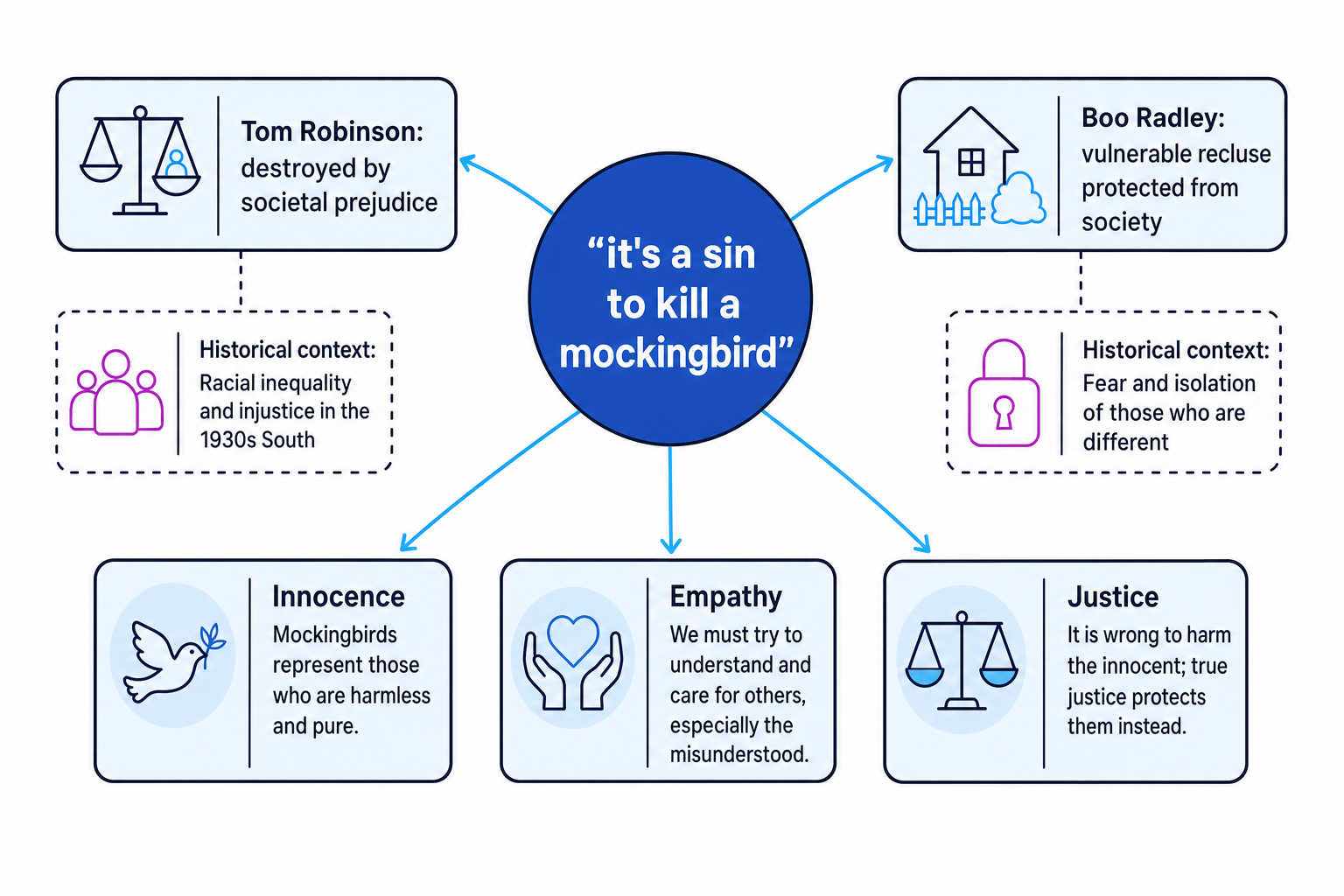
- Linguistic Analysis: The noun "sin" elevates this from a simple household rule to a profound moral and religious commandment. In the deeply religious American South, calling an action a "sin" carries immense weight. The mockingbird is established as a symbol of absolute innocence because, as Miss Maudie later explains, they do not damage gardens or nests; they only sing.
- Thematic Connections: Innocence, Prejudice, Justice vs. Law.
- Character Links:
- Tom Robinson: A harmless man destroyed by the predatory racism of Maycomb's court.
- Boo Radley: A gentle recluse who must be shielded from the destructive spotlight of local gossip.
- Historical Context (AO4): In the 1930s Alabama where the novel is set, black defendants like Tom Robinson faced a heavily biased legal system. The "killing of a mockingbird" acts as a symbolic critique of the systemic destruction of vulnerable, innocent lives under Jim Crow laws.
The Core Symbol
The mockingbird is the novel's central motif. Whenever you write about injustice, prejudice, Boo Radley, or Tom Robinson, you must refer to this symbol to show how Harper Lee structured her narrative around a single, powerful moral metaphor.
Quote 3: True Moral Courage
"I wanted you to see what real courage is, instead of getting the idea that courage is a man with a gun in his hand. It’s when you know you’re licked before you begin but you begin anyway and you see it through no matter what."
— Atticus Finch, Chapter 11
- Linguistic Analysis: Lee uses juxtaposition to contrast the superficial, violent "courage" of "a man with a gun" (which references the community's obsession with physical dominance and masculinity) with the quiet endurance of moral integrity. The colloquial phrasing "licked before you begin" highlights the inevitability of defeat in a prejudiced society, yet emphasizes that the value of the struggle lies in the attempt, not the victory.
- Thematic Connections: Courage, Moral Integrity, Education.
- Character Links: Mrs. Dubose (battling her morphine addiction), Atticus (defending Tom Robinson despite knowing the all-white jury will convict him).
- Historical Context (AO4): Atticus’s defense of Tom Robinson mirrors the real-life struggles of liberal white southern lawyers who faced social ostracism and physical danger for representing black clients in the Scottsboro Boys trials of the 1930s.
Quote 4: Institutionalized Racism
"In our courts, when it's a white man's word against a black man's, the white man always wins. They're ugly, but those are the facts of life."
— Atticus Finch, Chapter 23
- Linguistic Analysis: The stark, unadorned syntax and the absolute adverb "always" strip away any romantic illusions of Southern hospitality. The adjective "ugly" is a simple but emotionally charged word that conveys Atticus’s profound moral disgust at the legal system.
- Thematic Connections: Social Injustice, Prejudice, Loss of Innocence.
- Character Links: Jem (whose idealistic faith in justice is shattered by this reality), Atticus (who must prepare his children for a corrupted world).
- Historical Context (AO4): This quotation addresses the institutionalized racism of the judicial system in the Deep South, where black Americans were completely excluded from serving on juries, guaranteeing that any conflict of testimony along racial lines would end in a wrongful conviction.
Ignoring the Frame Narrative
Do not write about the novel as if it were written in the 1930s. Harper Lee wrote To Kill a Mockingbird in the late 1950s, publishing it in 1960 during the height of the Civil Rights Movement. The novel is a retrospective reflection. When analyzing quotes about injustice, always point out that Lee was highlighting historical parallels to encourage her 1960s readers to support racial equality.
3. How to Explode a Quotation
To achieve top marks, you must use the "Quote Explosion" technique. This means taking a small, specific quote and drawing out multiple layers of meaning, link by link.
Here is how to construct a high-level analytical paragraph using our analytical structure: Point →\to→ Evidence →\to→ Method →\to→ Effect →\to→ Context / Link.
Developing a thesis-driven quote analysis
-
State your analytical point clearly: Introduce a focused argument that directly answers the essay prompt (e.g., how Lee presents the theme of courage).
Example: "Harper Lee presents true courage not as an act of physical bravado, but as a persistent adherence to moral duty in the face of certain defeat."
-
Embed a short, precise quotation: Integrate your selected quotation smoothly into a grammatically correct sentence rather than dropping it in as a standalone sentence.
Example: This alternative perspective on bravery is highlighted when Atticus defines courage to Jem as knowing you are
'licked before you begin but you begin anyway.' -
Identify the writer's methods: Name the literary or structural devices used by the author and explain their immediate linguistic effect.
Example: The colloquial idiom
'licked'highlights the inevitable defeat that Atticus knows he will face. By juxtaposing this defeat with the moral determination to'begin anyway,'Lee constructs a definition of courage based on ethical resilience rather than physical triumph. -
Connect the analysis to context and the author's purpose (AO4): Explain why the writer chose these words in relation to the historical setting of the 1930s and the social context of the 1960 Civil Rights Movement.
Example: Through this, Lee mirrors the real-world sacrifices of civil rights activists in the American South who challenged deeply entrenched Jim Crow segregation despite knowing the immense social and legal forces stacked against them.
Integrating Quotes Smoothly
Never write: "A quote that shows this is..."
Instead, weave the quote into your own prose:
Scout’s growing maturity is evident when she finally realizes that most people are nice once you 'finally see them.'
In the exam
- Keep quotes short: Focus on memorizing fragments of 3–7 words (e.g.,
"climb into his skin","sin to kill a mockingbird","licked before you begin"). These are much easier to recall accurately under pressure and encourage tight, word-level analysis. - Anchor to characters and themes: For every quote you write down, ensure you can link it to at least one character and at least two themes. This ensures your memorized bank is highly flexible.
- Always integrate context: Do not add context as an afterthought at the end of a paragraph. Use phrases like "Lee's use of the metaphor 'skin' directly challenges the segregationist legislation of the 1930s Deep South by..." to merge AO1 and AO4 seamlessly.
Check yourself
- Can you explain the symbolic difference between Atticus's metaphor of climbing into someone's "skin" and the common idiom of walking in their "shoes"?
- How does the word "sin" in the mockingbird quote shift the novel's focus from simple legal justice to a higher, universal moral law?
- Which characters in the novel can be classified as metaphorical "mockingbirds," and what specific textual evidence supports this classification?
