What you'll learn
- How to recognise which chapters in To Kill a Mockingbird are most important.
- How Lee’s chapter structure moves from childhood mystery to moral judgement.
- Which chapters you should revise closely for Edexcel IGCSE answers.
- How to use key chapters as evidence without simply retelling the plot.
First: what makes a chapter “key”?
A chapter is “key” when it does important work in the novel’s structure. It might introduce a major idea, change a character, create a turning point, or bring together several themes at once.
Key chapter
A key chapter is a chapter that does more than move the plot forward: it changes a character’s understanding, develops a major theme, reveals context, or prepares the reader for a later event.
In To Kill a Mockingbird, key chapters often matter because they connect childhood experiences with adult moral questions. Scout begins by misunderstanding Boo Radley, school, class and local gossip; by the end, she has learned to judge more thoughtfully.
Chapters work as stepping stones
Lee structures the novel so that early “small” lessons — about empathy, courage and prejudice — prepare you for the larger injustice of Tom Robinson’s trial and the final revelation of Boo Radley.
The shape of the novel
To Kill a Mockingbird is narrated by Scout Finch, but she is looking back on her childhood from a more mature point of view.
Retrospective narrator
A retrospective narrator tells events from the past while looking back with later knowledge and understanding. Scout often describes what she thought as a child, but the adult narrator helps the reader see the deeper meaning.
The novel also has features of a bildungsroman, which means a coming-of-age story. Scout’s growth is not just about becoming older; it is about learning how to see other people more fairly.
The timeline below shows how the most important chapters build from childhood curiosity to the trial, then to the final moral lesson on the Radley porch.
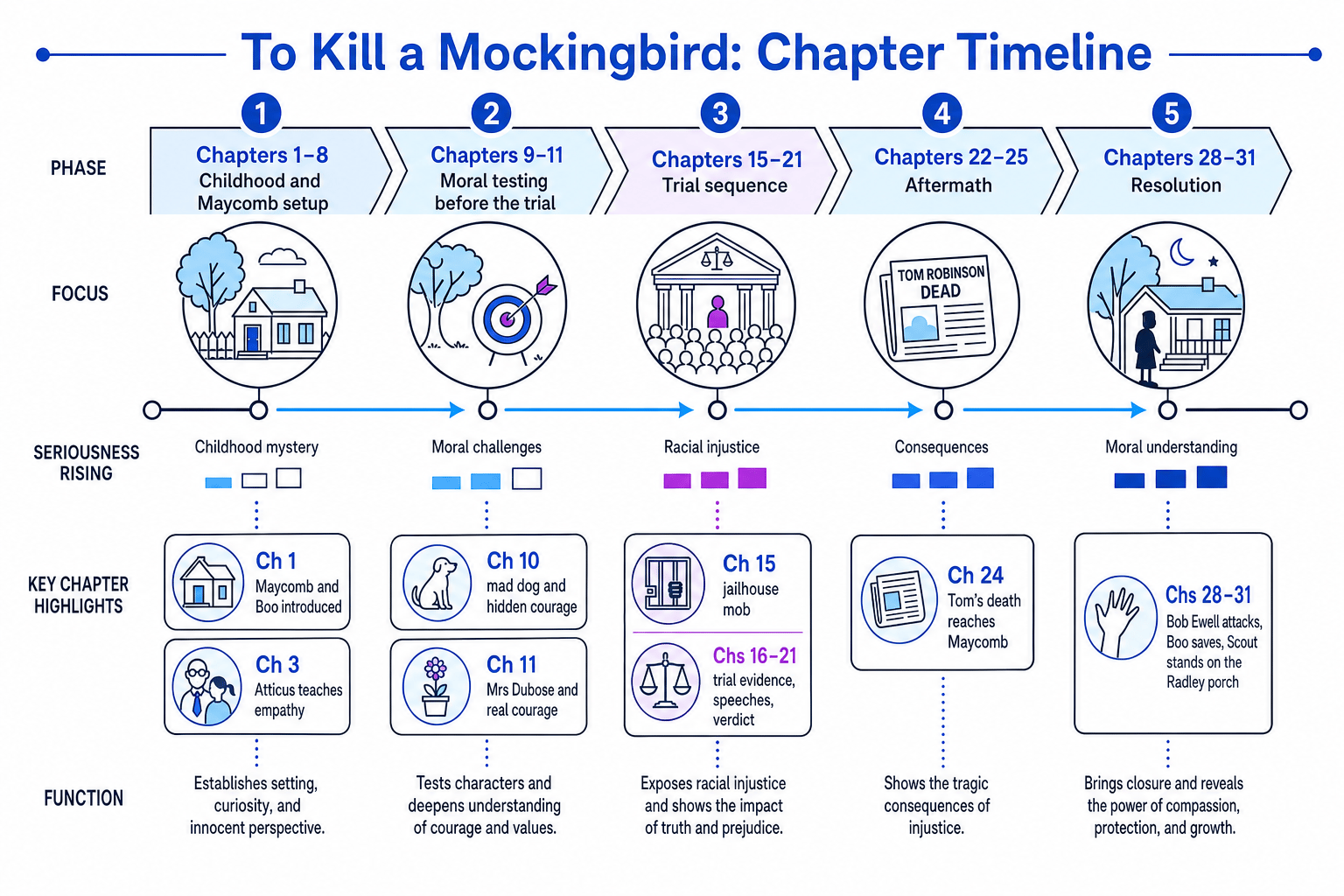
Chapters 1 and 3: Maycomb and moral vision
Chapter 1 — Maycomb, memory and Boo Radley
Chapter 1 introduces Maycomb as a place shaped by habit, poverty and social judgement. Scout describes it as “a tired old town”, and the slow pace suggests a community stuck in old attitudes.
This chapter also introduces Boo Radley through rumour. Scout says, “Inside the house lived a malevolent phantom.” The word “phantom” shows how Boo is turned into a frightening myth before the children know him as a person.
Setting
A setting is the time, place and social world of a text. In this novel, Maycomb is not just a location; it represents the traditions, inequalities and prejudices of the American South in the 1930s.
Chapter 1 matters because Lee establishes the gap between appearance and reality. Boo appears monstrous because Maycomb gossips about him. Later, Scout learns that this judgement is unfair.
Chapter 3 — Atticus’s empathy lesson
Chapter 3 gives one of the novel’s most important moral principles. After Scout has struggled at school, Atticus tells her:
“You never really understand a person until you consider things from his point of view … until you climb into his skin and walk around in it.”
This becomes a guide for reading the whole novel. Scout must learn to understand Walter Cunningham, Mayella Ewell, the mob outside the jail, and finally Boo Radley.
Treating empathy as approval
Atticus’s lesson does not mean that every action is acceptable. Lee asks the reader to understand why people behave as they do, while still recognising cruelty, racism and injustice.
Chapters 9–11: courage before the trial
Chapter 9 — Atticus chooses to defend Tom
Chapter 9 prepares the reader for the trial. Scout learns that Atticus will defend Tom Robinson, even though many people in Maycomb disapprove.
Atticus says:
“Simply because we were licked a hundred years before we started is no reason for us not to try to win.”
The phrase “licked” means beaten or defeated. Atticus already knows the racism of Maycomb makes victory unlikely, but he believes moral action still matters.
This is important for AO4 context: in the segregated American South, a Black man accused by white people would face deep racial prejudice, especially before an all-white jury. Lee uses Atticus to challenge that injustice, but she also shows how powerful it is.
Chapter 10 — the mad dog and the mockingbird
Chapter 10 contains two crucial symbols: the mockingbird and the mad dog.
Symbol and motif
A symbol is something concrete that represents a larger idea. A motif is a repeated image, object or idea that develops meaning across a text.
Atticus tells the children that “it’s a sin to kill a mockingbird.” Miss Maudie explains that mockingbirds “don’t do one thing but make music for us to enjoy.” The mockingbird becomes a symbol of innocence harmed by cruelty.
The mad dog, Tim Johnson, can also be read symbolically. Atticus standing alone in the street to shoot the dog foreshadows his later role in court: he faces a dangerous threat to the community, even though others are afraid or passive.
Reading Chapter 10 as foreshadowing
-
Identify the event: Atticus shoots Tim Johnson, a rabid dog that threatens the street.
-
Connect it to character: Jem and Scout discover that Atticus has hidden courage and skill; he is not weak just because he avoids violence.
-
Link it to the trial: Like the mad dog, Maycomb’s racism is dangerous and infectious. Atticus stands against it almost alone.
-
Explain the effect: Lee prepares the reader to see Atticus’s courtroom courage as moral courage, not physical aggression.
Chapter 11 — Mrs Dubose and “real courage”
Chapter 11 deepens the idea of courage. Mrs Dubose is racist and cruel to the children, but Atticus still wants Jem to understand her struggle to free herself from morphine addiction.
Atticus says:
“I wanted you to see what real courage is … it’s when you know you’re licked before you begin but you begin anyway and you see it through no matter what.”
This clearly connects back to Chapter 9. Atticus knows Tom’s case is almost impossible to win, but he still sees it through.
Chapters 15–21: the trial sequence
Chapter 15 — the jailhouse mob
Chapter 15 is a major turning point because private prejudice becomes public violence. A mob arrives at the jail where Tom Robinson is being held. Scout does not fully understand the danger, but the reader can.
Dramatic irony
Dramatic irony happens when the reader understands more about a situation than a character does. In Chapter 15, Scout’s innocence makes the scene more tense because we recognise the threat of lynching more clearly than she does.
Scout speaks to Mr Cunningham as an individual: “Hey, Mr. Cunningham.” Her ordinary politeness breaks the mob’s group mentality. Atticus later says that “a gang of wild animals can be stopped” because “they’re still human.”
Analysing Chapter 15 as a turning point
-
Start with the situation: The mob comes to the jail because Tom Robinson is vulnerable before the trial.
-
Analyse Scout’s perspective: Scout sees familiar neighbours, while the reader understands the historical danger of racist mob violence.
-
Use the key moment: When Scout speaks to Mr Cunningham personally, she reminds him of his identity as a father and neighbour, not just a member of a mob.
-
Link to theme and context: Lee shows that prejudice can be collective and frightening, but individual conscience can interrupt it, even if it does not remove racism from Maycomb.
Chapters 17–19 — evidence versus prejudice
These chapters present the evidence in court. Lee makes Tom’s innocence clear. Tom’s left arm “hung dead”, making it highly unlikely that he caused Mayella’s injuries in the way described. Bob Ewell, by contrast, is shown to be left-handed.
Chapter 19 is especially important because Tom speaks for himself. His statement, “I felt right sorry for her,” shocks the courtroom because racist Southern society will not tolerate a Black man pitying a white woman. The problem is not the evidence; the problem is the racist social code.
Chapters 20–21 — Atticus’s speech and the verdict
In Chapter 20, Atticus argues:
“This case is as simple as black and white.”
The phrase has a double meaning. It suggests the evidence is obvious, but it also points to the racial division that shapes the verdict.
He ends by saying:
“In the name of God, do your duty.”
The appeal to “duty” shows Atticus’s belief in justice and moral responsibility. However, Chapter 21 exposes the failure of that ideal. The repeated verdict — “guilty … guilty … guilty” — slows the moment down and makes the injustice feel unavoidable.
Reverend Sykes tells Scout:
“Miss Jean Louise, stand up. Your father’s passin’.”
This gives Atticus moral honour, even though the legal system has failed Tom.
The trial is not a mystery
Lee does not structure the trial around the question “Is Tom guilty?” His innocence is made clear. The real question is whether Maycomb will choose truth or prejudice.
Chapters 22–25: aftermath and consequences
Chapter 22 — Jem’s disillusionment
After the verdict, Jem says, “It ain’t right.” Atticus replies, “No son, it’s not right.”
This chapter matters because Jem’s belief in fairness breaks. He has watched the evidence carefully and expected justice to follow. Instead, he learns that institutions can be shaped by prejudice.
Chapter 24 — missionary circle and Tom’s death
Chapter 24 shows hypocrisy in Maycomb society. The missionary circle speaks about helping people far away, while some of its members show little compassion for Black people in their own town.
Then news arrives that Tom Robinson has been killed while trying to escape prison. Atticus says there were “seventeen bullet holes in him.” The number suggests excessive force and brutal injustice.
This chapter is important because the trial’s consequences become final. Tom is not only wrongly convicted; he is destroyed by the system.
Chapter 25 — Tom as a mockingbird
Mr Underwood’s editorial compares Tom’s death to “the senseless slaughter of songbirds.” This directly connects Tom to the mockingbird symbol.
Tom, like the mockingbird, is innocent and vulnerable. He helps Mayella, but that act of kindness is twisted against him. Lee uses this chapter to make the symbolic meaning unmistakable.
Chapters 28–31: attack, Boo Radley and closure
Chapter 28 — Bob Ewell attacks the children
The final attack brings together the two main plots: the trial plot and the Boo Radley plot. Bob Ewell’s violence is a consequence of the trial, while Boo’s intervention resolves the childhood mystery.
The darkness and confusion create suspense, but structurally the chapter is also a return to the fears of Chapter 1. The children once imagined Boo as dangerous; now the real danger comes from Bob Ewell.
Chapters 29–30 — Boo is revealed and protected
Scout finally sees Boo and says, “Hey, Boo.” The simplicity of the greeting matters: Boo is no longer a “phantom”, but a shy human being.
Atticus says, “Thank you for my children, Arthur.” Calling him “Arthur” gives Boo dignity and adulthood.
Heck Tate then refuses to expose Boo publicly. He argues that dragging Boo “into the limelight” would be “a sin”. This echoes the mockingbird idea: Boo has done good and should not be harmed by public attention.
Chapter 31 — Scout stands on the Radley porch
The ending returns to Atticus’s empathy lesson from Chapter 3. Scout says:
“Atticus was right. One time he said you never really know a man until you stand in his shoes and walk around in them.”
She then adds:
“Just standing on the Radley porch was enough.”
This is the novel’s emotional and structural closure. Scout does not need to become Boo; she only needs to see the world from his position for a moment.
How to revise key chapters
For Edexcel IGCSE, To Kill a Mockingbird appears in Component 1, Section C: Modern Prose. This is closed book, so you need secure chapter knowledge and short, accurate quotations.
| Chapter(s) | Why it matters | Short quotation to remember |
|---|---|---|
| Chapter 1 | Maycomb and Boo are introduced | “a tired old town” |
| Chapter 3 | Atticus teaches empathy | “climb into his skin” |
| Chapter 9 | Atticus commits to Tom’s defence | “licked a hundred years before we started” |
| Chapter 10 | Mockingbird symbol and hidden courage | “it’s a sin to kill a mockingbird” |
| Chapter 11 | Courage is defined | “real courage” |
| Chapter 15 | Scout stops the mob | “they’re still human” |
| Chapters 17–19 | Evidence proves Tom’s innocence | “I felt right sorry for her” |
| Chapters 20–21 | Atticus’s appeal and the guilty verdict | “do your duty” |
| Chapters 24–25 | Tom dies; mockingbird meaning is confirmed | “senseless slaughter of songbirds” |
| Chapter 31 | Scout understands Boo | “standing on the Radley porch” |
Revise by function, not just number
When you revise a chapter, attach it to a job: “Chapter 15 = mob violence and Scout’s innocence”, “Chapter 11 = real courage”, “Chapter 31 = empathy fulfilled.” This makes it much easier to use chapters flexibly in essays.
Retelling instead of analysing
Do not spend a paragraph narrating everything that happens in a chapter. Choose one precise moment, quote briefly, and explain how it develops Lee’s ideas about justice, prejudice, courage or empathy.
In the exam
-
Choose chapters that directly fit the question’s theme or character, rather than forcing in your favourite quotation.
-
Use short quotations accurately, then explain their meaning and importance in the chapter.
-
Link context to the moment: for example, connect Tom’s trial to racial injustice in the 1930s American South, not to vague comments about “the past”.
Check yourself
- Which early chapter first gives Scout the moral lesson she fulfils at the end?
- Why is Chapter 15 more than just a tense scene outside the jail?
- How do Chapters 24 and 25 develop the mockingbird symbol after the trial?
