What you'll learn
- What a theme is, and how to turn a one-word topic into a strong literary argument.
- The main themes in Things Fall Apart: tradition, masculinity, fate, religion, colonialism, and storytelling.
- How Achebe develops themes across the novel’s structure.
- How to write about themes in a closed-book Edexcel IGCSE answer using short, accurate quotations.
What is a theme?
A theme is more than a topic. “Masculinity” is a topic; “Achebe shows that a narrow idea of masculinity can become destructive” is a theme statement.
Theme
A theme is a recurring idea, issue, or message explored through a text. In an essay, you should usually express a theme as a full idea, not just a single word.
In Things Fall Apart, Achebe does not give simple moral lessons. He often presents two truths at once: Igbo society is rich, ordered and meaningful, but it also contains tensions; colonial rule is brutal and arrogant, but it succeeds partly because it exploits divisions already present in the community.
Turning a topic into a theme statement
-
Start with the topic: fear.
-
Ask what Achebe shows about it: Okonkwo’s fear is not ordinary caution; it is a fear of seeming like his father, Unoka, whom he sees as weak.
-
Add evidence: the narrator says Okonkwo’s life is “dominated by fear, the fear of failure and of weakness” in Chapter 2.
-
Turn it into an arguable theme statement: Achebe presents fear as a hidden force that drives Okonkwo’s violence and helps cause his downfall.
How Achebe develops themes across the novel
Structure
Structure means the way a writer organises a text, including the order of events, shifts in focus, contrasts, beginnings and endings.
The novel’s structure helps its themes develop. The early chapters establish Umuofia’s customs, speech, religion and social rules. The middle section shows exile, uncertainty and the arrival of Christianity. The final section shows colonial law and religion changing the clan so deeply that Okonkwo can no longer understand his world.
The map below shows how the major themes overlap. Notice especially how Okonkwo’s private fear connects to the public collapse of Umuofia.
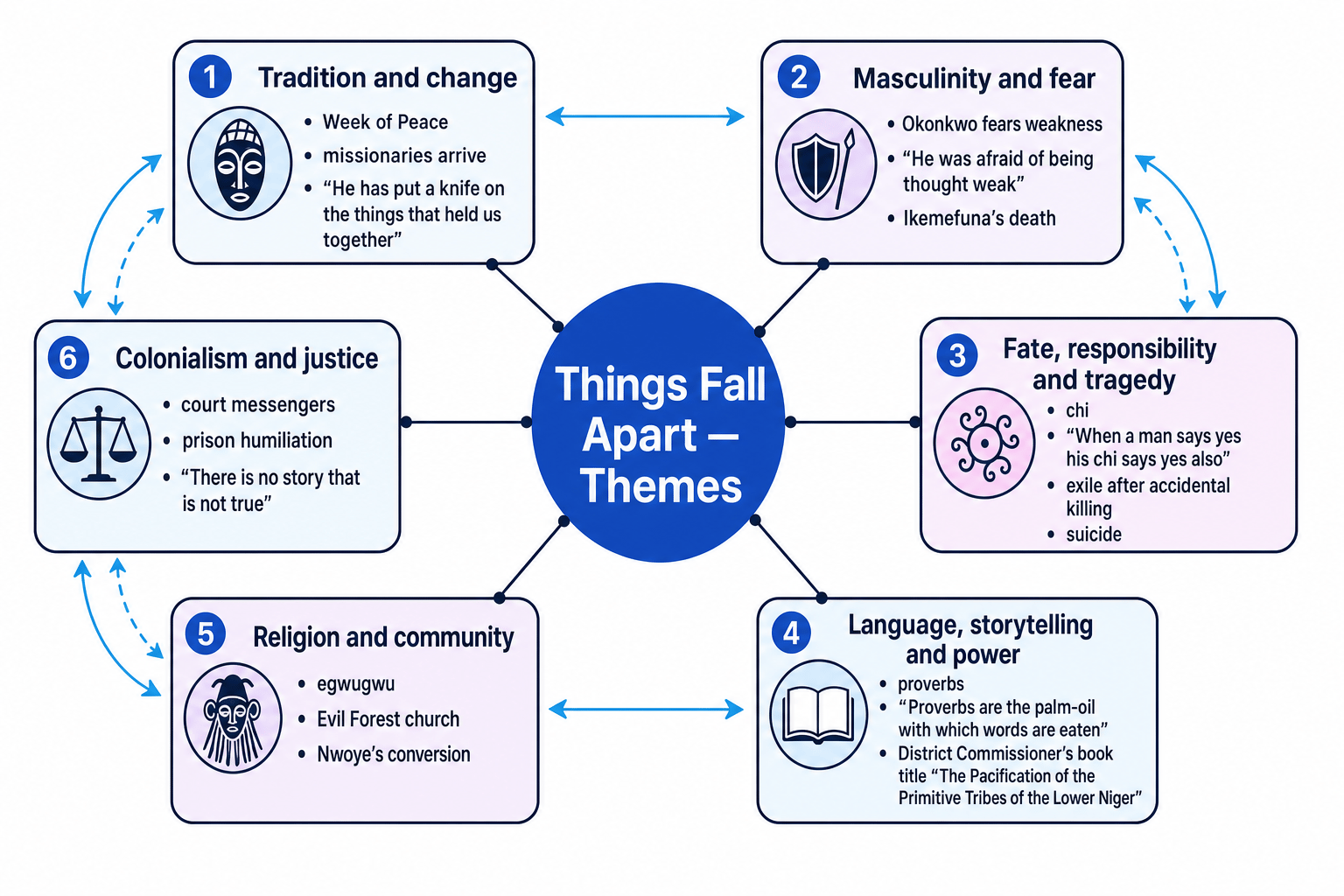
Themes overlap
The best essays do not treat themes as separate boxes. In Things Fall Apart, masculinity links to violence; religion links to community; storytelling links to colonial power.
Tradition, community and change
Achebe presents Igbo society as complex and highly organised. Umuofia has laws, rituals, titles, family duties, religious beliefs and forms of justice. This matters because Achebe was writing partly against racist colonial stereotypes that represented African societies as primitive or chaotic.
Context
Context means the social, historical and cultural circumstances surrounding a text. For Edexcel IGCSE, Things Fall Apart is Modern Prose, so you should link Achebe’s ideas to context as part of your interpretation.
A key example is the importance of communal ritual. During the Week of Peace, Okonkwo beats Ojiugo, and the priest Ezeani condemns him because “it was unheard of to beat somebody during the sacred week” in Chapter 4. This shows that Umuofia has moral and spiritual limits, even for powerful men.
However, Achebe does not idealise tradition. Some customs cause suffering, including the killing of Ikemefuna, the abandonment of twins, and the exclusion of outcasts. This makes the arrival of Christianity more complicated: some people join the new religion because they feel wounded or rejected by the old order.
Obierika sums up the theme of change in Chapter 20 when he says of the white man: “He has put a knife on the things that held us together and we have fallen apart.” The metaphor of the “knife” suggests violence, division and cutting apart. It also echoes the novel’s title, taken from W. B. Yeats’s poem “The Second Coming”: “Things fall apart; the centre cannot hold.”
Allusion
An allusion is a reference to another text, event, person or idea. Achebe’s title alludes to Yeats to suggest social breakdown and disorder.
Masculinity, fear and violence
Okonkwo’s idea of masculinity is built against everything he associates with his father, Unoka: gentleness, debt, music, failure and emotion. The narrator states that Okonkwo’s “whole life was dominated by fear, the fear of failure and of weakness” in Chapter 2.
This fear becomes destructive because Okonkwo confuses strength with hardness. When the clan decides Ikemefuna must die, Ogbuefi Ezeudu warns Okonkwo not to take part. Yet in Chapter 7, Okonkwo kills Ikemefuna because “he was afraid of being thought weak.” Achebe makes this moment crucial: Okonkwo’s public image matters more to him than love, loyalty or moral judgement.
Tragic flaw
A tragic flaw is a weakness in a central character that contributes to their downfall. Okonkwo’s flaw is not simply anger; it is his fearful, rigid version of manhood.
Achebe also complicates gender. Umuofia is patriarchal, meaning men hold most social and political power. The word “agbala” can mean both “woman” and an untitled man, showing how femininity is treated as weakness. Yet the novel also values the “motherland” of Mbanta and Uchendu’s idea that “Mother is Supreme” in Chapter 14. This challenges Okonkwo’s narrow thinking.
Oversimplifying Okonkwo
Do not write that Okonkwo is “just evil” or “just a victim”. A stronger answer shows that Achebe presents him as admirable in discipline and status, but tragically damaged by fear, pride and violence.
Fate, chi and personal responsibility
Chi
In Igbo belief, a person’s chi is their personal spiritual force or personal god, linked to destiny and fortune.
Achebe explores the tension between fate and choice. Early in the novel, the narrator gives the proverb: “When a man says yes his chi says yes also” in Chapter 4. This suggests that effort and willpower matter. Okonkwo seems to prove this through his hard work, wrestling fame and rise from poverty.
But later events challenge that confidence. Okonkwo’s gun accidentally kills Ezeudu’s son at the funeral in Chapter 13, forcing him into exile. The narrator explains that the crime is “female” because it is inadvertent, but it still has devastating consequences. Okonkwo’s downfall is therefore partly caused by chance, partly by cultural law, and partly by his own choices.
Weighing fate and responsibility
-
Compare the evidence for personal choice: Okonkwo chooses to join Ikemefuna’s killing, even after being warned not to.
-
Compare the evidence for fate or accident: Okonkwo’s gun explodes at Ezeudu’s funeral, causing an accidental death and exile.
-
Reach a balanced interpretation: Achebe presents Okonkwo as trapped by circumstance, but not innocent of responsibility; his choices prepare the ground for his tragedy.
Religion, belief and belonging
Religion in the novel is not just private belief. It shapes law, land, family and identity. The egwugwu, ancestral spirits represented by masked elders, settle disputes and reinforce the authority of the clan.
Christianity disrupts this system because it offers belonging to people who feel alienated. Nwoye is drawn to “the poetry of the new religion” in Chapter 16, partly because he is disturbed by the killing of Ikemefuna and the suffering of twins. The church also accepts outcasts, which challenges the clan’s boundaries.
Achebe presents this with nuance. The missionaries are not all identical: Mr Brown tries dialogue and education, while Reverend Smith is more aggressive and divisive. This helps you avoid a flat answer. The theme is not simply “old religion good, new religion bad”; it is about how belief systems shape community, comfort and power.
Language, storytelling and power
Proverb
A proverb is a short traditional saying that expresses shared wisdom or cultural values.
Achebe makes Igbo speech central to the novel. In Chapter 1, the narrator says, “Proverbs are the palm-oil with which words are eaten.” This metaphor presents language as something that enriches and makes meaning easier to receive. Storytelling is a form of cultural knowledge, not decoration.
At the end, Achebe sharply contrasts Igbo storytelling with colonial storytelling. The District Commissioner imagines reducing Okonkwo’s life to a paragraph in his book, The Pacification of the Primitive Tribes of the Lower Niger. The title is deeply ironic: “Pacification” hides violence, and “Primitive” exposes the Commissioner’s racist assumptions.
Irony
Irony is when there is a gap between appearance and reality, or between what is said and what the reader understands.
This ending is powerful because the whole novel has shown the depth of Okonkwo’s life and culture. The Commissioner’s planned book would erase that complexity. Achebe, by writing the novel, gives back the story that colonial language tries to simplify.
Useful closed-book quotation bank
For Component 1 Section C, the exam is closed book, so memorise a small number of flexible quotations: “dominated by fear”, “He was afraid of being thought weak”, “Proverbs are the palm-oil”, “When a man says yes his chi says yes also”, “the poetry of the new religion”, “He has put a knife”, and “The Pacification of the Primitive Tribes of the Lower Niger”.
Writing about themes well
A strong theme paragraph usually follows this movement: make a clear point, embed a short quotation, analyse the writer’s method, explain the effect, and link to context or the wider theme.
For example, if writing about colonialism, do not just say “the white men destroy Igbo culture.” Instead, show how Achebe presents colonial power as military, legal, religious and linguistic. The court messengers, prison humiliation and District Commissioner’s book title all reveal different kinds of control.
In the exam
-
Turn the question wording into a theme statement, then choose two or three moments from different parts of the novel.
-
Use brief, accurate quotations and analyse individual words or methods, such as metaphor, proverb, irony or structural contrast.
-
Link context to Achebe’s purpose: he challenges colonial stereotypes while still presenting Igbo society as complex, flawed and fully human.
Check yourself
- How does Okonkwo’s fear of weakness connect to the wider collapse of Umuofia?
- Why is Nwoye attracted to Christianity, and what does this reveal about Igbo society?
- How does the District Commissioner’s planned book title change the reader’s understanding of storytelling and power?
