What you'll learn
- What “context” means for Things Fall Apart in the Edexcel IGCSE exam.
- How Achebe presents pre-colonial Igbo society as complex, organised and human.
- How British colonialism and Christianity affect Umuofia.
- How to use context in essays without turning your answer into a history lesson.
Why context matters in Things Fall Apart
In the Edexcel International GCSE, Things Fall Apart appears in Component 1, Section C: Modern Prose. This is closed book, so you need secure knowledge of the novel and a few short, accurate quotations.
For this text, context is especially important because Achebe is writing about a society before and during colonial disruption — but he is also writing in 1958, near the end of British rule in Nigeria. That means the novel looks both backwards to Igbo life before colonial conquest and outwards to challenge how Africa had been described by European writers.
Context
Context means the circumstances surrounding a text: the historical period, social values, beliefs, literary traditions and political events that help shape its meaning.
AO4 is a relationship
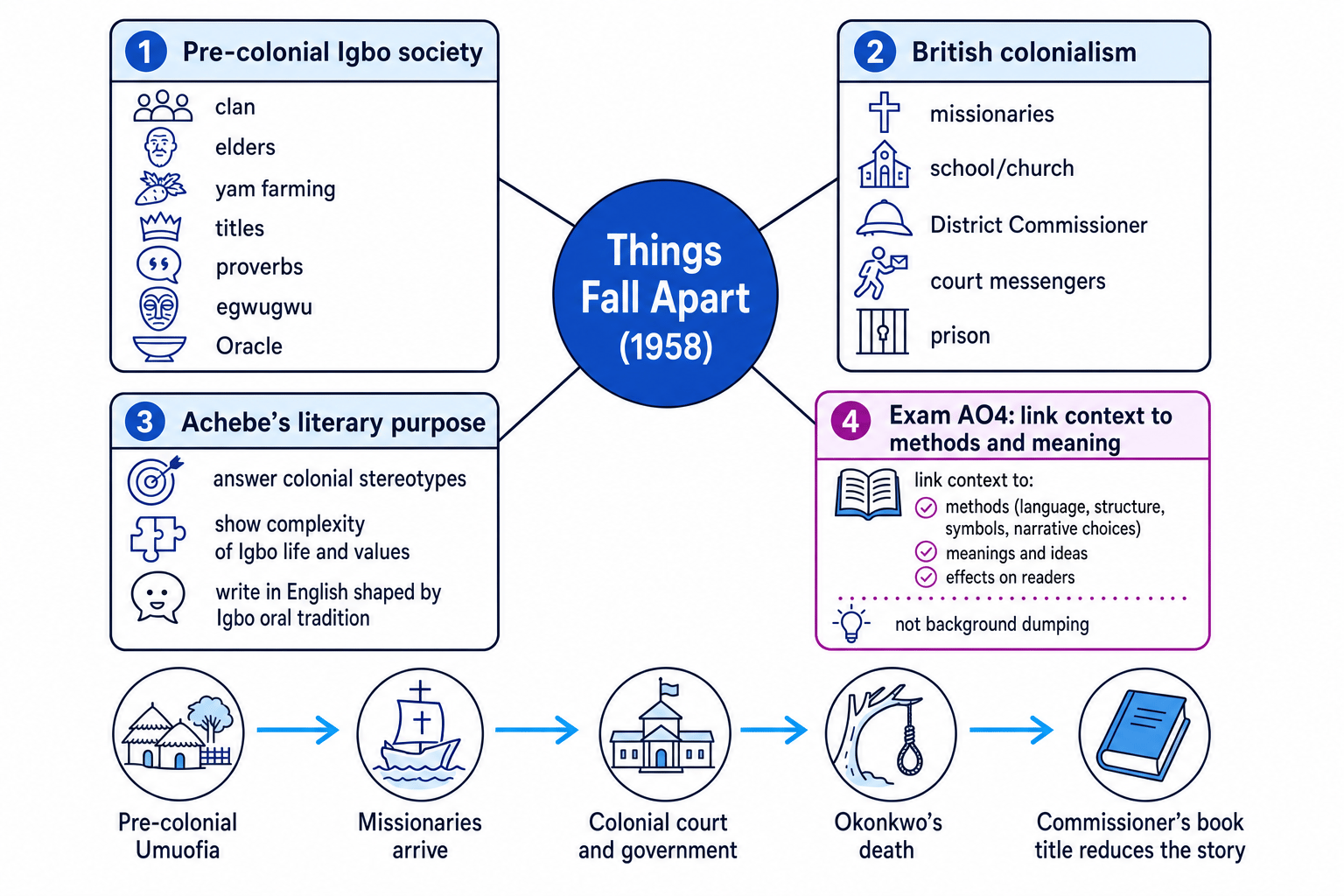
For AO4, you are not rewarded for dumping facts about history. You are rewarded for exploring the relationship between the text and its context: how Achebe uses characters, structure, language and events to present ideas about Igbo society, masculinity, religion and colonialism.
This map shows the main contextual areas you should connect to the novel.
Achebe’s purpose: writing back
Chinua Achebe was a Nigerian writer from an Igbo background. Things Fall Apart was published in 1958, two years before Nigeria became independent from Britain in 1960. Achebe was writing at a time when many African nations were questioning colonial rule and reclaiming their histories.
One important literary context is that many European texts had presented African societies as primitive, silent or lacking civilisation. Achebe challenges this by giving Igbo people complex speech, beliefs, laws, humour, family tensions and moral debates.
The novel’s final irony is that the District Commissioner thinks Okonkwo’s story might make “a reasonable paragraph” in his planned book, The Pacification of the Primitive Tribes of the Lower Niger. Achebe exposes how colonial writing reduces whole lives and cultures into racist, simplified labels.
Colonialism
Colonialism is the process by which one country takes political, economic and cultural control over another territory or people. In the novel, British colonialism arrives through missionaries, courts, messengers, prisons and government authority.
Worked example: Linking Achebe’s purpose to the ending
Analysing the District Commissioner’s viewpoint
-
Start with the contextual idea: colonial authorities often claimed they were bringing “civilisation” and order, while ignoring the complexity of the people they controlled.
-
Connect that idea to the text: the District Commissioner plans a book called The Pacification of the Primitive Tribes of the Lower Niger. The words “pacification” and “primitive” reveal his patronising view of Igbo people.
-
Analyse the effect: “pacification” makes colonial violence sound calm and reasonable, while “primitive” reduces Umuofia to a stereotype. Achebe makes the reader see the Commissioner’s ignorance because we have already spent the whole novel inside Igbo society.
-
Link back to meaning: the ending shows why Achebe’s novel itself is necessary. It gives the full human story that colonial accounts would erase.
Pre-colonial Igbo society: not simple, not perfect
Achebe presents Umuofia before the main arrival of colonial power as a highly organised society. It has laws, rituals, farming systems, marriage customs, titles, religious beliefs and ways of settling disputes.
This matters because Achebe is not presenting Igbo society as chaotic before Europeans arrive. The clan has its own structures. Elders are respected, titles bring status, yams symbolise masculine success, and the Oracle and egwugwu help enforce spiritual and legal authority.
Pre-colonial
Pre-colonial means before the full political control of a colonising power. In Things Fall Apart, it refers to Igbo life before British colonial systems dominate Umuofia.
A key example is Achebe’s use of proverbs. Early in the novel, the narrator says, “proverbs are the palm-oil with which words are eaten.” This metaphor presents speech as something culturally rich and nourishing. Conversation is an art, not a sign of simplicity.
At the same time, Achebe does not idealise Igbo society. Some customs are shown as harsh or painful: Ikemefuna is killed because of the Oracle’s command, twins are abandoned in the Evil Forest, and outcasts such as the osu are marginalised. This balanced presentation is crucial.
Making Igbo society too simple
Avoid writing, “Achebe shows Igbo society was perfect before colonialism.” He does not. A stronger argument is that Achebe presents Igbo society as complex: it has beauty, order and wisdom, but also violence, exclusion and fear.
Religion and belief
Religion in Umuofia is not just private belief. It shapes law, agriculture, family life and justice. The earth goddess Ani is connected to morality and fertility, while the Oracle influences major decisions. The egwugwu represent ancestral authority in public judgement.
Egwugwu
The egwugwu are masked ancestral spirits performed by titled men in Umuofia. They represent the authority of the ancestors and help judge disputes.
When the missionaries arrive, Christianity does not simply defeat Igbo religion by being “stronger”. Achebe shows that Christianity appeals to people who feel hurt or excluded by clan customs. Nwoye is troubled by Ikemefuna’s death and by the killing of twins; the new religion gives him emotional relief.
This makes the colonial encounter more complicated. Some people join the church because of spiritual conviction, some because it offers status, and some because it challenges customs that have wounded them.
Masculinity and patriarchy
Okonkwo’s society values strength, farming success, titles and courage. Okonkwo responds to these values in an extreme way because he is ashamed of his father Unoka, who was poor and considered weak. The narrator says, “His whole life was dominated by fear, the fear of failure and of weakness.”
Patriarchy
Patriarchy is a social system in which men hold most authority in the family, politics and public life. In Umuofia, men usually control titles, households and public decision-making.
Achebe connects Okonkwo’s personal tragedy to social expectations. Okonkwo believes tenderness is weakness, so “Okonkwo ruled his household with a heavy hand.” The phrase suggests power, but also cruelty. Context helps you see that Achebe is exploring a culture where masculine status matters deeply — but he is also criticising Okonkwo’s narrow, violent version of manhood.
However, do not reduce the novel to “men have power, women have none.” Female spiritual power matters too. The earth goddess Ani is central, Chielo has authority as priestess, and Uchendu reminds Okonkwo in exile, “Mother is Supreme.”
Worked example: Using gender context with nuance
Analysing masculinity and context
-
Choose the contextual focus: Umuofia is patriarchal, so male success is linked to farming, titles, physical courage and control of the household.
-
Anchor the point in evidence: Achebe writes that “Okonkwo ruled his household with a heavy hand.” This shows how Okonkwo performs masculinity through domination.
-
Analyse the method and effect: “heavy hand” suggests authority becoming violence. The reader sees that Okonkwo’s fear of weakness damages his relationships with his wives, children and clan.
-
Add nuance: the novel also includes female spiritual authority, such as Ani and Chielo, and the phrase “Mother is Supreme.” So Achebe critiques extreme masculinity rather than simply presenting all Igbo values as one thing.
British colonialism: division before conquest
The arrival of the white missionaries begins as a religious event, but it gradually becomes political. A church is built, converts gather, schools appear, and eventually colonial courts and messengers enforce British authority.
Obierika gives one of the clearest summaries of colonial disruption: “The white man is very clever. He came quietly and peaceably with his religion… He has put a knife on the things that held us together and we have fallen apart.”
The metaphor of the “knife” is important. It suggests violence, cutting and separation. Colonialism does not only attack from outside; it divides the clan internally by exploiting existing tensions.
Best colonialism quotation
Obierika’s “knife” quotation is one of the most useful context quotations in the whole novel because it links religion, politics, social division and the title Things Fall Apart.
Worked example: Connecting colonialism to structure
Analysing how the clan falls apart
-
Identify the structural movement: the novel begins with Umuofia’s internal customs and conflicts, then gradually shifts towards missionary and colonial power.
-
Link this to context: British colonialism in Nigeria often worked through religion, education, trade, courts and indirect authority, not only through open battle.
-
Use the quotation: Obierika says the white man “put a knife on the things that held us together.” The “knife” metaphor shows the clan being cut apart from within.
-
Explain the reader’s response: because Achebe has already shown the clan’s rituals, language and relationships, the reader understands colonialism as the destruction of a living society, not the improvement of an empty one.
Language, oral tradition and Igbo words
Achebe writes the novel in English, but he reshapes English through Igbo speech patterns, proverbs, folktales and untranslated words. This is a major part of the novel’s literary context.
Oral tradition
Oral tradition means cultural knowledge passed down through spoken forms such as stories, songs, proverbs, myths and ritual speech.
Achebe includes Igbo terms such as chi, egwugwu, osu and ogbanje. He often gives enough context for you to understand them, but he does not always replace them with English equivalents. This matters: the reader has to enter Igbo culture rather than expecting everything to be translated into a European framework.
The novel also uses folktales, especially through characters such as Ekwefi and Ezinma. These moments show that storytelling is part of family life, moral teaching and cultural memory.
The title and Yeats’s epigraph
The title Things Fall Apart comes from W. B. Yeats’s poem “The Second Coming”: “Things fall apart; the centre cannot hold.” Achebe uses this European literary reference in a new African context.
Epigraph
An epigraph is a short quotation placed at the beginning of a text to suggest important themes or ideas.
The “centre” can refer to many things in the novel: Okonkwo’s identity, family authority, clan unity, traditional religion, and the wider social order of Umuofia. Achebe’s title therefore works on both a personal and political level. Okonkwo falls apart, but so does the world that gave him meaning.
How to write about context well
A strong context paragraph does not begin with a huge historical fact. It begins with the question, the character or the theme, then uses context to deepen the analysis.
A useful sentence pattern is:
Achebe presents [idea in the novel] in the context of [historical/social belief], showing that [meaning/effect].
For example: Achebe presents Okonkwo’s violence in the context of a patriarchal society that prizes strength and titles, showing that social values can become destructive when they are driven by fear.
Context bolted on
Do not add context as a separate final sentence like, “This was because Nigeria was colonised by Britain.” Instead, make context explain Achebe’s choices and the reader’s understanding of the novel.
Closed-book preparation
Learn a small bank of flexible quotations: “proverbs are the palm-oil,” “heavy hand,” “fear of failure and of weakness,” “Mother is Supreme,” “put a knife,” and “a reasonable paragraph.” These can support many context-focused arguments.
In the exam
-
Start from the question, then choose the context that genuinely helps: Igbo society, masculinity, religion, colonialism, language or Achebe’s purpose.
-
Keep quotations short and accurate. Since this is closed book, brief embedded references are better than long, uncertain quotations.
-
Link every contextual point to meaning: ask, “How does this help Achebe shape the reader’s view of Okonkwo, Umuofia or colonial power?”
Check yourself
- How does Achebe show that Igbo society is complex rather than primitive or perfect?
- Why is Obierika’s “knife” metaphor so useful for writing about colonialism?
- How can you use context in an essay without turning your paragraph into a history summary?
