What you'll learn
- How Achebe presents the main characters in Things Fall Apart.
- How to analyse characters as individuals and as part of Igbo society.
- How relationships create conflict, especially between fathers and sons.
- How to use short, precise quotations for Edexcel IGCSE closed-book prose answers.
Starting point: what is character analysis?
In Things Fall Apart, characters are not just “people in the story”. Achebe uses them to explore values, pressures and conflicts in Umuofia before and during colonial disruption.
Characterisation
Characterisation means the methods a writer uses to create a character. This can be direct characterisation, where the narrator tells us something, or indirect characterisation, where we infer it from actions, speech, reactions and relationships.
For Edexcel IGCSE, Things Fall Apart appears in Component 1 Section C: Modern Prose, which is closed book. That means you need secure knowledge of characters, moments and short quotations. The main assessment focus is your informed response to the text and its context, so always connect character to Achebe’s presentation of Igbo society and colonial change.
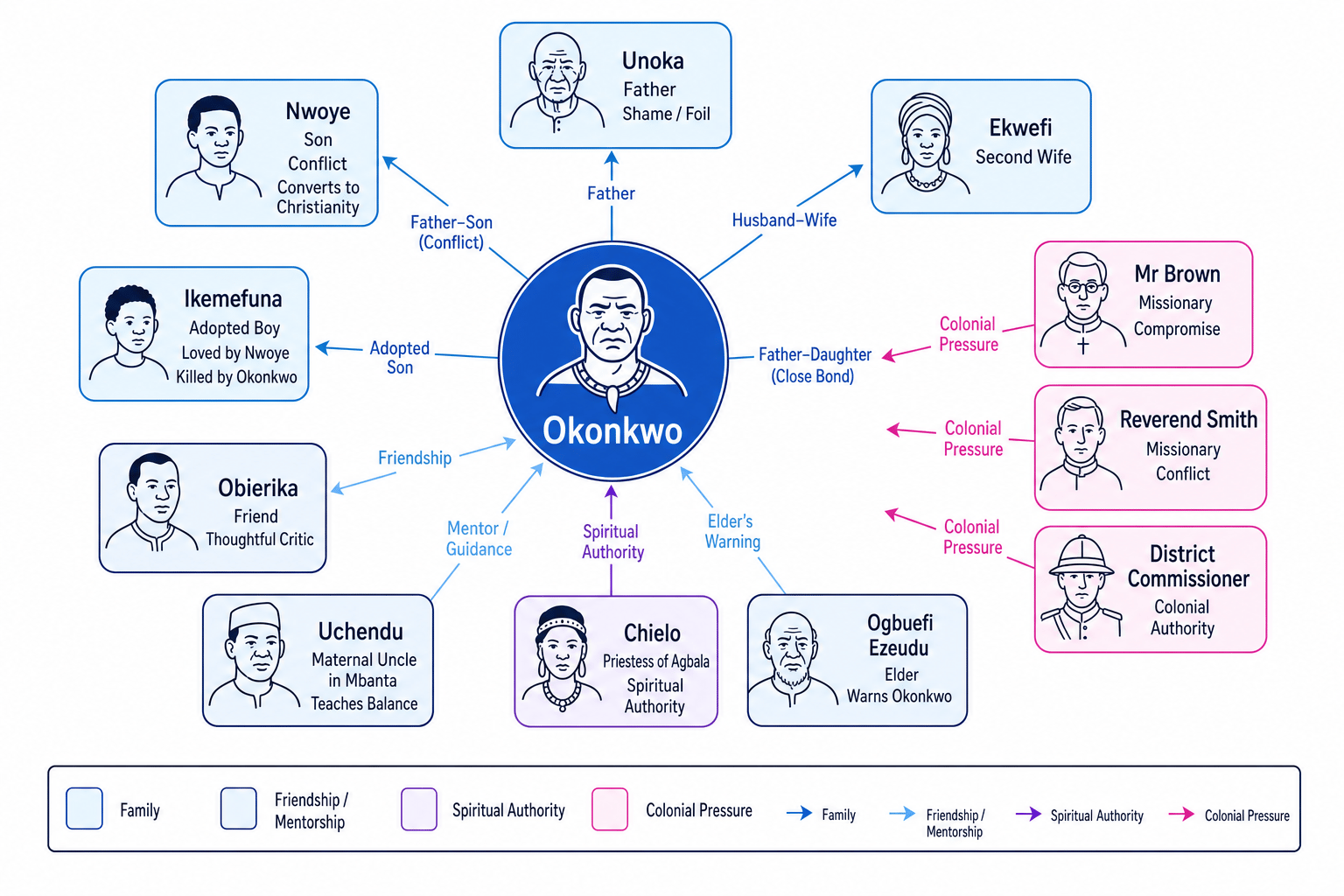
Character map: who connects to whom?
Okonkwo sits at the centre of many relationships: family, clan, spiritual authority and colonial power all press on him. Use this map to revise the main connections before building detailed interpretations.
Okonkwo: strength built on fear
Okonkwo is the protagonist, meaning the central character whose actions drive the plot. Achebe introduces him through achievement: “Okonkwo was well known throughout the nine villages” and “His fame rested on solid personal achievements” in Chapter 1.
At first, this makes him seem admirable. He has risen from poverty, won wrestling fame and earned status through work. However, Achebe quickly complicates him. His strength is not calm confidence; it is built on terror of becoming like his father.
Okonkwo’s central contradiction
Okonkwo looks powerful in public, but privately he is ruled by “the fear of failure and of weakness”. This fear makes him successful, but it also makes him violent, emotionally narrow and finally self-destructive.
Achebe’s narrator tells us that Okonkwo “never showed any emotion openly, unless it be the emotion of anger”. This direct characterisation is crucial: Okonkwo has trained himself to treat tenderness as weakness. That is why he struggles with Nwoye, Ikemefuna and even Ezinma, the daughter he loves.
Analysing Okonkwo's fear
-
Start with Achebe’s direct statement that Okonkwo’s “whole life was dominated by fear”. The word “dominated” suggests fear controls him rather than simply motivating him.
-
Connect this to his father, Unoka. The narrator explains that Okonkwo is afraid “lest he should be found to resemble his father”, so his identity is built as a rejection of Unoka’s gentleness, debt and lack of titles.
-
Apply this to action. When Ikemefuna is killed, Okonkwo joins in because “He was afraid of being thought weak.” The sentence is blunt and causal: fear directly produces brutality.
-
Link back to Achebe’s larger purpose. Okonkwo’s tragedy is not that strength is bad, but that strength without balance, compassion or self-knowledge becomes destructive.
Unoka: the father who haunts the son
Unoka, Okonkwo’s father, dies before the main events of the novel, but he shapes Okonkwo’s entire personality.
Foil
A foil is a character who contrasts with another character so that their differences stand out more clearly.
Unoka is Okonkwo’s foil. Achebe describes him as “lazy and improvident” and says that when he died “he had taken no title at all and he was heavily in debt”. To Umuofia, where titles, farming and masculine success matter, Unoka is a failure.
But Achebe does not make him worthless. Unoka loves music, conversation and beauty. This makes the contrast more interesting: Okonkwo rejects not only his father’s failures, but also his softer, more artistic qualities.
Using Unoka as Okonkwo's foil
-
Compare public status: Unoka has “taken no title”, while Okonkwo’s fame rests on “solid personal achievements”. Achebe places failure and success side by side.
-
Compare values: Unoka enjoys music and present pleasure, while Okonkwo values work, discipline and toughness. Their contrast exposes different ideas of what a “man” should be.
-
Explain the effect on Okonkwo. Because he is ashamed of Unoka, Okonkwo overcorrects: he treats gentleness as weakness and anger as strength.
Nwoye: the son who cannot become his father
Nwoye is Okonkwo’s son, but he does not fit Okonkwo’s ideal of masculinity. Early on, the narrator says Nwoye is already causing “great anxiety” because of his “incipient laziness”. The word “incipient” means just beginning to develop, so Okonkwo fears Nwoye may become another Unoka.
Nwoye’s importance is emotional and moral. He responds deeply to suffering: the abandoned twins, Ikemefuna’s death and the harshness of his father’s household. Achebe writes that Nwoye “preferred the stories that his mother used to tell”, which contrasts with Okonkwo’s preference for “masculine” tales of violence.
When the missionaries arrive, Nwoye is drawn to Christianity partly because it gives language to feelings he has not been able to express. The hymn about “brothers who sat in darkness and in fear” seems to answer “the question of the twins crying in the bush and the question of Ikemefuna who was killed”.
Explaining Nwoye's conversion
-
Identify Nwoye’s conflict with Umuofia’s harsher customs: he is troubled by the killing of Ikemefuna and the abandonment of twins.
-
Connect this to his conflict with Okonkwo: his father demands violent masculinity, but Nwoye’s nature is more sensitive and questioning.
-
Explain why Christianity appeals to him. Achebe shows conversion not simply as betrayal, but as an emotional escape from unresolved suffering.
Oversimplifying Nwoye
Do not write that Nwoye converts only because he is “weak”. Achebe presents him as sensitive, morally disturbed and alienated by Okonkwo’s version of manhood.
Ikemefuna: the loved outsider
Ikemefuna is given to Umuofia as compensation after a crime committed by his village. He becomes part of Okonkwo’s household and is especially loved by Nwoye. Even Okonkwo becomes “very fond of the boy — inwardly of course”.
Ikemefuna matters because he reveals what Okonkwo cannot admit: Okonkwo is capable of love. Yet Okonkwo’s fear of weakness destroys that love. Ogbuefi Ezeudu warns him, “That boy calls you father. Do not bear a hand in his death.” Okonkwo ignores this, and the killing becomes a turning point for the family.
Ikemefuna is also a catalyst, meaning a character or event that triggers change. His death permanently damages Nwoye’s relationship with Okonkwo and pushes Nwoye towards the missionaries later.
Ekwefi and Ezinma: love, loss and hidden tenderness
Ekwefi is Okonkwo’s second wife and Ezinma’s mother. Her story reveals the suffering of women in the novel, especially through childbirth and child loss. She has borne ten children, and nine have died. Achebe links her to the Igbo belief in the ogbanje, a child believed to die and return repeatedly to torment its mother.
Ezinma is her only surviving child, so their bond is unusually close. Achebe shows this through the fact that Ezinma calls her mother by her name, “Ekwefi”, rather than using a more formal address.
Ezinma also reveals Okonkwo’s tenderness. He repeatedly thinks she should have been a boy, and says she has “the right spirit”. This is affectionate but also limited: Okonkwo can recognise her strength only by imagining it as masculine.
Ezinma reveals Okonkwo’s limits
Okonkwo loves Ezinma deeply, but his society’s gender expectations mean he cannot fully value her as a girl. Achebe uses her to expose both tenderness and patriarchy.
Obierika: the thoughtful friend
Obierika is Okonkwo’s close friend and one of the novel’s most important voices of reflection. Achebe says, “Obierika was a man who thought about things.” That simple sentence separates him from Okonkwo, who often acts before thinking.
Obierika respects Igbo customs, but he questions them. After Okonkwo is exiled for accidentally killing a clansman, Obierika wonders, “Why should a man suffer so grievously for an offence he had committed inadvertently?” He does not reject the clan, but he recognises moral difficulty within it.
Later, he gives one of the novel’s clearest explanations of colonial disruption: “He has put a knife on the things that held us together and we have fallen apart.” The metaphor of the “knife” suggests violence, division and the cutting of communal bonds.
Obierika is useful for balanced essays
If a question asks whether Achebe presents Igbo society positively or critically, Obierika helps you avoid a one-sided answer. He loves the clan, but he can see its contradictions.
Uchendu: the voice of balance in exile
Uchendu is Okonkwo’s maternal uncle in Mbanta. He teaches Okonkwo lessons about resilience, family and the importance of the mother’s side of kinship. His famous idea “Mother is Supreme” challenges Okonkwo’s obsession with fatherhood, titles and masculine achievement.
Uchendu’s role is partly structural. During Okonkwo’s exile, he slows the novel down and offers wisdom. He reminds Okonkwo that suffering is not unique to him, and that survival requires humility as well as strength.
Chielo and Ogbuefi Ezeudu: spiritual and elder authority
Chielo is the priestess of Agbala. She shows that women can hold frightening spiritual authority in Umuofia, even within a patriarchal society. When she carries Ezinma away at night, Ekwefi’s terror shows the power of religion over family life.
Ogbuefi Ezeudu is an elder whose warning about Ikemefuna carries moral weight. When Okonkwo later kills Ezeudu’s son accidentally at the funeral, the event feels structurally significant: Okonkwo ignores wise authority, and then fate turns against him.
Mr Brown, Reverend Smith and the District Commissioner
Achebe presents the colonial characters with important differences.
Mr Brown is a missionary who uses patience and conversation. He “preached against such excess of zeal” and tries to understand Igbo beliefs through discussion with Akunna. He still represents colonial religious change, but he is not as openly destructive as his successor.
Reverend Smith is far more rigid. Achebe says he “condemned openly Mr Brown’s policy of compromise and accommodation” and “saw things as black and white. And black was evil.” This language exposes his absolutism and racialised thinking.
The District Commissioner represents colonial government. At the end, he reduces Okonkwo’s life to material for a paragraph in his planned book, The Pacification of the Primitive Tribes of the Lower Niger. This title is bitterly ironic: the word “Pacification” hides violence, and “Primitive” shows colonial arrogance.
Treating the white characters as identical
Mr Brown, Reverend Smith and the District Commissioner all contribute to colonial change, but Achebe characterises them differently. Strong answers notice the movement from dialogue, to extremism, to bureaucratic control.
How to write about characters in essays
A strong character paragraph should move from what the character is like to how Achebe presents them and why that matters.
For example, do not only write: “Okonkwo is violent.” Instead, develop it: Achebe presents Okonkwo’s violence as the result of fear, especially fear of resembling Unoka. This makes him both frightening and tragic, because his desire to appear strong destroys the relationships that might have saved him.
In the exam
-
Begin each paragraph with a clear argument about the character, not just a plot summary.
-
Use short quotations you can remember accurately, such as “fear of failure and of weakness”, “He was afraid of being thought weak”, or “Mother is Supreme”.
-
Link character to context carefully: discuss Igbo social values, gender expectations and colonial disruption without turning the essay into a history answer.
Check yourself
-
How does Unoka shape Okonkwo even though he is dead before most of the novel happens?
-
Why is Nwoye’s conversion emotionally believable?
-
Which character gives Achebe the best opportunity to question Igbo customs from within the clan?
