What you'll learn
- How Things Fall Apart is organised into three clear parts.
- The key events in Okonkwo’s rise, exile, return, and death.
- How the plot connects personal tragedy with colonial change.
- How to use plot knowledge in an Edexcel IGCSE essay without simply retelling the story.
First: what does “plot” mean?
The plot of a novel is not just “what happens”. It is the sequence of events as the writer arranges them to create meaning, tension, and emotional impact.
In Things Fall Apart, Chinua Achebe begins with Okonkwo’s fame and ends with his death, but the plot is also about Umuofia, the Igbo clan whose shared customs are disrupted by missionaries and colonial government.
Plot
Plot means the organised sequence of events in a text. A good plot summary should explain not only what happens, but why each major event matters.
The protagonist is the central character whose choices and conflicts drive much of the story. Here, that is Okonkwo. However, Achebe makes the clan itself feel important too, so the novel is not only a private story about one man.
The big shape of the novel
Achebe divides the novel into three main parts. This structure — the way a text is arranged — helps you see the movement from stability, to disruption, to collapse.
The timeline below gives you the broad shape of the plot before we go through it more slowly.
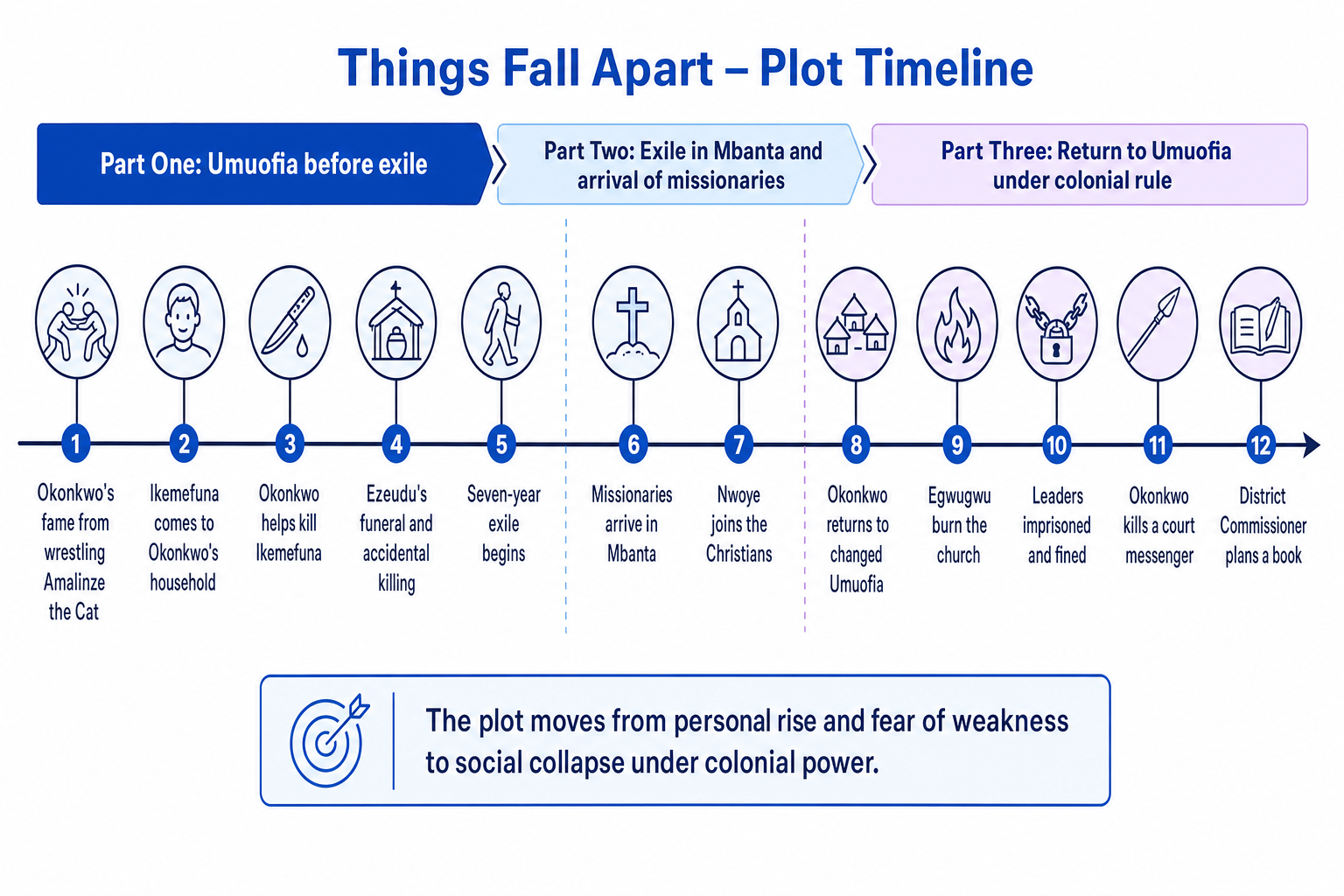
The plot in one sentence
The novel moves from Okonkwo’s personal rise in Umuofia, through exile and religious change, to his final isolation when colonial power and internal division make his old idea of strength impossible.
Part One: Umuofia before exile
Okonkwo’s reputation is established
The novel opens with Okonkwo’s public success: “Okonkwo was well known throughout the nine villages and even beyond.” He has earned fame by defeating Amalinze the Cat in a wrestling match.
This opening works as exposition, meaning the part of a story that introduces the setting, characters, and key tensions. We learn that Umuofia is a complex Igbo society with laws, rituals, titles, farming customs, family duties, and religious beliefs.
We also learn that Okonkwo is driven by fear. Achebe writes: “But his whole life was dominated by fear, the fear of failure and of weakness.” This fear comes from his shame about his father, Unoka, who was gentle, musical, poor, and in debt.
Okonkwo’s harshness causes trouble
Okonkwo wants to appear strong at all times. This affects his treatment of his wives and children. He beats Ojiugo during the Week of Peace, showing that his private anger can clash with communal law.
Achebe does not present Umuofia as perfect, but he does present it as organised and meaningful. The clan has systems for justice, marriage, religion, farming, and punishment. This matters because colonial characters later misunderstand Igbo society as “primitive”.
Ikemefuna enters the household
Ikemefuna, a boy from another village, is given to Umuofia as compensation after a killing. He lives in Okonkwo’s household and becomes close to Nwoye, Okonkwo’s son. For a while, Ikemefuna brings warmth and confidence into the family.
Then the Oracle decides Ikemefuna must be killed. Ogbuefi Ezeudu warns Okonkwo: “The boy calls you father. Do not bear a hand in his death.” Okonkwo ignores this warning and takes part in the killing because “He was afraid of being thought weak.”
This is one of the plot’s most important turning points.
Turning point
A turning point is a moment when the direction of the plot changes significantly. After Ikemefuna’s death, Okonkwo’s family relationships, especially with Nwoye, are permanently damaged.
The accidental killing and exile
At Ezeudu’s funeral, Okonkwo’s gun explodes and accidentally kills Ezeudu’s son. Because the killing is unintentional, clan law treats it differently from murder, but Okonkwo must still leave Umuofia for seven years.
His compound is destroyed, and he goes into exile in Mbanta, his mother’s village. Structurally, this reverses his rise. The man who wanted status and titles is cut off from the centre of power.
Retelling without meaning
A weak answer says, “Okonkwo kills Ikemefuna, then he is exiled, then missionaries arrive.” A stronger answer explains the pattern: Okonkwo’s fear of weakness leads to violence, and his exile gives change time to take root in Umuofia.
Part Two: exile in Mbanta
Okonkwo loses momentum
In Mbanta, Okonkwo is alive but frustrated. He feels his ambitions have been interrupted. His uncle Uchendu tries to teach him the importance of the motherland and the value of comfort in suffering, but Okonkwo struggles to accept anything that feels soft or patient.
This section slows the pace of the plot. That slower pace matters: it gives space for a much bigger historical change to enter the novel.
The missionaries arrive
Christian missionaries come to Mbanta. At first, many villagers find them strange. The missionaries are given land in the Evil Forest, a place associated with dangerous spiritual forces, because the clan expects them to die there. When they survive, some people begin to take them seriously.
Nwoye is especially drawn to the new religion. His conversion is not random. It connects back to the emotional damage caused by Ikemefuna’s death and other aspects of clan life that trouble him. Okonkwo sees Nwoye’s conversion as betrayal and thinks bitterly: “Living fire begets cold, impotent ash.”
The plot is now linking family conflict with religious and cultural change.
Tracing Okonkwo’s downfall
-
Start with Okonkwo’s inner motive: Achebe says his life is “dominated by fear,” so many of his actions are attempts to avoid seeming weak.
-
Apply that motive to Ikemefuna’s death: Okonkwo helps kill the boy despite Ezeudu’s warning, which damages Nwoye’s trust in his father and in the clan’s values.
-
Connect the private break to the public change: when missionaries arrive, Nwoye is already emotionally prepared to reject his father’s world, so conversion becomes part of a wider pattern of division.
-
Add the structural reversal: Okonkwo’s exile removes him from Umuofia just when the new religion and colonial influence are growing stronger.
-
Interpret the ending: when Okonkwo kills the court messenger and the clan does not rise with him, his old model of heroic violence has become useless.
Part Three: return to a changed Umuofia
Okonkwo comes back too late
After seven years, Okonkwo returns to Umuofia expecting to rebuild his status. Instead, he finds a changed clan. The church has grown, and colonial government has brought courts, messengers, and new forms of authority.
Obierika explains the danger clearly: “The white man is very clever. He came quietly and peaceably with his religion.” He also says, “He has put a knife on the things that held us together and we have fallen apart.”
That quotation is crucial because it links the plot directly to the title. The clan is not defeated only by force; it is weakened by division from within as well as pressure from outside.
Conflict escalates
Mr Brown, the earlier missionary, is relatively patient and tries to understand local beliefs. His replacement, Reverend Smith, is much harsher. Under Smith, conflict becomes more extreme.
A zealous convert, Enoch, unmasks an egwugwu. The egwugwu are masked ancestral spirits who represent the authority of the clan’s ancestors in public justice. Unmasking one is a serious spiritual and social offence. In response, the egwugwu burn the church.
The District Commissioner then imprisons and humiliates six Umuofia leaders, including Okonkwo. They are beaten and fined. This event shows colonial power becoming openly coercive — based on force and punishment.
The final meeting and Okonkwo’s death
Umuofia gathers to decide what to do. Okonkwo wants war. When court messengers arrive to stop the meeting, Okonkwo kills one of them with his machete.
But the crowd does not follow him. This is the plot’s climax, the moment of highest conflict and decisive change. Okonkwo realises that Umuofia will not fight. His values no longer match his society’s reality.
He then dies by suicide, which is considered an offence against the earth in Igbo belief. This means his own clansmen cannot touch or bury him. Obierika tells the District Commissioner: “That man was one of the greatest men in Umuofia. You drove him to kill himself.”
The ending is bitterly ironic. The District Commissioner thinks Okonkwo’s life might become only “a reasonable paragraph” in his planned book, The Pacification of the Primitive Tribes of the Lower Niger. Achebe makes us see how colonial writing can shrink a complex human life and culture into a racist stereotype.
Why the plot is tragic
A tragedy is a story in which serious flaws, conflicts, or pressures lead to suffering and catastrophe. Okonkwo’s tragedy is personal because his fear and violence help destroy his relationships. It is also historical because colonial rule changes the conditions around him.
So, do not reduce the plot to “Okonkwo is destroyed by Europeans” or “Okonkwo causes everything himself.” Achebe’s plot is more balanced and more powerful: Okonkwo’s rigid personality meets a moment of massive social change.
Three-part memory hook
Remember the plot as rise → exile → return and rupture. Okonkwo rises in Umuofia, loses his place through exile, then returns to a society that no longer works according to his expectations.
Using plot summary in essays
For Edexcel IGCSE, Things Fall Apart appears in Component 1, Section C: Modern Prose, which is closed book. That means you need secure knowledge of the plot and a few short, accurate quotations.
Plot knowledge mainly supports AO1, which means showing close understanding, a clear argument, and relevant textual references. Context, or AO4, means linking the novel to its historical and social background, such as colonialism in late nineteenth-century Igboland, but only when it helps your point.
A strong paragraph should not retell the whole story. Instead, choose one plot moment and explain its significance.
For example, if the question is about change, you might focus on Nwoye’s conversion, Obierika’s explanation of the white man’s power, or Okonkwo’s final isolation after killing the messenger. Each event should become evidence for an argument, not just another item in a list.
In the exam
-
Memorise the three-part structure: Umuofia before exile, Mbanta and the missionaries, return to a changed Umuofia.
-
Use short quotations accurately, such as “fear of failure and of weakness” or “He has put a knife on the things that held us together.”
-
Avoid plot dump: for every event you mention, explain how it develops character, theme, structure, or context.
-
Link the ending to Achebe’s wider purpose: the District Commissioner’s viewpoint shows how colonial narratives reduce and distort Igbo lives.
Check yourself
- Which event forces Okonkwo into exile, and why is it structurally important?
- How does Ikemefuna’s death help explain Nwoye’s later conversion?
- Why is the District Commissioner’s final reaction such a powerful ending?
