Welcome to your study guide for Chinua Achebe’s masterpiece, Things Fall Apart (1958). As a core text for the Edexcel IGCSE English Literature specification (Component 1, Section C: Modern Prose), this novel offers a profound exploration of cultural collision, colonial history, and human tragedy.
Because Section C is a closed-book exam, you will not have a copy of the text with you. Developing a strong, high-level overview of the novel's structure, context, and key themes is your first step toward exam success.
What you'll learn:
- How Achebe structures the novel across three distinct parts to mirror the collapse of traditional Igbo society.
- The historical and literary contexts (AO4) that prompted Achebe to write the novel.
- How to trace the trajectory of the tragic protagonist, Okonkwo, alongside the arrival of British colonial forces.
The Core Concept: Achebe’s Dual Purpose
To understand Things Fall Apart, you must understand why Chinua Achebe wrote it. In the mid-20th century, Western literature frequently portrayed Africa as a primitive, "dark" continent devoid of history, culture, or complex social systems. Achebe wrote Things Fall Apart to challenge this Eurocentric perspective, presenting a rich, self-governing, and highly sophisticated pre-colonial society.
Post-colonial Literature
Post-colonial literature is a body of writing that reacts to, analyzes, and dismantles the cultural, political, and psychological legacies of colonial rule. It often seeks to reclaim history from the perspective of the colonised rather than the coloniser.
At the same time, Achebe does not romanticise the Igbo clan of Umuofia. He presents their world with striking realism, showing both its beauty—its deep respect for justice, community, and language—and its internal flaws, such as the abandonment of twin babies in the Evil Forest and the ritual killing of Ikemefuna. By doing so, Achebe elevates the story into a universal tragedy.
The Balance of Representation
Achebe writes Umuofia as a complex society with its own laws, religious rituals, and rich oral traditions. By refusing to paint pre-colonial life as either purely idyllic or purely barbaric, Achebe forces the reader to acknowledge the tragedy of its destruction.
The Three-Part Structure
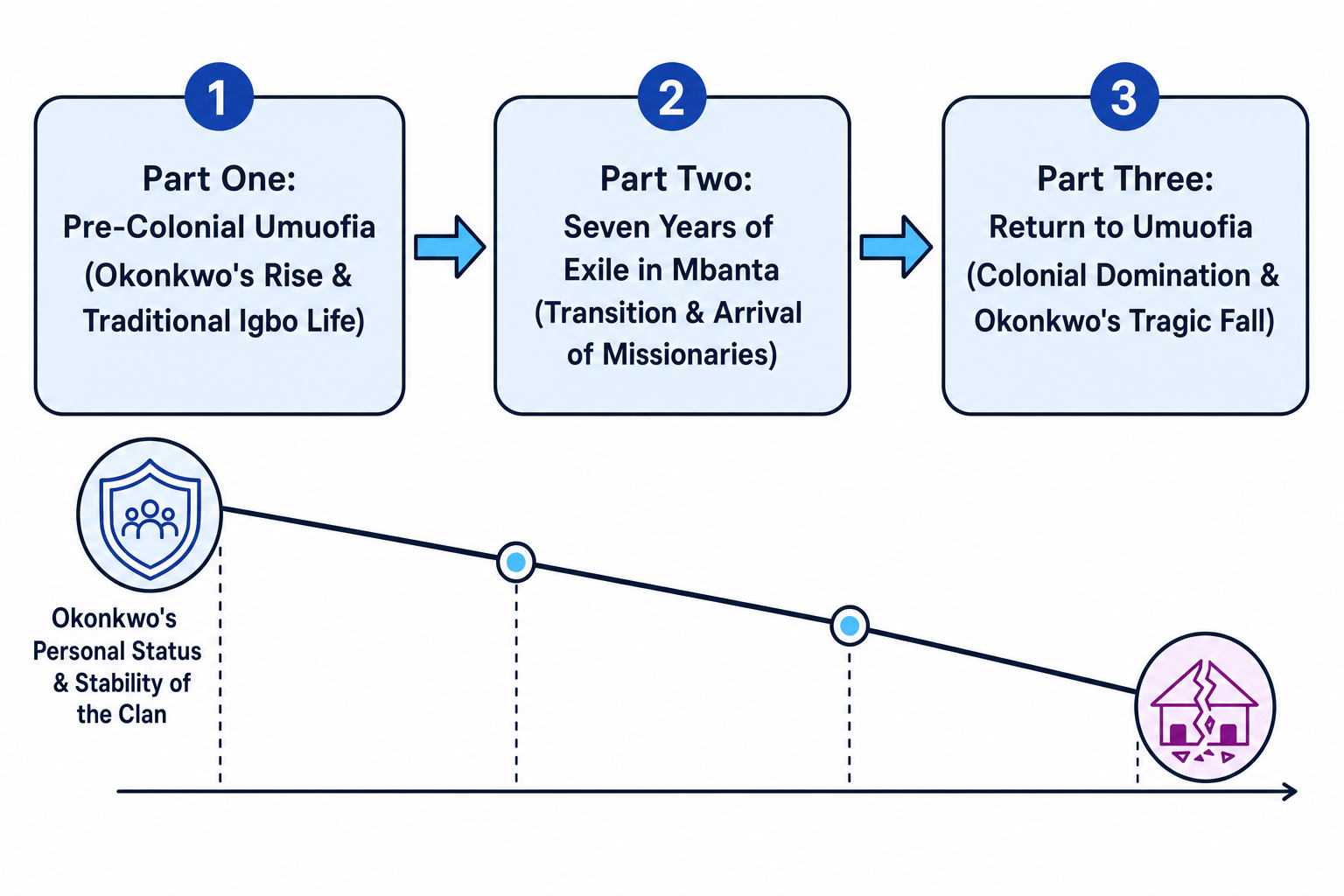
The novel is divided into three parts, each representing a crucial stage in both Okonkwo’s life and the fate of Umuofia.
Part One: The Height of traditional Igbo Culture
Part One is the longest section of the novel, focusing on traditional Igbo life before the arrival of Europeans. We witness Okonkwo’s rise to prominence from the shame of his lazy father, Unoka. Achebe establishes the social, economic, and judicial systems of Umuofia, showing how the community functions through consensus, religious reverence, and seasonal agricultural cycles (primarily centered on the yam harvest).
Part Two: Exile and Transition
After Okonkwo accidentally commits a "feminine" crime (killing a clansman during a funeral) and is exiled to his motherland, Mbanta, for seven years, the novel's focus shifts. This part represents a transitional period. While Okonkwo is away, the first Christian missionaries arrive. We witness the gradual, soft-power infiltration of the British, who target the marginalized members of the clan (the efulefu and the outcasts, or osu).
Part Three: The Clash and the Collapse
Okonkwo returns to Umuofia, expecting to reclaim his high status, only to find the clan fundamentally altered. The British have established not only a church but also a government court and a trading store. The tragedy accelerates as the traditional systems of justice and faith clash directly with colonial authority, culminating in Okonkwo’s isolation and ultimate suicide.
The Significance of the Title
The title Things Fall Apart is taken from W.B. Yeats’s poem 'The Second Coming': "Things fall apart; the centre cannot hold; / Mere anarchy is loosed upon the world." By using a quote from a canonical Western poet, Achebe signals that the collapse of African societies is a tragedy of epic, universal scale, comparable to any catastrophe in Western history.
Historical and Literary Context (AO4)
To score highly on your Edexcel IGCSE exam, you must weave context (AO4) seamlessly into your literary analysis.
1. Pre-Colonial and Colonial Nigeria
- Setting: The novel is set in the late 1890s, during the early stages of British colonial expansion in Nigeria.
- The "Scramble for Africa": Under the Berlin Conference of 1884–1885, European powers partitioned the African continent. British forces entered Nigeria using a dual strategy of religious conversion (the "Bible") and administrative/military force (the "Sword").
2. A Response to Colonial Narratives
- The African as "Other": Achebe was deeply troubled by novels like Joseph Conrad’s Heart of Darkness (1902) and Joyce Cary's Mister Johnson (1939), which depicted Africans as savage, unintelligent, or childlike.
- Reclaiming Language: Achebe chose to write in English—the language of the colonisers—but integrated Igbo proverbs, idioms, and untranslated cultural terms (like chi, ogbanje, and egwugwu). This created a unique literary style that forced the English language to carry the weight of an African experience.
Treating Umuofia as a Primitive Society
Never write that the British "civilised" or "brought order" to Umuofia. Achebe explicitly structures Part One to prove that Umuofia already had a highly structured court system (the egwugwu), a complex theology, and a thriving economy. Frame the colonial encounter as a clash of two distinct civilisations, rather than the civilising of a lawless land.
Worked Example: Analysing a Cultural Clash
Here is how you can build an analytical response linking structure, character, and context (AO1/AO2/AO4).
Analysing the breakdown of communication
Prompt: Explore how Achebe presents the breakdown of communication between the Igbo clan and the British colonisers in Part Three of the novel.
- Formulate a clear point addressing the prompt and context (AO1/AO4): Start by asserting how Achebe uses the tragic trajectory of the novel to demonstrate that colonial authority relied on a deliberate refusal to understand indigenous culture, leading to the collapse of the clan.
- Select precise textual evidence (AO1): Focus on the character of Obierika or the actions of the District Commissioner. A crucial quote comes from Obierika in Chapter 20, explaining why the clan cannot fight back: "He [the white man] has put a knife on the things that held us together and we have fallen apart."
- Analyse Achebe's language methods and structure (AO2): Focus on the powerful metaphor of the "knife". The knife represents not just physical violence, but the surgical severing of social, religious, and familial bonds. The passive construction of "we have fallen apart" echoes Yeats's poem, highlighting a tragic sense of inevitability and a loss of agency.
- Synthesise with historical context (AO4): Link this metaphor to the historical reality of British colonial administration, which exploited existing social fractures within Nigerian ethnic groups to establish control, rendering resistance impossible.
In the exam
- Balance AO1 and AO4: Since this is a closed-book modern prose essay, do not simply retell the story. Ensure every paragraph begins with an analytical point about Achebe's authorial intention, introduces a short quote, and immediately connects this to the social or historical context of late 19th-century Nigeria.
- Memorise Short, Versatile Quotes: Focus on quotes that can apply to multiple themes (e.g., gender, change, fate, masculinity). For instance, "Our own men and our sons have joined the ranks" works for themes of betrayal, generational divide, and colonial tactics.
- Trace the Tragedy: Always relate Okonkwo’s personal downfall to the collective tragedy of the clan. His suicide is not just a personal defeat; it symbolizes the ultimate death of Umuofia’s traditional, masculine warrior spirit.
Check yourself
- Why did Chinua Achebe choose to write Things Fall Apart in English rather than his native Igbo language?
- How does the structural transition from Part One to Part Two highlight the changing nature of the British arrival?
- What does the metaphor of the "knife" in Obierika's speech tell us about the impact of the colonizers on the Umuofia community?
